
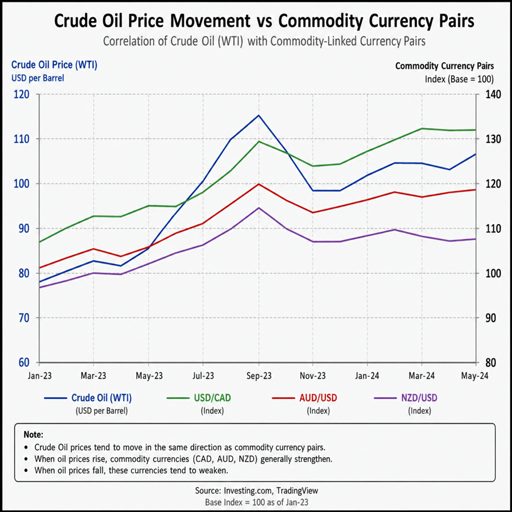
Crude oil and currencies are linked because oil is priced globally, traded in U.S. dollars, and central to the economies of major exporting and importing nations. Understanding crude oil forex correlation helps traders interpret currency strength, inflation pressure, risk sentiment, and commodity-linked market moves more clearly. This guide explains how oil price changes can influence forex pairs, why the relationship shifts over time, and how to use oil market context without treating correlation as a guaranteed signal.
What does crude oil forex correlation mean?
Crude oil forex correlation describes the tendency for oil prices and certain currency pairs to move in related patterns. A positive correlation means oil and a currency often rise or fall together, while a negative correlation means they often move in opposite directions. In practice, the relationship is never fixed: oil market dynamics, interest rates, geopolitical risk, inflation expectations, and the strength of the U.S. dollar can all change how the correlation behaves.
The concept matters because crude oil is not just another commodity. It affects transport costs, industrial production, government revenues, trade balances, and consumer inflation. When oil prices rise sharply, the market may reassess which economies benefit, which economies face higher import costs, and which central banks may respond to inflation pressure.
For forex traders, the key is not to ask whether oil “always” moves a currency. It does not. The better question is whether crude oil trends are currently important enough to influence the currency pair being traded.
The U.S. dollar sits at the center of oil pricing
Most global crude oil trading is quoted in U.S. dollars, which makes the dollar a major part of oil price interpretation. When the dollar strengthens, dollar-priced commodities can become more expensive for buyers using other currencies. That can weigh on demand expectations and sometimes pressure oil prices. When the dollar weakens, oil can become relatively cheaper for non-dollar buyers, which may support demand and price sentiment.
This is one reason oil and the U.S. dollar often show an inverse relationship. However, that relationship is not automatic. During periods of geopolitical stress, for example, oil may rise because supply risk increases while the dollar also strengthens because investors seek liquidity or safety. In that environment, both markets can climb at the same time even if their longer-term relationship often points the other way.
Traders should therefore treat the dollar as both a pricing mechanism and a macro signal. A move in crude may reflect supply and demand. A move in the dollar may reflect interest rate expectations, global risk appetite, or capital flows. The most useful analysis looks at both sides instead of forcing one market to explain the other.
Currencies most sensitive to crude oil trends
Oil price impact is usually strongest in currencies connected to countries that either export large amounts of crude or rely heavily on imported energy. These currencies are often called commodity-linked or resource-sensitive currencies, but each one responds through a different economic channel.
Canadian dollar
The Canadian dollar is one of the most watched currencies in crude oil correlation forex analysis because Canada is a major oil producer and exporter. When oil prices rise, market participants may expect stronger export revenues, improved trade conditions, and better income for the energy sector. This can support the Canadian dollar, especially against currencies from economies less connected to oil production.
The USD/CAD pair is commonly watched in this context. Since the U.S. dollar is the base currency in USD/CAD and the Canadian dollar is the quote currency, Canadian dollar strength often appears as a falling USD/CAD chart. That inverse visual relationship can confuse newer traders: rising crude does not necessarily mean USD/CAD rises; it may mean CAD strengthens and USD/CAD declines.
Norwegian krone
The Norwegian krone can also be sensitive to crude oil trading conditions because Norway is an energy-exporting economy. Higher oil prices may improve national income expectations and support the krone, while falling oil prices may create pressure. Still, Norway’s currency is also affected by European growth, domestic interest rates, and broader risk sentiment.
For that reason, oil is one part of the krone story, not the entire story. A strong oil rally may fail to lift the currency if global markets are risk-averse or if local monetary policy expectations are weak.
Mexican peso
The Mexican peso can react to oil because Mexico has energy exposure, but its relationship is more mixed than a simple exporter-currency model suggests. The peso is also heavily influenced by U.S. growth, interest rate differentials, trade flows, and investor appetite for higher-yielding currencies. Oil may matter more during periods when energy policy, public finances, or regional trade conditions are in focus.
Japanese yen and energy importers
Japan imports significant energy, so higher oil prices can create pressure through import costs and inflation. In theory, rising crude may weigh on currencies of energy-importing economies because more money leaves the country to pay for fuel. In practice, the yen is also shaped by safe-haven flows, monetary policy, and global bond yields, which can overpower the oil connection.
This is a useful reminder: oil correlation is strongest when the market is actively focused on energy costs. When investors are focused on risk aversion or central bank policy, the same currency may behave very differently.
Why does oil price impact change over time?
Oil price impact changes because correlation is a market behavior, not a law of nature. The same crude oil move can mean different things depending on whether it is driven by supply disruption, demand growth, recession fears, currency weakness, or political risk. A rally caused by strong global demand may support commodity currencies, while a rally caused by supply shock may hurt risk sentiment and create mixed currency reactions.
Several forces can shift the crude oil forex correlation:
- Supply shocks: Production cuts, conflict risk, shipping disruptions, or infrastructure issues can push oil higher even when the global economy is slowing.
- Demand expectations: Strong manufacturing, travel, and consumption trends can support oil because traders expect more fuel use.
- Central bank policy: Higher interest rates can strengthen a currency even if oil prices move against it.
- Inflation pressure: Rising oil can lift inflation expectations, changing bond yields and monetary policy forecasts.
- Risk sentiment: In uncertain markets, investors may prioritize liquidity and safety over commodity fundamentals.
- Seasonality and inventories: Refinery demand, stockpile changes, and seasonal fuel use can affect oil without directly changing forex trends.
The practical implication is simple: correlation must be checked in context. A trader using a static assumption, such as “oil up means CAD up,” can be caught off guard when the reason for the oil move does not support that currency.
Reading oil market dynamics before trading forex
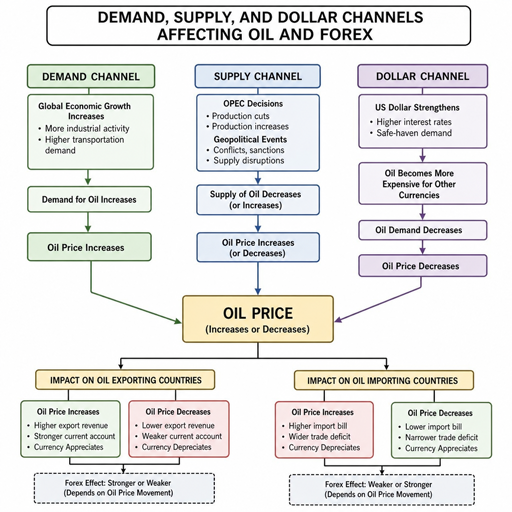
Good forex analysis starts with the driver behind the oil move. If crude is rising because demand is improving, the market may view that as positive for growth-sensitive and commodity-linked currencies. If crude is rising because supply is threatened, the effect may be less positive, especially for oil-importing economies or risk-sensitive assets.
A useful framework is to separate oil moves into three broad categories:
- Demand-led moves: Prices rise because economic activity is expected to strengthen. This can support commodity currencies and risk appetite.
- Supply-led moves: Prices rise because production or transport may be constrained. This can raise inflation concerns and pressure importers.
- Dollar-led moves: Prices move partly because the U.S. dollar is changing. In this case, the forex market itself may be driving part of the oil move.
This framework helps traders avoid double-counting the same signal. For example, if oil rises mainly because the dollar weakens, and a trader also buys a currency against the dollar because oil rose, the trade may simply be another version of selling USD. That may still work, but the risk is concentrated.
How can traders use crude oil correlation forex analysis?
Traders can use crude oil correlation forex analysis as a supporting tool for market context, trade confirmation, and risk management. It should not be used as a standalone entry signal. The strongest use is to identify whether a currency move aligns with oil fundamentals or whether a divergence deserves closer attention.
For example, if crude oil trends are clearly rising and the Canadian dollar is also strengthening, the relationship may confirm that energy sentiment is influencing the pair. If oil rises sharply but CAD fails to respond, traders may investigate whether U.S. dollar strength, weak Canadian data, or risk aversion is offsetting the oil effect.
A practical workflow may look like this:
- Start with the currency pair: Identify whether the pair includes an oil-sensitive currency, such as CAD or NOK.
- Check the oil trend: Look at whether crude is trending, ranging, or reacting to a short-term shock.
- Identify the driver: Decide whether the move is demand-led, supply-led, or dollar-led.
- Compare price action: See whether the currency is confirming or ignoring the oil move.
- Review macro context: Consider interest rates, inflation, economic data, and risk sentiment.
- Plan risk first: Use position sizing and stop placement that assume the correlation can break.
This process keeps crude oil trading information connected to the forex decision without allowing it to dominate every trade.
Common mistakes when interpreting crude oil forex correlation
One common mistake is assuming correlation equals causation. Oil and a currency may move together for a period because both are responding to the same third force, such as dollar weakness or improving global growth. If that shared driver fades, the correlation may disappear quickly.
Another mistake is using the wrong chart relationship. With USD/CAD, a stronger Canadian dollar usually pushes the pair lower, not higher. Traders who overlook base and quote currency structure may read the signal backward.
A third mistake is ignoring time frame. A short-term intraday oil spike may not matter to a weekly forex trend if the currency is being driven by central bank policy. Likewise, a long-term energy trend may be important even if the currency does not respond immediately.
Finally, traders sometimes focus only on crude prices and ignore volatility. A calm, steady oil rally may be constructive for exporter currencies. A violent oil spike may create inflation fear, damage risk appetite, and produce a less predictable currency response.
Building a balanced oil and forex watchlist
A balanced watchlist helps keep analysis organized. Instead of watching every market at once, traders can group instruments by the role they play in the oil and forex relationship.
|
Market to watch |
Why it matters |
Practical use |
|---|---|---|
|
Crude oil benchmark |
Shows the main energy price trend |
Confirms whether oil is rising, falling, or range-bound |
|
U.S. dollar index or major USD pairs |
Shows broad dollar pressure or strength |
Helps separate oil-led moves from dollar-led moves |
|
USD/CAD |
Reflects CAD and USD interaction |
Useful for observing oil-sensitive currency behavior |
|
NOK pairs |
Adds another exporter-currency perspective |
Helps compare whether oil strength is broad or country-specific |
|
JPY pairs |
Shows importer and risk-sentiment dynamics |
Useful when oil affects inflation or global risk mood |
|
Bond yields |
Reflect interest rate expectations |
Helps explain currency moves that overpower oil signals |
This kind of structure prevents tunnel vision. If oil is rising but the dollar is also rising, bond yields are jumping, and risk appetite is weakening, a trader has a more complete explanation for mixed currency behavior.
Best practices for using oil correlation in forex strategy
Crude oil correlation works best as part of a broader decision process. It can add valuable context, but it should be tested against price action, macro data, and risk controls. The goal is not to predict every tick in oil or forex; the goal is to understand when oil is likely to matter and when other forces are more important.
Use these best practices:
- Avoid permanent assumptions. Correlations strengthen, weaken, and reverse depending on market conditions.
- Focus on drivers, not just direction. The reason oil is moving often matters more than the fact that it moved.
- Respect currency pair structure. Know which currency is the base and which is the quote before interpreting the chart.
- Compare multiple markets. Oil, USD, yields, equities, and commodity currencies often tell a fuller story together.
- Match time frames. Do not use a one-hour oil move to justify a multi-week forex view without broader confirmation.
- Control risk. Even strong correlations can fail during news shocks, policy surprises, or sudden liquidity changes.
For longer-term analysis, it may also help to review rolling correlations rather than relying on memory. A rolling view can show whether the relationship between crude and a currency pair has recently strengthened or faded.
Key takeaways for traders and analysts
Crude oil and forex markets are connected through trade balances, inflation, the U.S. dollar, risk sentiment, and the economic exposure of oil exporters and importers. The crude oil forex correlation is especially relevant for currencies such as CAD and NOK, but even importer currencies can react when energy costs reshape inflation and growth expectations.
The most important lesson is flexibility. Oil price impact depends on why crude is moving, how the U.S. dollar is behaving, and whether the market is focused on growth, inflation, supply risk, or safety. Traders who treat oil correlation as context rather than a mechanical rule are better positioned to read changing conditions and avoid misleading signals.
Used carefully, oil market dynamics can make forex analysis more informed and practical. The value is not in predicting a perfect one-to-one relationship, but in understanding when crude oil trading conditions are likely to influence currency behavior and when another market force has taken control.
