
The outlook for Federal Reserve rate cuts in 2026 has changed sharply. After the Federal Reserve raised rates on September 16, the latest federal reserve updates now point to no rate cuts this year and a meaningful chance of at least one more increase before 2027. For households, borrowers, savers, and investors, the practical message is clear: 2026 interest rates may stay higher for longer than earlier rate cut predictions suggested.
Are Federal Reserve rate cuts still expected in 2026?
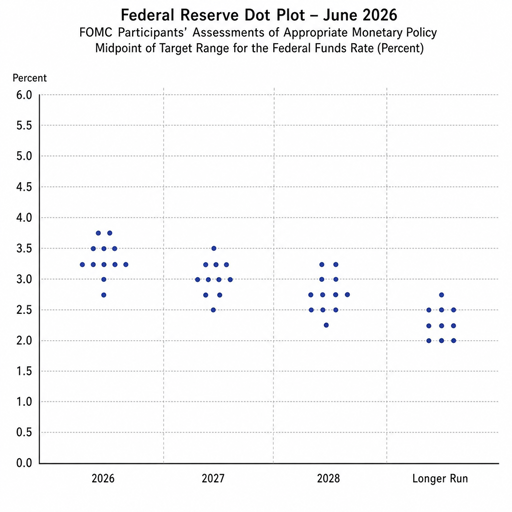
Not by Fed officials, based on the latest Summary of Economic Projections. The Federal Open Market Committee raised the target range for the federal funds rate by 0.25 percentage point to 3.75% to 4.00% on September 16, 2026, and the new “dot plot” shows a median year-end 2026 federal funds rate of 4.1%, up from 3.8% in June. That implies officials, in aggregate, are not forecasting a 2026 cut from the current range; instead, they are leaning toward one additional quarter-point hike by year-end.
The details are even more restrictive for anyone looking for near-term easing. In the September projections, 12 of 18 participants placed the appropriate end-2026 midpoint at 4.125%, four placed it at 4.375%, and two placed it at 3.875%, the midpoint of the current 3.75% to 4.00% range. None projected a lower end-2026 rate than the current midpoint, meaning the official baseline for federal reserve rate cuts expectations 2026 has effectively moved from “possible” to “not in the central case.”
That does not mean a cut is impossible. The Fed’s own materials stress that projections are conditional on incoming data and that the future path of the federal funds rate is subject to “considerable uncertainty.” But as of late September, rate cut predictions need to clear a higher bar: inflation would likely need to cool faster, the labor market would need to soften more visibly, or financial conditions would need to tighten enough to change the central bank’s reaction function.
What changed at the September Fed meeting
The September meeting marked a turn in the 2026 interest rate forecast. The FOMC voted 12–0 to raise the benchmark rate by a quarter point, with the statement saying economic activity was expanding at a solid pace, domestic spending had been resilient, productivity growth was strong, capital investment was robust, and job gains had kept pace with the workforce. At the same time, the Committee said inflation remained elevated and that the move would support a faster return to its 2% goal.
The latest projections also revised the economic backdrop in a way that helps explain why fed rate cuts have fallen out of the 2026 discussion. The median projection for 2026 real GDP growth rose to 2.3% from 2.2% in June, while the projected unemployment rate fell to 4.1% from 4.3%. Stronger growth and lower unemployment give policymakers less reason to ease policy, especially when inflation is still above target.
Inflation projections moved the other way. The September median projection for 2026 PCE inflation rose to 3.7%, while core PCE inflation was marked at 3.4%. Those numbers remain well above the Fed’s 2% goal and help explain why the interest rate forecast now emphasizes restraint rather than relief.
Key numbers behind the new rate cut predictions
The September decision and projections give readers a concise map of where policy stands. The most important figures are not just the current rate, but the gap between current policy and where officials think policy should be at year-end.
- Current federal funds target range: 3.75% to 4.00%, after the September 16 quarter-point hike.
- Current midpoint: 3.875%, the midpoint of the new target range.
- Median end-2026 Fed projection: 4.1%, up from 3.8% in June.
- Median end-2027 Fed projection: 4.1%, up from 3.6% in June, suggesting officials do not see quick relief next year either.
- Median end-2028 Fed projection: 3.9%, up from 3.4% in June, showing that the path back toward lower rates has been pushed further out.
- Longer-run federal funds rate estimate: 3.2%, slightly above June’s 3.1%, suggesting officials see the neutral level of policy as a bit higher than before.
Together, those figures explain why “Federal Reserve rate cuts 2026” is no longer the dominant policy story. The Fed is not merely holding back from cuts; it has just restarted tightening and now projects a higher rate path across 2026, 2027, and 2028.
Inflation remains the main obstacle to cuts
The Fed’s decision comes after recent inflation data showed renewed pressure in consumer prices. The Consumer Price Index rose 0.4% in August after a 0.1% increase in July, and the all-items CPI was up 3.4% over the previous 12 months. Gasoline accounted for more than one-third of the monthly increase, while shelter also rose.
The Fed targets PCE inflation rather than CPI, but the CPI report still matters because it shapes expectations for the broader inflation trend. The September projections show policymakers expecting PCE inflation to end 2026 at 3.7%, then slow to 2.3% in 2027 and 2.1% in 2028. That path suggests officials still expect disinflation, but not quickly enough to justify cutting rates this year.
The risk assessment is also important. In the September projection materials, 17 of 18 participants judged uncertainty around PCE inflation as higher than normal, and 17 of 18 saw risks to PCE inflation as weighted to the upside. For core PCE inflation, 15 participants saw risks weighted to the upside. That is a hawkish backdrop: when policymakers believe inflation risks are skewed higher, they are less likely to pre-commit to easing.
This is why rate cut predictions have become more conditional. A single cooler inflation report may not be enough to revive a 2026 cutting cycle. The Fed would likely need a run of data showing that headline and core inflation are moving convincingly toward 2%, not just stabilizing above target.
A resilient labor market reduces pressure to ease
The labor market has also given the Fed room to hold policy firm. The August jobs report showed total nonfarm payroll employment rose by 162,000, while the unemployment rate remained at 4.1%. That report came before the September FOMC decision and supported the view that the economy could absorb tighter policy without an immediate labor-market break.
The Fed’s September projections align with that picture. Officials lowered their median unemployment forecast for 2026 to 4.1%, from 4.3% in June, and also projected unemployment at 4.1% in 2027 and 2028. In plain English, the central bank does not currently see a sharp enough labor slowdown to force near-term rate cuts.
That matters because the Fed has a dual mandate: maximum employment and stable prices. When unemployment is rising quickly, policymakers may accept more inflation risk to support jobs. When unemployment is stable and inflation is elevated, the balance tilts toward keeping rates restrictive.
Officials are signaling patience, not relief
Recent comments from Fed officials reinforce the message in the dot plot. Boston Fed President Susan Collins told The Associated Press that persistent inflation led her to support the September rate increase, and she said she expects the Fed to keep rates unchanged next year. She cited the risk that inflation could remain stuck above 2%, a concern that has become central to the post-meeting narrative.
That view does not bind the whole Committee, but it captures the larger shift in federal reserve updates: policymakers are more concerned about inflation persistence than about delivering near-term borrowing-cost relief. AP also reported that the September hike was the Fed’s first since 2023 and that the central bank signaled another hike could occur later this year.
The result is a more restrictive interest rate forecast than many borrowers and investors expected earlier in the year. Earlier discussions about 2026 rate cuts have been overtaken by a new debate: whether the Fed is done hiking, or whether October or December could bring another move.
The next Fed dates will test the forecast
The Fed has two scheduled policy meetings left in 2026: October 27–28 and December 8–9. The December meeting is also associated with a new Summary of Economic Projections, which means it will bring an updated dot plot and a fresh look at the Committee’s rate path.
The October meeting may be more about tone than projections, unless incoming data create a clear case for another move. The December meeting, by contrast, is where the market will see whether the September hawkish shift holds, strengthens, or begins to unwind.
The data points most likely to influence the next interest rate forecast include:
- Inflation reports: Cooler monthly CPI and PCE readings would be the clearest path back toward rate cut talk, while another upside surprise would support the case for higher rates.
- Payrolls and unemployment: A sudden slowdown in hiring or a rise in unemployment could make cuts more plausible, but steady job growth would leave the Fed focused on inflation.
- Energy prices and geopolitical risks: The Fed’s September statement cited elevated uncertainty partly tied to geopolitical developments, and energy-driven inflation can complicate policy even when core categories are more stable.
- Financial conditions: Rising Treasury yields, tighter credit, or falling asset prices can do some of the Fed’s work by slowing demand; easier financial conditions can have the opposite effect.
- Consumer spending and business investment: The Fed specifically noted resilient domestic spending, strong productivity growth, and robust capital investment, so a change in those trends would matter.
What this means for consumers and markets
For consumers, the disappearance of 2026 rate cut expectations means borrowing costs may not fall quickly. Credit card rates, auto loans, home-equity lines, and some business loans are more directly exposed to short-term rates than fixed-rate mortgages. A higher-for-longer Fed path can also keep pressure on mortgage affordability, even though mortgage rates are influenced by longer-term Treasury yields and lender spreads rather than the federal funds rate alone.
For savers, the picture is different. Higher policy rates can support yields on savings accounts, money market funds, Treasury bills, and certificates of deposit, though individual rates vary by institution and product. If the Fed holds rates near current levels or hikes again, savers may continue to find attractive short-term yields compared with the low-rate era.
For investors, the main issue is not just the level of rates but the direction of revisions. The September dot plot moved the expected rate path higher across multiple years, which can affect equity valuations, bond prices, credit spreads, and currency markets. A delayed cutting cycle can pressure rate-sensitive sectors, while also improving income opportunities in short-duration fixed income.
The base case: no cuts in 2026 unless the data breaks clearly lower
The most defensible baseline after the September meeting is simple: no Federal Reserve rate cuts in 2026, with one additional hike still on the table. That is the message from the dot plot, the policy statement, and recent official commentary. It is also the reason SEO searches for “fed rate cuts” now need to be read in context: the latest Fed signals are pointing away from cuts, not toward them.
A 2026 cut scenario still exists, but it is now a downside-growth or rapid-disinflation scenario rather than the central forecast. If inflation cools convincingly and unemployment rises, the Fed could pivot. If inflation remains elevated while growth and hiring hold up, the Committee is more likely to maintain restrictive policy or tighten further.
For now, Federal Reserve rate cuts 2026 look unlikely. The live question is whether the September hike was a one-off adjustment or the start of a longer tightening phase. The answer will come from the next round of inflation, labor, and spending data — and from whether the December dot plot confirms that higher-for-longer has replaced rate cuts as the Fed’s main 2026 story.
