
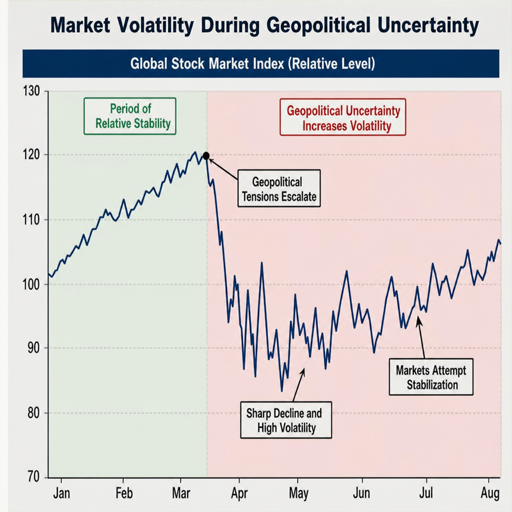
A geopolitical risk premium is the extra return investors demand when political instability, conflict, trade disruption, sanctions, or diplomatic tension make future cash flows harder to predict. When that premium spikes, markets are not simply reacting to bad news; they are repricing uncertainty across assets, sectors, and regions. Understanding how this works helps investors, business leaders, and risk teams separate short-term market volatility from deeper changes in investment risk.
What does a spike in geopolitical risk premium mean?
A spike in geopolitical risk premium means investors suddenly require more compensation for holding assets exposed to political or security-related uncertainty. That compensation can appear in lower equity valuations, wider credit spreads, higher commodity prices, weaker currencies, or a flight toward assets perceived as safer. In practical terms, the market is saying: “The range of possible outcomes has widened, and we need to be paid more to accept that risk.”
This does not always mean a crisis will escalate. Markets often price probabilities, not certainties. A sharp move can reflect fear of supply disruption, capital controls, policy retaliation, cyber risk, border conflict, social unrest, or a shift in regulation. The key is that geopolitical developments can change investor assumptions faster than traditional economic data.
Why political instability becomes a market price
Political instability affects markets because financial assets are valued on expectations. If investors trust that trade routes, legal systems, supply chains, currencies, and policy environments will remain stable, they are usually willing to accept lower returns. When that trust weakens, risk assessment changes quickly.
A company may still have strong revenue, a capable management team, and a healthy balance sheet, but if it operates in a region exposed to sanctions, civil unrest, export controls, or government intervention, its future earnings may become harder to forecast. That uncertainty can push investors to apply a higher risk premium, even before any financial damage appears in reported results.
The same logic applies to entire countries and sectors. Energy, defense, shipping, agriculture, semiconductors, banking, and infrastructure can all respond sharply when geopolitical conditions shift. The market does not wait for perfect information. It discounts what might happen, then adjusts again as the facts become clearer.
The channels that transmit geopolitical risk
A geopolitical shock rarely stays in one place. It tends to travel through several market channels at once, which is why the reaction can feel larger than the original event.
Common transmission channels include:
- Commodity prices: Conflict, sanctions, or shipping disruption can affect oil, gas, metals, and food inputs, raising cost pressures for businesses and consumers.
- Currency moves: Investors may sell currencies tied to vulnerable regions and move toward currencies viewed as more liquid or stable.
- Credit spreads: Lenders may demand higher yields from companies or governments exposed to uncertain policy, trade, or repayment conditions.
- Equity valuation: Stocks can reprice when earnings visibility falls, especially in sectors tied to global demand or complex supply chains.
- Supply chains: Even a limited disruption can force companies to rethink sourcing, inventory, logistics, and supplier concentration.
- Consumer and business confidence: Economic uncertainty can delay hiring, investment, expansion, and discretionary spending.
These channels often overlap. A rise in energy prices can pressure inflation expectations. Higher inflation expectations can influence interest-rate assumptions. Shifting rate assumptions can then feed back into equity valuations and bond yields. That chain reaction is one reason geopolitical risk premium can become visible across nearly every asset class.
How should investors interpret market volatility?
Investors should interpret market volatility during geopolitical stress as a signal to review assumptions, not as an automatic instruction to sell. Volatility often reflects a sudden search for new prices in an environment where information is incomplete. The goal is to identify whether the shock changes long-term fundamentals, short-term sentiment, liquidity conditions, or all three.
A disciplined approach starts with separating direct exposure from indirect exposure. Direct exposure might include assets tied to a specific country, commodity, route, counterparty, or regulation. Indirect exposure might include companies affected by higher input costs, weaker demand, currency translation, or funding stress.
It is also useful to distinguish between price risk and permanent impairment risk. A high-quality asset may fall because investors are reducing exposure broadly. That can be uncomfortable, but it is different from a business whose cash flows, licenses, or ability to operate have been structurally damaged. The same headline can create very different risks across a portfolio.
A practical risk assessment checklist
A strong risk assessment does not require predicting every political outcome. It requires asking better questions before emotions dominate decision-making. When geopolitical risk premium rises, investors and companies can use a structured review like this:
- Map exposure clearly. Identify which holdings, suppliers, customers, currencies, and markets are directly connected to the event or region.
- Review dependency points. Look for reliance on a single shipping lane, country, supplier, energy source, bank, or regulatory approval.
- Test cash-flow assumptions. Consider whether revenue, margins, working capital, financing costs, or capital spending plans could change.
- Check liquidity. Determine whether assets can be sold, hedges can be adjusted, or funding can be accessed if conditions worsen.
- Evaluate time horizon. Decide whether the risk is likely to affect short-term pricing, medium-term operations, or long-term strategy.
- Avoid single-scenario thinking. Build base, adverse, and severe cases rather than anchoring on one forecast.
- Document decisions. Record why changes are made, what would cause a reassessment, and which indicators deserve monitoring.
This checklist turns uncertainty into a process. It cannot remove investment risk, but it can reduce the chance of making reactive decisions based only on headlines.
The difference between temporary fear and lasting repricing
Not every spike in geopolitical risk premium lasts. Sometimes markets overreact to a headline, then recover as diplomatic channels open, supply disruptions prove limited, or policy responses calm investors. In these cases, the risk premium can compress quickly.
Other times, the repricing persists because the event reveals a more durable problem. A trade relationship may become less reliable. A region may remain difficult for foreign capital. A supply chain may look efficient but fragile. A government may introduce policies that permanently change the investment case for certain industries.
The distinction matters. Temporary fear can create volatility that eventually fades. Lasting repricing can change expected returns, capital allocation, and business strategy. Investors should look for evidence that the rules of the game have changed, not just that the news cycle has become louder.
Signals worth monitoring when uncertainty rises
No single indicator captures geopolitical risk perfectly, but several signals can help reveal whether stress is spreading or stabilizing. These indicators are most useful when viewed together rather than in isolation.
Key signals include:
- Credit spreads: Widening spreads may show that lenders are demanding more compensation for default or liquidity risk.
- Commodity curves: Moves in spot and futures prices can suggest whether markets expect a short disruption or a longer shortage.
- Currency pressure: Persistent weakness in exposed currencies can point to capital flight or reduced confidence.
- Shipping and insurance costs: Rising costs can indicate that physical trade routes are becoming riskier.
- Policy announcements: Sanctions, export restrictions, tariffs, and emergency measures can shift the economic impact quickly.
- Corporate guidance: Management commentary may reveal supply issues, demand changes, or margin pressure before they appear in final results.
These signals help investors avoid relying only on broad market indexes. A headline may fade while credit or commodity markets continue to price stress. Conversely, dramatic headlines may have limited financial impact if these deeper indicators remain stable.
Portfolio and business responses should be measured
When economic uncertainty rises, the best response is usually measured, not dramatic. Portfolios and businesses should be resilient enough to absorb shocks without abandoning long-term goals every time market volatility increases.
For investors, that may mean reviewing diversification across regions, currencies, sectors, and asset classes. It can also mean reassessing position sizes in areas where the potential downside is larger than originally assumed. Hedging may be appropriate in some cases, but hedges should match the actual exposure rather than serve as a vague reaction to fear.
For companies, the response may include supplier diversification, inventory planning, contract review, currency management, and scenario planning. Businesses that understand their operational weak points can move faster when conditions change. They are also better prepared to explain the impact to lenders, customers, employees, and investors.
The most important principle is proportionality. If the risk has changed, the plan should change. If only sentiment has changed, a calm review may be more valuable than immediate action.
What happens after the premium spikes?
After the geopolitical risk premium spikes, markets usually move through a process of reassessment. First comes the shock, when investors reduce exposure and seek liquidity. Then comes the information phase, when details about policy, supply impact, military developments, or diplomatic options become clearer. Finally, markets decide whether the premium should remain elevated, decline, or rise further.
This process can be uneven. Some assets may recover quickly while others remain under pressure. A broad selloff can become more selective as investors identify which companies have real exposure and which were sold mainly because of risk aversion. That is why careful analysis becomes more valuable after the first wave of volatility.
Patience matters here. Acting too early can mean reacting before the risk is understood. Waiting too long can mean missing the moment when the market has already adjusted. The balance comes from having a framework before the next shock arrives.
The bigger lesson for long-term decision-makers
Geopolitical risk is not an occasional exception to normal market behavior. It is part of the environment in which capital is allocated, supply chains are built, and business strategies are tested. A geopolitical risk premium spike simply makes that hidden reality visible.
Long-term decision-makers do not need to predict every election, conflict, sanction, or diplomatic dispute. They need to understand where their assumptions depend on stability and what happens if that stability weakens. That means building portfolios, operations, and plans that can tolerate surprise without being ruled by it.
The takeaway is straightforward: a higher risk premium is a warning to reassess, not a reason to panic. By focusing on exposure, liquidity, scenario planning, and real economic impact, investors and businesses can respond to political instability with discipline. In uncertain markets, the advantage often belongs to those who can think clearly while prices are moving quickly.
