
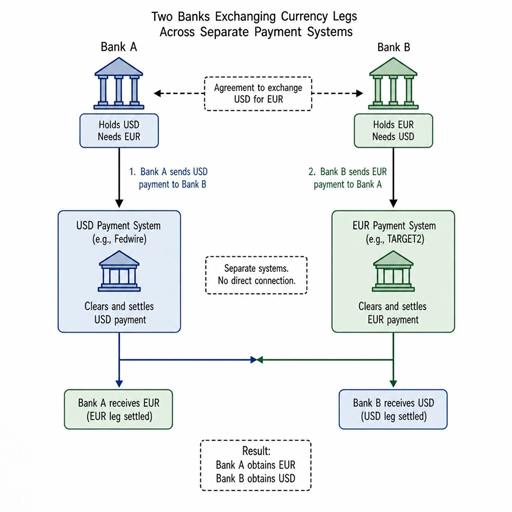
Interbank foreign exchange settlement risk is the possibility that one bank delivers the currency it sold but does not receive the currency it bought. It sits inside broader foreign exchange risk and currency exchange risk, but it is not mainly about exchange-rate movement; it is about the safe completion of both payment legs of an FX transaction. This guide explains how FX settlement risk arises, why it matters in interbank markets, and how institutions approach settlement risk management in practice.
What is interbank foreign exchange settlement risk?
Interbank foreign exchange settlement risk is the risk that the two sides of an FX trade do not settle as expected between banks. In a simple spot trade, one bank may pay dollars while expecting to receive euros, yen, sterling, or another currency; if the counterparty fails after the first payment is made, the paying bank can be exposed to the full principal amount of the currency it delivered. Supervisory guidance describes FX settlement risk as covering principal risk, replacement cost risk, liquidity risk, operational risk, and related legal risk in the settlement process.
This makes fx transaction risk different from market-price exposure. A bank can hedge an exchange rate and still face settlement exposure if payment timing, counterparty failure, system disruption, documentation gaps, or cut-off processes create a mismatch. The issue is especially important because FX trading spans currencies, jurisdictions, payment systems, and time zones.
Why FX settlement risk matters in interbank markets
The FX market is one of the largest financial markets in the world, and interbank activity forms a critical part of its liquidity and price discovery. BIS data show that global FX market turnover averaged about $9.5 trillion per day in April 2025, up from $7.5 trillion per day in April 2022. At that scale, even short-lived settlement failures can create funding pressure, counterparty losses, and operational stress across multiple institutions.
The interbank market also concentrates relationships among institutions that often trade repeatedly throughout the day. A single counterparty can have many unsettled trades across currency pairs and value dates. Without strong settlement risk management, a bank may underestimate its true exposure because trades that look separate in the front office can accumulate into a large payment obligation in the back office.
FX settlement risk also matters because settlement windows are not uniform. One currency may settle through one payment system during its local business day, while the other settles hours later in a different jurisdiction. That timing gap can turn an ordinary currency exchange risk into a full principal exposure if one party has already paid and cannot recover the funds.
The mechanics of an FX settlement exposure
An FX trade creates obligations before it creates final settlement. The deal is executed, confirmed, matched, funded, and then settled through one or more payment systems or settlement arrangements. Risk can appear at each stage, but it becomes most severe when a payment instruction is no longer revocable and the corresponding incoming currency has not yet been received.
A typical exposure timeline includes:
- Trade execution: The front office agrees the currency pair, amount, rate, value date, and counterparty.
- Confirmation and matching: Operations teams or automated systems verify that both parties have the same economic details.
- Funding preparation: Treasury ensures the selling currency is available in the right account, at the right time, and in the right payment system.
- Payment release: The bank sends the currency it sold, often subject to local cut-off times.
- Receipt monitoring: The bank waits for the currency it bought and investigates exceptions.
- Final reconciliation: Operations confirms that both legs have settled and unresolved items are escalated.
The highest-risk period begins when the outgoing payment can no longer be cancelled. It ends only when the purchased currency is finally received with settlement finality. If the counterparty fails during that window, the bank may need to replace the transaction in the market, absorb liquidity stress, and pursue recovery through legal or insolvency processes.
Main sources of FX transaction risk
FX settlement risk is not caused by one weakness alone. It is usually the combined result of timing, counterparty, process, system, and legal factors. Understanding those sources helps banks design controls that reduce exposure before settlement day.
Counterparty default and principal exposure
The most severe form of fx settlement risk occurs when a counterparty fails after one side has paid. This is principal risk: the exposed bank may lose the full amount of the currency delivered, not merely the mark-to-market movement. In high-value interbank trading, that can be materially larger than the profit or loss originally expected on the deal.
Banks manage this risk by setting counterparty settlement limits, monitoring exposures by value date, and reducing exposure through payment-versus-payment where available. Limits should reflect not only credit appetite but also the timing of payment finality and the counterparty’s settlement arrangements.
Replacement cost and market movement
If a counterparty fails before final settlement, the bank may need to replace the trade at a new market rate. Replacement cost is usually smaller than principal exposure, but it can still be significant during volatile markets. It also interacts with foreign exchange risk because the cost of replacing a failed transaction depends on where the exchange rate has moved.
A practical risk framework separates replacement cost from principal risk. The former is tied to market movement; the latter is tied to delivery failure. Both should be measured, but they require different controls.
Liquidity pressure and funding gaps
Settlement disruption can create immediate funding needs. A bank may have paid out one currency while the expected incoming currency has not arrived, leaving it short for other obligations. Even when the counterparty eventually pays, the delay can force intraday borrowing, emergency funding, or payment prioritization.
This is why settlement risk management must involve treasury as well as credit and operations. The question is not only “Will the counterparty pay?” but also “Can we fund our obligations if they do not pay on time?”
Operational and legal risk
Trade capture errors, incorrect settlement instructions, missed cut-offs, messaging failures, and reconciliation delays can all create settlement exposure. Legal uncertainty can add another layer if netting, close-out, or payment obligations are not clearly enforceable in the relevant jurisdictions. BIS guidance emphasizes governance, operational controls, and legal arrangements as part of a broader FX settlement risk framework.
How do banks manage FX settlement risk?
Banks manage FX settlement risk by combining governance, exposure measurement, counterparty limits, operational controls, legally robust agreements, and safer settlement mechanisms. No single control is enough. Effective settlement risk management treats settlement as a lifecycle issue that starts at trade approval and ends only when both currencies have reached final settlement.
A strong framework typically includes the following elements:
- Board and senior management oversight: Policies should define risk appetite, escalation routes, and accountability for FX settlement exposures.
- Counterparty settlement limits: Limits should cover unsettled exposures and be monitored against actual payment status, not just booked trades.
- Accurate exposure measurement: Banks should measure when outgoing payments become irrevocable and when incoming funds are finally received.
- Use of payment-versus-payment: PvP mechanisms reduce or eliminate principal risk by linking the two currency legs.
- Operational resilience: Systems, staffing, cut-off controls, exception management, and contingency plans should be tested.
- Legal enforceability: Netting and settlement arrangements should be reviewed for enforceability in relevant jurisdictions.
- Independent review: Risk, compliance, audit, or control functions should test whether procedures work in real settlement conditions.
The best frameworks are practical, not merely documentary. A policy that defines exposure but cannot produce intraday visibility will not help much during a counterparty failure. Likewise, a limit structure that ignores payment cut-offs can understate risk precisely when it matters most.
Payment-versus-payment reduces principal risk
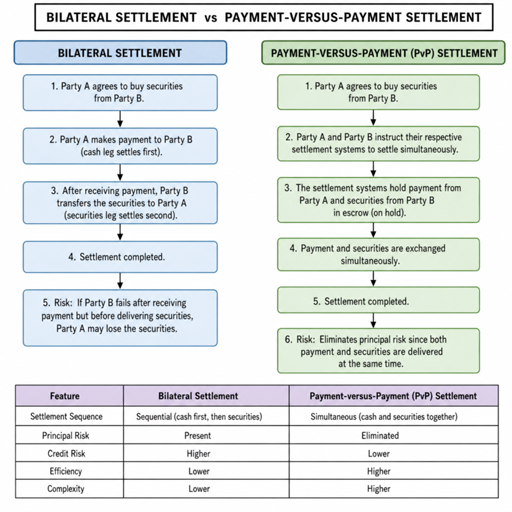
Payment-versus-payment, often shortened to PvP, is a settlement method designed so that one currency leg settles only if the other currency leg also settles. This directly addresses the classic problem in interbank FX settlement: paying away one currency without receiving the other. CLSSettlement is a prominent PvP service that settles eligible FX payment instructions simultaneously, and CLS describes its model as using PvP to mitigate settlement risk.
PvP does not remove every form of foreign exchange risk. It does not eliminate pre-settlement market risk, operational risk before instructions are submitted, liquidity risk from funding obligations, or risks in currencies and products outside the service. However, it is a powerful control for principal risk because settlement of both legs is linked.
A useful way to compare approaches is to separate the settlement method from the remaining risk:
|
Settlement approach |
Principal risk impact |
Practical consideration |
|---|---|---|
|
Bilateral gross settlement |
Higher |
Each leg may settle through separate payment systems at different times. |
|
Bilateral netting |
Lower than gross, if enforceable |
Reduces payment amounts but depends on legal and operational certainty. |
|
Payment-versus-payment |
Lowest for covered trades |
Links both legs, but may not cover every currency, counterparty, or product. |
|
Manual exception handling |
Variable |
Useful for remediation, but not a substitute for preventive controls. |
Institutions should therefore treat PvP as a central tool, while still maintaining limits, funding plans, confirmation discipline, and escalation procedures for trades that settle outside PvP.
Building a practical settlement risk management framework
A practical framework turns policy into repeatable decisions. It should be clear enough for front office, treasury, operations, credit risk, and senior management to understand their roles. It should also be specific enough to answer hard questions during market stress.
Define exposure accurately
The first step is to define when exposure starts and ends. For each currency and settlement channel, the bank should know when payment instructions become irrevocable, when funds are expected, and when receipt is final. This prevents the common mistake of measuring exposure only by value date rather than by the actual hours of risk.
Align limits with real settlement behavior
Counterparty limits should reflect the maximum expected settlement exposure, not only credit ratings or trading volumes. Banks may need separate limits for pre-settlement exposure, settlement principal exposure, intraday liquidity exposure, and unsettled failed trades. Limits should also account for concentration by counterparty, currency, branch, and settlement system.
Strengthen trade confirmation and matching
Fast confirmation reduces the chance that errors reach settlement day. Automation helps, but process discipline still matters. Unmatched trades, stale settlement instructions, late amendments, and unusual value dates should trigger escalation before payment release.
Monitor payments intraday
End-of-day reconciliation is too late for many FX settlement problems. Banks need intraday monitoring that shows which outgoing payments have been released, which incoming payments are overdue, and which counterparties or currencies are creating exceptions. This information should be visible to teams that can act, not trapped in isolated operational queues.
Prepare contingency plans
Contingency planning should cover system outages, correspondent bank disruption, payment-system delays, sanctions screening interruptions, and counterparty default. The plan should state who can hold or release payments, how senior leaders are notified, and how liquidity will be sourced if expected receipts do not arrive.
Warning signs and control gaps
Weak FX settlement controls often reveal themselves before a major loss. The challenge is to treat small exceptions as useful signals rather than routine noise. Repeated late confirmations, frequent settlement amendments, and unexplained payment delays can show that the process is carrying more risk than management realizes.
Common warning signs include:
- Trades settling outside approved channels without clear justification.
- Counterparty exposures measured only at end of day.
- Payment cut-off times maintained in spreadsheets with limited review.
- Unmatched confirmations allowed to remain unresolved near value date.
- No clear owner for failed incoming payments.
- PvP eligibility not checked before settlement instructions are finalized.
- Legal netting assumptions not reviewed after market or jurisdictional changes.
- Treasury unaware of large expected receipts until they fail to arrive.
These gaps do not always create immediate losses, but they reduce the institution’s ability to respond quickly. In settlement risk, speed and clarity matter because the exposure window can be measured in hours.
Best practices for reducing currency exchange risk at settlement
Reducing currency exchange risk at settlement requires both preventive and detective controls. Preventive controls stop avoidable exposures from arising. Detective controls identify problems quickly enough for teams to act.
A practical checklist includes:
- Use PvP settlement for eligible currencies and counterparties where feasible.
- Maintain current standard settlement instructions and validate changes independently.
- Confirm and match trades as early as possible.
- Measure exposure from irrevocable payment release to final receipt.
- Set limits by counterparty, currency, entity, and settlement channel.
- Monitor settlement status intraday, not only after close of business.
- Escalate failed, late, or unmatched items through defined workflows.
- Test contingency plans under realistic stress scenarios.
- Review legal agreements, netting enforceability, and documentation standards.
- Report meaningful settlement metrics to senior management.
The aim is not to eliminate all FX transaction risk; that is rarely realistic. The aim is to know where exposure exists, reduce avoidable principal risk, and ensure the organization can respond before an operational issue becomes a financial loss.
A disciplined approach to FX settlement risk
Interbank foreign exchange settlement risk is a core risk in global banking because FX trades require two payments that may not become final at the same time. The strongest programs combine accurate exposure measurement, payment-versus-payment where available, enforceable legal arrangements, resilient operations, and active oversight. BIS supervisory materials continue to emphasize governance, measurement, monitoring, and control as essential components of managing risks associated with FX settlement.
For banks and market participants, the practical message is straightforward: do not treat settlement as a back-office formality. Settlement is where a trade becomes cash, where timing becomes exposure, and where weak controls can turn ordinary foreign exchange risk into principal loss. A disciplined framework gives institutions a clearer view of their obligations, stronger protection against counterparty failure, and greater confidence in the daily movement of currencies across the interbank market.
