
Forex risk sentiment indicators help traders judge whether the market is broadly seeking risk or avoiding it. In a risk-on environment, investors usually favor higher-yielding, growth-sensitive, or commodity-linked currencies; in a risk-off environment, they tend to move toward perceived safe havens and liquidity. This guide explains how forex market sentiment works, which trading sentiment indicators matter, and how to combine them without turning a single signal into a complete trading plan.
What does risk-on and risk-off mean in forex?
Risk-on and risk-off describe the market’s appetite for uncertainty. When market risk sentiment is risk-on, traders are generally more willing to buy assets linked to growth, carry, and global demand. When sentiment turns risk-off, traders often reduce exposure to riskier assets and seek currencies or instruments considered more defensive.
In forex, this matters because currencies do not move in isolation. A currency pair reflects relative expectations between two economies, but those expectations are shaped by global equity performance, interest rate expectations, bond yields, commodity prices, volatility, and geopolitical concern. That is why forex sentiment analysis often looks beyond the currency chart itself.
A simple example is a trader watching AUD/JPY. The Australian dollar is often treated as more growth-sensitive, while the Japanese yen is often watched as a defensive currency. If equities are rising, volatility is falling, and commodity demand looks steady, AUD/JPY may attract buyers. If stocks sell off sharply and volatility jumps, the same pair may come under pressure even if no major Australian or Japanese data has been released.
The core drivers behind forex market sentiment
Forex market sentiment is the result of many forces acting at once. Some are macroeconomic, such as interest rate expectations and inflation trends. Others are behavioral, such as fear, crowding, or the rush to unwind leveraged trades.
The most useful approach is to group drivers into a few categories instead of reacting to every headline. This makes sentiment easier to read and reduces the temptation to overtrade.
Growth expectations
Risk-on behavior often appears when traders believe global growth is stable or improving. Equity indices may rise, cyclical commodities may strengthen, and currencies tied to trade or commodities may perform well. In contrast, concerns about recession, weak demand, or financial stress can create risk-off flows.
For forex traders, growth expectations are important because they influence capital flows. A country with improving growth prospects may attract investment, especially if its central bank is not expected to cut rates aggressively. However, growth alone is not enough. If the market believes inflation, debt stress, or political risk will damage returns, sentiment can still remain fragile.
Interest rates and carry
Interest rate expectations influence forex trader sentiment because currencies with higher expected yields can attract demand during calmer markets. This is the foundation of carry trading: borrowing in a lower-yielding currency to buy a higher-yielding one.
Carry trades can perform well in risk-on conditions, but they are vulnerable when risk sentiment changes. If volatility rises quickly, traders may exit higher-yielding currencies and buy back funding currencies. This can create sharp moves that look disconnected from ordinary economic data.
Liquidity and safety
During risk-off periods, traders often value liquidity as much as yield. Deep, heavily traded markets can become more attractive because positions are easier to enter and exit. This is why the U.S. dollar, Japanese yen, and Swiss franc are commonly watched during periods of stress, though their behavior can vary depending on the cause of the stress and the interest rate backdrop.
Liquidity also affects emerging market currencies. When global conditions are stable, investors may seek higher returns in emerging markets. When conditions deteriorate, those flows can reverse quickly, especially where external financing needs or political risks are high.
Key forex risk sentiment indicators to monitor
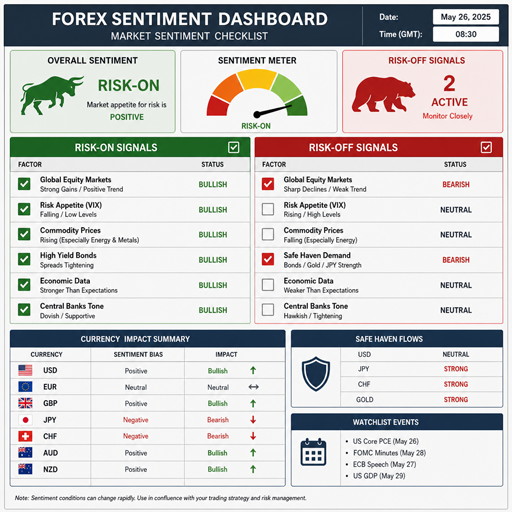
No single indicator can define sentiment perfectly. The strongest readings usually come from several forex risk sentiment indicators pointing in the same direction. Think of them as a dashboard: each gauge gives partial information, and the overall picture matters more than one flashing light.
|
Indicator type |
What it can show |
Risk-on clue |
Risk-off clue |
|---|---|---|---|
|
Equity indices |
Confidence in growth and earnings |
Broad indices rising |
Sharp, broad selling |
|
Volatility measures |
Demand for protection |
Volatility falling |
Volatility rising |
|
Bond yields |
Growth, inflation, policy expectations |
Yields rising for growth reasons |
Yields falling on safety demand |
|
Commodity prices |
Demand and inflation pressure |
Cyclical commodities firm |
Demand-sensitive commodities weak |
|
Credit spreads |
Stress in lending markets |
Spreads narrowing |
Spreads widening |
|
Positioning data |
Crowding and contrarian risk |
Balanced or supportive flows |
Extreme one-sided exposure |
Equity indices
Global stock indices are among the most watched trading sentiment indicators. Rising equities often suggest investors are comfortable holding risk assets. Falling equities, especially across regions and sectors, can signal stress.
For forex, the relationship is not mechanical. A strong U.S. equity market may support risk-sensitive currencies, but it may also strengthen the dollar if investors see the United States as the best destination for capital. The key is to compare equity performance with currency behavior rather than assume one always causes the other.
Volatility indicators
Volatility indicators are central to sentiment analysis tools because they reflect demand for protection. When implied volatility rises, traders are often paying more to hedge uncertainty. When volatility falls, markets may be more comfortable with risk.
Forex traders can look at equity volatility measures, bond market volatility, and currency implied volatility when available. A broad rise in volatility across asset classes is usually more meaningful than a small move in one market.
Bond yields and yield spreads
Government bond yields can reveal whether traders are pricing stronger growth, tighter policy, weaker growth, or a flight to safety. Falling yields may be risk-off if money is moving into government bonds for protection. Rising yields may be risk-on if they reflect stronger growth expectations, but they may be risk-off if they reflect inflation anxiety or fiscal concern.
Yield spreads between countries also matter because forex pairs compare two currencies. If one country’s expected rates rise relative to another’s, its currency may gain support, unless the broader risk environment overwhelms that rate advantage.
Commodities
Commodity-linked currencies often react to oil, metals, and agricultural markets. The Canadian dollar is commonly watched with oil, while the Australian and New Zealand dollars are often linked to global demand and commodity cycles.
Commodities can also complicate sentiment. Rising oil may support an oil-exporting currency but pressure economies that import energy. That means a commodity move should be interpreted through the lens of each currency’s economy.
How do traders use sentiment analysis tools without overreacting?
Traders use sentiment analysis tools best when they treat them as context, not as automatic buy or sell signals. A sentiment reading can help explain why a currency pair is moving, identify whether a trade has supportive conditions, and warn when a setup is fighting the broader market mood.
A practical workflow can look like this:
- Start with the pair. Identify the trend, key levels, volatility, and upcoming events on the currency pair you trade.
- Check the risk backdrop. Look at equities, volatility, bond yields, commodities, and credit conditions.
- Compare the currencies. Ask which side of the pair should benefit if the market stays risk-on or turns risk-off.
- Review positioning. If available, check whether traders are already heavily long or short. Crowded trades can reverse quickly.
- Wait for confirmation. Use price action, a break of structure, or a failed breakout before acting on the sentiment view.
- Define invalidation. Decide what would prove your sentiment read wrong before entering the trade.
This process keeps forex sentiment analysis grounded. Instead of saying “risk is on, so buy,” the trader asks whether the pair, macro backdrop, and timing all support the same idea.
Reading risk-on conditions in currency pairs
Risk-on conditions tend to favor currencies associated with higher yield, trade exposure, commodities, or emerging market growth. Pairs such as AUD/JPY, NZD/JPY, CAD/JPY, and selected emerging market pairs are often monitored as expressions of risk appetite.
The best risk-on setups usually show alignment. Equities are stable or rising, volatility is contained, commodity markets are supportive, and the higher-beta currency is making higher highs or holding pullbacks. If those pieces align, a trader may look for entries with the trend rather than chasing a move after it is already extended.
Still, risk-on does not mean every higher-yielding currency will rise. Domestic data, central bank guidance, political risk, or commodity exposure can change the picture. A currency with weak local fundamentals may lag even when global sentiment is positive.
Reading risk-off conditions in currency pairs
Risk-off conditions often favor defensive currencies, especially when traders are cutting leverage or seeking liquidity. The Japanese yen and Swiss franc are commonly watched in this context, while the U.S. dollar may strengthen when global investors prioritize liquidity or safety.
A risk-off move may appear as falling equity indices, widening credit spreads, lower risk-sensitive currencies, and rising volatility. In forex, this can produce rapid unwinds of carry trades. The moves can be sharp because many traders may try to exit similar positions at the same time.
In risk-off markets, patience matters. Spreads can widen, intraday ranges can expand, and false breaks may become more common. Traders often reduce position size, avoid thin markets, and pay closer attention to event risk.
Common mistakes in forex sentiment analysis
Sentiment is useful, but it can mislead traders who treat it too simply. The biggest risk is building a trade around a broad market story while ignoring price, timing, or the specific currency pair.
Avoid these common errors:
- Using one indicator as proof. A single equity rally or volatility dip does not confirm a durable risk-on environment.
- Ignoring relative policy. Central bank expectations can dominate sentiment, especially around rate decisions and inflation data.
- Assuming old correlations always work. Currency relationships change as macro conditions change.
- Chasing headlines. News can explain a move after it happens, but entries still need structure and risk control.
- Forgetting positioning. If a trade is crowded, even good news may fail to push it further.
- Confusing short-term noise with regime change. A one-day reversal does not always mean the market mood has shifted.
The goal is not to predict every turn. The goal is to avoid being surprised by the environment your trade is entering.
How should beginners build a sentiment dashboard?
Beginners should build a simple dashboard that tracks a few reliable market areas consistently instead of collecting too many indicators. A basic dashboard can include one or two equity indices, a volatility measure, key government bond yields, relevant commodities, and the major currency pairs connected to the trader’s strategy.
A useful starter checklist includes:
- Equities: Are major indices rising, falling, or diverging?
- Volatility: Is protection getting more expensive or cheaper?
- Rates: Are yield moves supporting one currency over another?
- Commodities: Are oil, metals, or other relevant markets helping or hurting the currency?
- Price action: Is the pair confirming the sentiment view?
- Events: Are central bank decisions, inflation reports, or employment data near?
- Risk plan: Where is the trade wrong, and how much is at risk?
This dashboard should be reviewed the same way each time. Consistency matters because sentiment is partly about pattern recognition. When you observe the same indicators daily, you start to notice when markets are aligned, mixed, or unstable.
Best practices for trading with market risk sentiment
The most effective use of market risk sentiment is to improve trade selection and risk management. It helps traders decide when to be aggressive, when to be selective, and when to stay out.
In calm risk-on conditions, trend-following and carry-based ideas may have a better backdrop, provided the pair confirms the view. In unstable risk-off conditions, traders may focus more on defensive currencies, shorter holding periods, or smaller positions. In mixed conditions, the best decision may be to wait until the market sends a clearer signal.
A balanced sentiment process should include both top-down and bottom-up analysis. Top-down analysis asks what the global environment supports. Bottom-up analysis asks whether the individual currency pair offers a clean technical and fundamental setup. When both agree, the trade idea is stronger. When they conflict, risk should usually be reduced or the trade skipped.
Bringing it all together
Forex risk sentiment indicators are most valuable when they help you understand the market environment before you place a trade. Risk-on and risk-off conditions influence currency flows, but they do not replace analysis of interest rates, local fundamentals, positioning, and price behavior.
A strong forex sentiment analysis process is simple, repeatable, and cautious. Watch several sentiment indicators, compare them with the currency pair, and require confirmation before acting. Used this way, trading sentiment indicators can help you avoid weak setups, recognize changing conditions, and make decisions with a clearer view of risk.
