
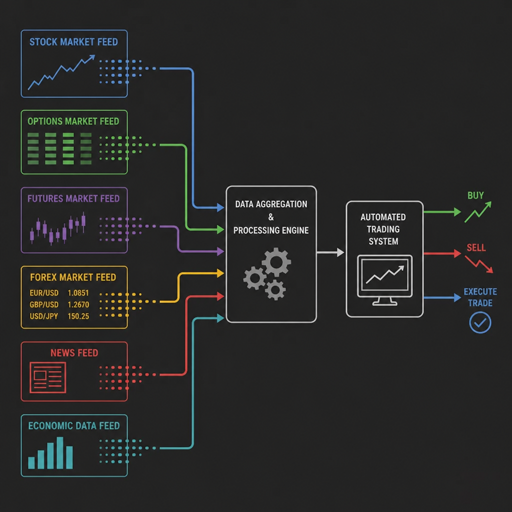
High-frequency trading arbitrage is the use of ultra-fast trading algorithms to identify and act on small pricing differences across markets, instruments, or venues. At its core, it is a speed-sensitive form of market arbitrage: the edge often exists for only a brief moment, so execution quality, data accuracy, infrastructure, and risk controls matter as much as the strategy idea itself. This guide explains how high-frequency trading works in arbitrage, where opportunities can appear, and why the approach is usually associated with sophisticated trading teams rather than casual manual traders.
What is high-frequency trading arbitrage?
High-frequency trading arbitrage is an automated trading approach that seeks to capture temporary price inefficiencies faster than other market participants. Instead of relying on long-term forecasts, the strategy focuses on short-lived discrepancies: one venue may show a slightly different price than another, a related instrument may lag its fair value, or a market maker may update quotes more quickly in one product than in another.
The defining feature is not simply automation. Many forms of algorithmic trading use automation, but high-frequency trading is built around low-latency decision-making and rapid order placement, modification, and cancellation. In an arbitrage context, the system must detect a potential spread, decide whether it is tradable after costs and risk, and execute before the opportunity disappears.
This is why high-frequency trading arbitrage is often discussed alongside market structure, co-location, order book data, exchange connectivity, and transaction cost analysis. A theoretical arbitrage opportunity may look profitable on a chart, yet fail in practice if another participant reacts first, the available size is too small, fees eliminate the edge, or one leg of the trade does not fill.
A simple way to think about it is this: traditional arbitrage asks, “Are two related prices misaligned?” High-frequency trading arbitrage adds a second question: “Can the system act quickly and reliably enough to capture the misalignment before it closes?”
The fundamentals behind market arbitrage
Market arbitrage exists because prices are not always perfectly synchronized. Different venues, liquidity pools, assets, and participants can process information at different speeds. Even in highly competitive markets, small frictions can create brief gaps between what something is worth in one place and what it costs in another.
In theory, arbitrage is often described as a low-risk or risk-free profit. In real trading, that description is too clean. Execution risk, latency, fees, slippage, partial fills, rejected orders, stale data, and sudden market moves can turn an apparent arbitrage into a loss. The practical challenge is not only finding a spread, but determining whether it remains profitable after all real-world costs and uncertainties.
High-frequency trading systems are designed to deal with these constraints at machine speed. They constantly monitor prices, order book depth, trade prints, and sometimes correlated instruments. When a rule or model identifies a possible mismatch, the algorithm evaluates whether the spread is large enough to justify action. If it is, the system may send one or more orders, hedge exposure, and update its inventory limits almost instantly.
The result is a highly operational form of trading. Strategy, software engineering, quantitative research, market access, and risk management are inseparable. A good arbitrage idea can fail because infrastructure is too slow, while a strong technical setup can fail if the strategy does not account for costs and adverse selection.
How HFT arbitrage differs from ordinary algorithmic trading
Algorithmic trading is a broad category. It can include long-term portfolio rebalancing, execution algorithms that break up large orders, trend-following models, statistical strategies, and market-making systems. High-frequency trading is a narrower subset that emphasizes very fast reaction times, frequent order activity, and short holding periods.
The distinction matters because not every trading algorithm is built to capture arbitrage opportunities. An algorithm that buys an index fund every week is automated, but it is not HFT. A system that executes a large institutional order gradually throughout the day is algorithmic, but it may be focused on minimizing market impact rather than exploiting microsecond-level pricing differences.
High-frequency trading arbitrage typically has several characteristics:
- Short-lived signals: The opportunity may last only briefly, so the model must evaluate it quickly.
- Automated execution: Manual confirmation is usually too slow for the strategy’s time horizon.
- Market data sensitivity: The system depends on accurate, timely data from exchanges, brokers, or data vendors.
- Transaction cost awareness: Small edges can disappear once commissions, exchange fees, rebates, and slippage are included.
- Inventory and exposure controls: Even arbitrage trades can leave a position open if one leg fills and another does not.
- Continuous monitoring: Systems must be watched for connectivity issues, abnormal behavior, and changing market conditions.
In other words, high-frequency trading arbitrage is not merely “fast trading.” It is a complete operating environment built to make small, repeatable decisions under strict time and risk constraints.
Main types of high-frequency trading arbitrage
There are many variations of HFT arbitrage, and the exact implementation depends on the asset class, venue rules, data access, and technology stack. The categories below are useful for understanding how trading algorithms may search for inefficiencies.
Cross-venue arbitrage
Cross-venue arbitrage looks for price differences between the same or closely equivalent instrument traded in more than one location. If an asset is available on multiple exchanges or platforms, temporary differences can appear when one venue updates faster than another or when liquidity is unevenly distributed.
A simplified example would be an instrument quoted at a slightly lower ask price on one venue and a slightly higher bid price on another. A system may attempt to buy where the price is lower and sell where it is higher. In practice, the algorithm must account for order book depth, fees, queue position, transfer constraints, and the likelihood that one side disappears before execution.
The challenge is that obvious cross-venue spreads are heavily competed. Many participants are watching the same data, so the tradable edge may be extremely small. Systems that pursue this type of market arbitrage need strong connectivity, fast data processing, and disciplined safeguards against stale or incomplete quotes.
Statistical arbitrage
Statistical arbitrage relies on relationships between instruments rather than identical prices. A model may observe that two assets, sectors, futures contracts, or exchange-traded products tend to move together. When that relationship temporarily diverges, the algorithm may buy the relatively undervalued instrument and sell the relatively overvalued one.
In a high-frequency context, statistical arbitrage often focuses on short-horizon mean reversion or lead-lag effects. For example, one instrument may react to new information before a related instrument adjusts. The system attempts to identify that lag and position accordingly.
This approach is more model-dependent than pure cross-venue arbitrage. The relationship can break down, especially during volatile conditions. Because the trade is based on probability rather than a guaranteed price convergence, risk controls and continuous model validation are essential.
Latency arbitrage
Latency arbitrage involves acting on information faster than other market participants can update their quotes or prices. If one venue, data feed, or participant reflects new information before another, a fast system may attempt to trade against prices that have not yet adjusted.
This is one of the most controversial areas of high-frequency trading because it depends heavily on differences in speed and market access. From a technical perspective, the strategy highlights why infrastructure is so important. From a market quality perspective, it raises questions about fairness, liquidity, and the value of speed competition.
For any firm considering latency-sensitive strategies, the practical issue is not only whether a signal exists. It is whether the strategy complies with market rules, whether it can operate without creating unacceptable operational risk, and whether the edge remains after the cost of maintaining very fast infrastructure.
Index, ETF, and futures arbitrage
Related products often have economic links. An index future, an exchange-traded fund, and the underlying basket of securities may all reflect similar exposure, but they do not always update at exactly the same pace. HFT arbitrage systems can monitor these relationships and look for moments when one product appears out of line with another.
The concept is straightforward, but implementation is complex. A basket may contain many instruments, each with its own liquidity and trading behavior. The algorithm must estimate fair value, account for costs, and determine whether the hedge is practical. In fast markets, the apparent mismatch can close before the system completes all legs of the trade.
These strategies require a strong understanding of product design. The algorithm must know what each instrument represents, how it trades, and what practical frictions affect conversion or hedging.
Market making arbitrage
Market making involves posting bids and offers, earning spread when trades occur, and managing the inventory that results. When combined with arbitrage logic, market making can use signals from related markets to adjust quotes, hedge positions, or avoid being picked off when prices move.
This is where phrases such as institutional grade high frequency trading strategies market making arbitrage often appear. At an institutional level, market making arbitrage is not a single trick. It is a framework that combines pricing models, inventory control, order book analytics, execution logic, and real-time risk management.
For example, a market maker may quote an asset while watching a correlated futures contract. If the futures price moves, the market maker may update quotes in the asset before stale prices are hit. If the market maker gets filled, the system may hedge the exposure in a related market. The goal is to provide liquidity while managing the risk that prices move against the inventory.
Where arbitrage opportunities come from
Arbitrage opportunities are usually created by friction. Markets are efficient in broad terms, but they are not frictionless. Data has to travel, orders have to be matched, liquidity varies by venue, and participants have different objectives and constraints.
Common sources include:
- Fragmented liquidity: When trading is split across venues, prices may not align perfectly at all times.
- Information delays: Some instruments or venues may incorporate new information faster than others.
- Order book imbalance: A temporary mismatch between buyers and sellers can create short-lived price pressure.
- Product relationships: Futures, options, ETFs, indexes, and underlying assets can drift from theoretical relationships.
- Participant behavior: Large orders, hedging activity, and automated strategies can create predictable microstructure patterns.
- Operational constraints: Settlement rules, borrowing costs, trading halts, or market access limitations can affect whether a theoretical trade is executable.
The important point is that an arbitrage opportunity is not valuable just because it appears in data. It must be accessible, executable, and large enough to overcome costs. Many apparent spreads are illusions caused by delayed data, unavailable size, or quotes that vanish when touched.
The technology stack behind HFT arbitrage
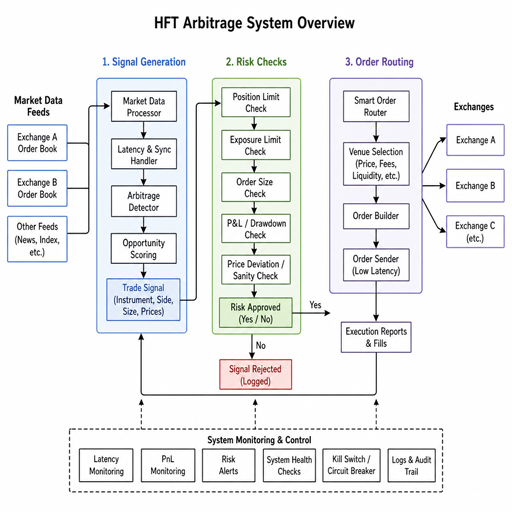
High-frequency trading arbitrage depends on a specialized technology environment. The specific setup varies, but the core components are similar: market data intake, signal generation, risk checks, order routing, execution monitoring, and post-trade analysis.
Market data processing
The system needs reliable access to price and order book information. For some strategies, top-of-book quotes may be enough. For others, full depth-of-book data is necessary to understand queue position, available liquidity, and order flow.
Data quality is critical. A delayed, dropped, duplicated, or misordered message can cause the algorithm to make the wrong decision. Strong systems include validation logic, timestamping, feed comparison, and failover procedures.
Signal generation
The signal engine determines whether market conditions meet the strategy’s criteria. It may compare prices across venues, estimate fair value, identify lead-lag relationships, or detect changes in order book pressure. In high-frequency trading, this logic must be efficient because even small delays can matter.
A signal does not automatically mean a trade should be placed. The system must decide whether the expected edge is large enough after costs, whether sufficient liquidity exists, and whether the trade fits current risk limits.
Order execution
Execution logic determines how orders are sent, priced, modified, or canceled. In arbitrage, execution can be especially delicate because multiple legs may need to be coordinated. If one leg fills and another does not, the system may be left with unwanted exposure.
Order types, routing choices, and venue rules all matter. A strategy may use aggressive orders to secure execution, passive orders to reduce costs, or a mix depending on conditions. The right choice depends on the opportunity, the urgency, and the cost of missing or partially completing the trade.
Risk management and kill switches
No HFT system should operate without real-time controls. Limits may include maximum position size, maximum order rate, maximum loss, venue-specific exposure, instrument restrictions, and checks for abnormal market data.
A kill switch is a mechanism that can stop trading when predefined conditions are breached. It is essential because automated systems can create problems quickly if they behave incorrectly. Risk controls should be designed before live trading, not added only after something goes wrong.
How do trading algorithms evaluate an arbitrage trade?
Trading algorithms evaluate an arbitrage trade by comparing the expected spread with the full cost and risk of execution. A price difference alone is not enough; the system must decide whether the opportunity is real, available, and likely to remain long enough to complete the trade.
A practical evaluation process may include the following steps:
- Identify the relationship. The algorithm defines which prices should be compared, such as the same instrument on two venues or a futures contract versus a related cash asset.
- Normalize the prices. Differences in currency, contract size, tick size, fees, or product structure must be adjusted so the comparison is meaningful.
- Check available liquidity. The system evaluates whether there is enough size at the quoted prices to support the trade.
- Estimate all costs. Fees, spreads, slippage, financing, borrowing, and market impact can reduce or eliminate the edge.
- Assess execution risk. The algorithm considers whether one leg may fill without the other and what hedge or unwind action would be needed.
- Apply risk limits. Position, loss, order rate, and venue exposure limits are checked before orders are released.
- Monitor the outcome. After execution, the system tracks fills, residual exposure, and realized performance.
This process may sound sequential, but in high-frequency trading it is highly optimized. Many checks occur automatically and nearly simultaneously. The purpose is to prevent the strategy from chasing every visible spread and instead focus on opportunities that meet strict tradability standards.
Benefits and limitations of high-frequency trading arbitrage
High-frequency trading arbitrage can contribute to tighter pricing relationships and faster information flow across markets. When arbitrageurs buy underpriced instruments and sell overpriced ones, they can help prices converge. Market making strategies may also provide liquidity by quoting bids and offers, although the quality of that liquidity can vary by market condition.
For the firms running these strategies, the appeal is the potential to capture many small edges rather than depend on a few large directional calls. A well-designed system can process more information than a human trader, apply consistent rules, and react rapidly to changing conditions.
However, the limitations are substantial. Competition is intense, and many simple arbitrage ideas are quickly discovered and compressed. Infrastructure can be expensive and complex. Small errors in assumptions, data handling, or execution logic can become costly when repeated at scale.
There is also a strategic limitation: markets evolve. A relationship that worked in one environment may stop working when volatility, liquidity, fees, venue rules, or participant behavior changes. Successful high-frequency trading requires ongoing research, testing, monitoring, and adaptation.
Key risks that can turn arbitrage into losses
The word “arbitrage” can create a false sense of safety. In live markets, even a strategy designed around price convergence can lose money. The risks are often practical rather than theoretical.
Important risks include:
- Latency risk: The opportunity disappears before the system completes the trade.
- Partial fill risk: One side executes while the other side remains open or fills at a worse price.
- Slippage: The actual execution price differs from the observed quote.
- Stale data: The system acts on market data that is no longer valid.
- Model risk: A statistical relationship breaks down or was overfit during research.
- Liquidity risk: The available size is smaller than expected, especially during stress.
- Fee and rebate changes: A strategy that depends on small margins can be affected by changes in trading costs.
- Operational risk: Software bugs, network issues, incorrect configuration, or venue outages disrupt trading.
- Regulatory risk: Market rules, reporting obligations, and acceptable order behavior must be understood and followed.
A strong risk framework treats these as normal design constraints, not rare exceptions. The system should be built with conservative assumptions, robust monitoring, and clear procedures for intervention.
Building blocks of a disciplined HFT arbitrage framework
A serious approach to high-frequency trading arbitrage starts with research, but it cannot stop there. The strategy must be translated into reliable software, tested under realistic conditions, and monitored continuously.
Research and hypothesis design
Every strategy should begin with a clear hypothesis. For example: a related instrument may lag price changes under certain liquidity conditions, or a cross-venue spread may appear when order book depth becomes imbalanced. The hypothesis should explain why the opportunity exists, not merely show that it appeared in historical data.
Good research includes out-of-sample testing, sensitivity analysis, and careful treatment of transaction costs. It should avoid assuming perfect fills at displayed prices unless that assumption is justified. In HFT arbitrage, fill probability and queue position can be as important as signal accuracy.
Simulation and backtesting
Backtesting high-frequency strategies is difficult because standard price bars are usually not enough. The system may need tick data, order book history, realistic latency assumptions, and execution simulation. Without these, a backtest may show profits that could not have been captured in live markets.
A useful simulation asks practical questions. Would the order have reached the venue in time? Was there enough liquidity ahead in the queue? What happens if only one leg fills? How does performance change when fees increase or fill rates decline?
Deployment and monitoring
Live deployment should be gradual. Many teams begin with paper trading, then limited-size production, then controlled scaling if behavior matches expectations. Monitoring should include both trading performance and system health.
Useful dashboards may track fill rates, rejected orders, latency, realized spread, inventory, exposure, data quality, and abnormal order behavior. Alerts should be actionable. If everything triggers an alert, nothing gets attention; if alerts are too narrow, the team may miss early signs of failure.
Practical checklist before pursuing HFT arbitrage
High-frequency trading arbitrage is not suitable for every trader or organization. Before pursuing it, a team should answer operational, financial, technical, and compliance questions honestly.
Use this checklist as a starting point:
- Market access: Do you have reliable connectivity to the venues where the strategy operates?
- Data quality: Can you obtain the level of market data needed for research and live trading?
- Cost model: Have you included commissions, fees, rebates, spreads, slippage, financing, and infrastructure costs?
- Execution realism: Does your testing account for latency, queue position, partial fills, and rejected orders?
- Risk controls: Are position limits, loss limits, order rate limits, and kill switches implemented before launch?
- Compliance review: Have applicable market rules and order behavior restrictions been reviewed?
- Monitoring: Can the team detect abnormal trading, connectivity problems, and data issues in real time?
- Capital and scale: Is the expected edge large enough to justify the technology and operational effort?
- Maintenance: Who is responsible for updating models, monitoring performance decay, and responding to incidents?
If several answers are unclear, the strategy is not ready for live deployment. In HFT, uncertainty does not remain small for long. Automated systems can multiply both good decisions and bad assumptions.
Common misconceptions about HFT arbitrage
One misconception is that high-frequency trading arbitrage is automatically risk-free. The concept of arbitrage may sound precise, but actual execution takes place in moving markets with uncertain fills. The spread visible at one moment may not be the spread achieved in the account.
Another misconception is that speed alone creates a sustainable advantage. Speed matters, but it is only one part of the system. A fast strategy with poor pricing logic, weak controls, or inaccurate cost assumptions can lose money quickly.
A third misconception is that all high-frequency trading is the same. Some strategies are market making, some are statistical, some are latency-sensitive, and some are execution-oriented. Each has different infrastructure needs, risk profiles, and market effects.
Finally, it is easy to underestimate competition. Many arbitrage opportunities are visible to sophisticated participants using advanced systems. Durable edges are more likely to come from a combination of research quality, market knowledge, engineering, execution, and risk discipline.
HFT arbitrage in the broader market ecosystem
High-frequency trading arbitrage sits at the intersection of technology and market efficiency. By reacting to price differences, these strategies can help align related markets. They may also add displayed liquidity when used in market making, though that liquidity can change depending on volatility and risk conditions.
At the same time, HFT raises legitimate questions. Market participants and regulators often focus on fairness, stability, excessive messaging, and the possibility that speed advantages benefit some firms more than others. Any serious discussion of high-frequency trading should acknowledge both sides: the efficiency benefits and the operational or market-structure concerns.
For traders, the practical takeaway is balanced. High-frequency trading arbitrage is not magic, and it is not simply a matter of installing software. It is a demanding discipline that requires clear strategy logic, strong infrastructure, realistic testing, and constant oversight.
A clear way to think about the opportunity
The best way to understand high-frequency trading arbitrage is to view it as a system, not a single trade idea. The system observes markets, estimates fair relationships, filters out false opportunities, manages execution, controls risk, and learns from results. Weakness in any part can erase the advantage created by another.
For educational purposes, the concept is valuable because it shows how modern markets operate. Prices are shaped not only by human opinions, but also by automated responses to liquidity, information, and cross-market relationships. Trading algorithms compete to process those relationships faster and more accurately.
For practical application, caution is essential. Most participants are better served by first understanding market structure, transaction costs, and algorithmic trading fundamentals before considering high-frequency deployment. Where HFT arbitrage is pursued, it should be treated as a professional-grade engineering and risk-management challenge rather than a shortcut to easy returns.
In short, high-frequency trading arbitrage is about capturing small inefficiencies under demanding real-world constraints. The opportunity lies in precision: better data, better models, better execution, and better controls. Without those foundations, even the most attractive arbitrage opportunities can disappear before they become profitable.
