
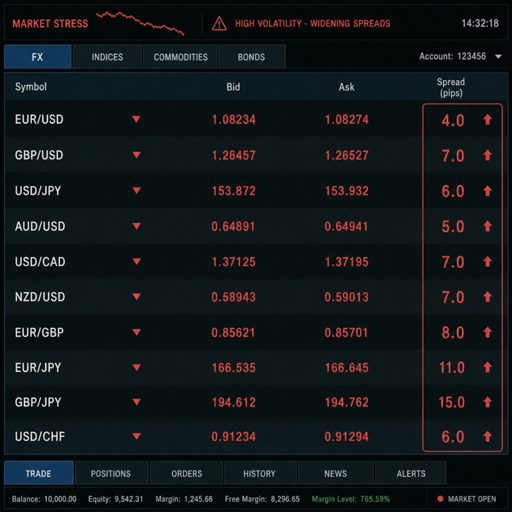
Foreign exchange liquidity is the ease with which currencies can be bought or sold without causing a sharp move in price. When that liquidity dries up, spreads widen, orders fill poorly, and markets that usually feel deep can become difficult to trade. For traders, treasurers, and anyone exposed to the foreign exchange market, understanding liquidity dry-ups is essential to managing risk before conditions turn disorderly.
What happens when foreign exchange liquidity dries up?
When foreign exchange liquidity dries up, there are fewer willing buyers and sellers at reliable prices, so even ordinary transactions can move the market more than expected. This can lead to wider bid-ask spreads, thinner order books, delayed execution, and greater slippage between the price a trader expects and the price actually received.
In normal conditions, major currency pairs often appear highly liquid because banks, brokers, funds, corporations, and other participants are continuously exchanging currency. But liquidity is not permanent. It can contract quickly when market participants become cautious, reduce risk, or withdraw quotes during uncertainty.
A dry-up does not always mean trading stops. More often, trading liquidity becomes uneven. A currency pair may still show prices on a screen, yet the amount available at those prices may be small, unstable, or quickly withdrawn.
The role of liquidity in the foreign exchange market
Market liquidity is one of the reasons the foreign exchange market is widely used by global businesses and investors. Strong currency liquidity helps participants convert one currency into another, hedge exposures, and move capital across borders with less friction.
Liquidity matters because it affects both cost and confidence. When liquidity is deep, the difference between buying and selling prices is usually narrower, and larger transactions are easier to complete without disrupting the market. When liquidity is thin, the same transaction may become more expensive and less predictable.
This is especially important in forex because currencies are often traded for practical reasons, not only speculation. Importers, exporters, asset managers, lenders, and multinational companies may need to transact regardless of whether market conditions are ideal. A sudden drop in forex liquidity can therefore create operational challenges as well as trading losses.
Common causes of liquidity dry-ups
Liquidity dry-ups are usually caused by a shift in participation, risk appetite, or market structure. Sometimes the trigger is obvious; other times, liquidity fades gradually before a larger price move reveals the problem.
Common drivers include:
- Major economic announcements: Central bank decisions, inflation data, employment reports, and growth updates can cause market makers to reduce quote sizes until the information is absorbed.
- Political or policy uncertainty: Elections, sanctions, fiscal announcements, capital controls, or unexpected government action can make currency pricing harder.
- Periods of market stress: During broader risk-off conditions, participants may focus on preserving capital instead of providing liquidity.
- Holiday and off-session trading: Forex trading volume can fall during local holidays, late trading sessions, and year-end periods, leaving fewer active counterparties.
- One-sided positioning: If many traders are trying to exit the same trade at once, currency liquidity can vanish on one side of the market.
- Reduced dealer risk appetite: Banks and liquidity providers may quote more defensively when volatility rises or balance-sheet capacity is limited.
The key point is that liquidity is partly psychological. If participants believe prices may move violently, they often step back, and that retreat can make the market more fragile.
Why do spreads widen during stressful currency moves?
Spreads widen because liquidity providers face greater uncertainty and demand more compensation for the risk of quoting prices. If prices are moving quickly, a dealer or market maker may not know whether a quote will remain fair even seconds later, so they increase the gap between bid and ask prices or reduce the size they are willing to trade.
For traders, the spread is not just a visible cost. It is also a signal. A sudden widening in spreads can suggest that the market is becoming less confident, less balanced, or less willing to absorb large orders.
This can create a feedback loop. Wider spreads make trading more expensive, which discourages some participants. With fewer participants, market liquidity can deteriorate further, and price swings may become sharper.
Signs that forex liquidity is weakening
Liquidity problems are not always obvious until an order performs badly. Watching several conditions together can help traders identify a potential dry-up earlier.
Useful warning signs include:
- Bid-ask spreads widen beyond normal levels. This is often the first visible sign that liquidity providers are becoming cautious.
- Order book depth becomes thinner. Prices may still be available, but the size behind them is smaller.
- Slippage increases. Market and stop orders execute farther from expected levels.
- Price jumps replace smooth movement. Instead of trading through nearby levels, the market gaps from one price area to another.
- Correlated currencies move together abruptly. Stress can cause broad currency baskets to move at once, especially when traders reduce risk.
- News moves last longer than usual. If the market struggles to find two-way flow after a release, liquidity may be impaired.
None of these signals is perfect on its own. Together, however, they can help distinguish a normal volatile session from a market where trading liquidity is genuinely weaker.
How liquidity dry-ups affect different participants
The impact of reduced foreign exchange liquidity depends on why someone is in the market. A short-term trader, corporate treasurer, and long-term investor may all experience the same dry-up differently.
For active traders, the main issues are execution quality and risk control. Stops may trigger at worse levels than expected, limit orders may not fill, and leverage can amplify losses when prices move abruptly.
For businesses, the concern is often budget certainty. A company that needs to exchange currency for payroll, imports, debt service, or overseas revenue conversion may face higher hedging costs or less favorable execution during thin conditions.
For investors, liquidity dry-ups can affect portfolio rebalancing and hedging. Currency moves may become less reflective of long-term fundamentals and more driven by urgent flows, positioning, or temporary risk aversion.
Practical ways to manage liquidity risk
No one can prevent a liquidity dry-up, but traders and organizations can prepare for one. The goal is not to predict every disruption; it is to avoid being forced into poor decisions when forex liquidity becomes scarce.
Consider these practices:
- Use position sizes that can survive imperfect execution. If a trade only works with flawless fills, it may be too fragile.
- Avoid unnecessary market orders during known event risk. Around major announcements, execution can change quickly.
- Plan orders in smaller pieces. Breaking up large trades may reduce visible market impact, though it cannot remove risk.
- Monitor spreads before entering. A trade that looks attractive on a chart may be costly once execution conditions are included.
- Review stop placement. Stops are useful, but in thin markets they may fill far from the trigger level.
- Keep liquidity calendars in mind. Holidays, session changes, and major data releases can affect forex trading volume.
- Maintain more than one execution option when possible. Relying on a single venue or counterparty may create avoidable bottlenecks.
Good liquidity risk management is often boring when markets are calm. Its value becomes clear when conditions deteriorate and the ability to act calmly matters most.
The difference between volatility and liquidity
Volatility and liquidity are related, but they are not the same. Volatility describes how much prices move; liquidity describes how easily trades can be executed near expected prices.
A market can be volatile but still liquid if many participants are actively trading on both sides. In that case, prices move, but there is still depth and continuous execution. A market can also look quiet yet be illiquid if few participants are present and even a modest order could cause a large move.
This distinction matters because a low-volatility environment can create false comfort. If traders assume stable prices mean strong market liquidity, they may take positions that become difficult to exit when conditions change.
A calmer approach to fragile markets
Foreign exchange liquidity dry-ups are not rare accidents; they are a recurring feature of global markets. They tend to appear when uncertainty rises, participation falls, or too many traders need the same exit at the same time.
The best response is preparation. By watching spreads, depth, timing, order type, and position size, traders and businesses can reduce the damage caused by weak currency liquidity. In the foreign exchange market, the price on the screen matters, but the ability to trade at that price matters just as much.
