
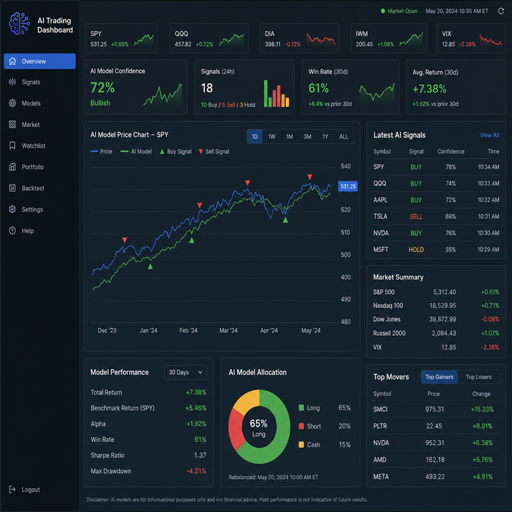
AI-driven algorithmic trading brings artificial intelligence, market data, and automation together to help traders research ideas, execute rules, and adapt to changing conditions faster than manual trading allows. It does not remove risk or guarantee better results, but it can make trading strategies more systematic, testable, and scalable when used with clear controls. For investors, developers, and finance teams exploring ai finance, the real value is not “letting a machine trade,” but building a disciplined process around data, models, execution, and risk.
What is AI-driven algorithmic trading?
AI-driven algorithmic trading is the use of artificial intelligence within algorithmic trading systems to analyze data, identify potential market opportunities, and place or recommend trades based on predefined rules. Traditional automated trading often follows fixed instructions, such as buying when one moving average crosses another. AI trading adds models that can learn patterns from historical and real-time data, making the system more flexible, though also more complex.
At its best, this approach supports better decision-making by reducing emotional reactions and creating a repeatable workflow. At its worst, it can encourage overconfidence, overfitting, and excessive reliance on technology. The difference usually comes down to whether the strategy is built, tested, monitored, and governed with care.
The building blocks of an AI trading system
AI-driven algorithmic trading is not a single tool. It is a stack of connected parts that must work together: data, models, strategy logic, execution, and oversight. If one layer is weak, the entire system can produce misleading signals or poor trades.
A typical system includes:
- Market data: Price, volume, order book data, spreads, volatility, and other trading inputs.
- Alternative data: News, social sentiment, macroeconomic indicators, satellite data, or company-specific signals where legally and ethically sourced.
- Feature engineering: The process of turning raw data into useful model inputs, such as momentum, liquidity, trend strength, or abnormal activity.
- AI or machine learning models: Systems that classify market conditions, forecast probabilities, detect anomalies, or optimize entries and exits.
- Strategy rules: Practical trading logic that defines when to act, how much to trade, and when to stop.
- Execution engine: The automated trading layer that sends orders, manages timing, and attempts to reduce slippage.
- Risk controls: Limits on position size, loss thresholds, exposure, leverage, and model behavior.
- Monitoring: Human and technical review to catch errors, market regime shifts, data issues, or unexpected performance.
This structure matters because AI by itself is not a trading strategy. A model may suggest that a pattern has predictive value, but the strategy must decide whether the opportunity is tradable after costs, spreads, liquidity, taxes, and risk limits are considered.
Why AI changes trading strategies
AI changes trading strategies by making it easier to process more variables, detect subtle relationships, and adjust to new information. In quantitative trading, traders often test hypotheses using data. AI expands that process by allowing models to evaluate large combinations of signals, market conditions, and outcomes.
For example, a traditional strategy might look for a breakout above a resistance level. An AI-enhanced strategy could also consider volatility, volume acceleration, broader sector movement, news sentiment, liquidity conditions, and recent false breakout patterns. The trade decision becomes less about one signal and more about the probability that multiple conditions support the same idea.
This can be useful in several strategy types:
- Trend-following: Identifying when a price move has enough strength to continue.
- Mean reversion: Spotting when an asset may have moved too far from a typical range.
- Statistical arbitrage: Finding temporary pricing relationships between related assets.
- Market making: Quoting bids and offers while managing inventory and spread risk.
- Event-driven trading: Reacting to earnings, news, economic releases, or corporate actions.
- Portfolio optimization: Allocating capital across assets based on expected return, risk, and correlation.
The practical benefit is not that AI “knows the future.” It is that AI can help evaluate probabilities across messy, fast-moving data. That makes it valuable, but only when paired with realistic assumptions.
How does AI fit into quantitative trading?
AI fits into quantitative trading as a research and decision-support layer that can test patterns, rank opportunities, forecast scenarios, and automate parts of the trading process. Quantitative trading already depends on math, statistics, and rules. AI extends that foundation with models that can learn from data rather than relying only on hand-coded formulas.
Common techniques include supervised learning, unsupervised learning, reinforcement learning, and natural language processing. Supervised models may classify whether a setup is likely to be profitable based on past examples. Unsupervised models may group market regimes, such as calm, volatile, trending, or choppy conditions. Natural language processing can help interpret news, filings, or sentiment signals.
Still, the research process should remain disciplined. A model that performs beautifully on historical data may fail in live markets if it captured noise rather than a durable relationship. That is why backtesting, walk-forward testing, paper trading, and live monitoring are essential.
Practical workflow for building an AI-driven strategy
A strong workflow keeps excitement from replacing evidence. Before connecting any model to real capital, traders should move through a structured process that tests whether the idea is logical, measurable, and robust.
- Define the market and objective. Decide whether the system will trade equities, futures, crypto, forex, or another asset class. Clarify whether the goal is short-term execution, signal generation, portfolio allocation, or risk management.
- Form a trading hypothesis. Start with a clear idea, such as “assets with improving momentum and rising volume may outperform over a short horizon.” Avoid feeding data into a model with no economic rationale.
- Collect and clean data. Remove bad ticks, duplicate records, survivorship bias, look-ahead bias, and inconsistent timestamps. AI trading is only as reliable as the data behind it.
- Create features. Build inputs that describe market behavior in useful ways. These might include volatility changes, liquidity measures, relative strength, sentiment scores, or correlation shifts.
- Train and validate the model. Use separate data for training and testing. Consider whether performance holds across different periods, assets, and market conditions.
- Backtest with realistic costs. Include commissions, spreads, slippage, borrow costs, funding costs, and market impact where relevant.
- Add risk controls. Set limits before live deployment. Define maximum drawdown, exposure caps, stop conditions, and alerts.
- Paper trade first. Run the strategy in a simulated or limited environment to observe execution behavior.
- Deploy gradually. Start small, monitor closely, and scale only if live results match expectations.
- Review continuously. Markets evolve, and models can decay. Ongoing review is part of the strategy, not an optional extra.
This workflow is slower than simply turning on an automated trading bot, but it is far more responsible. It also makes strategy improvements easier because each part of the process can be measured.
The benefits of automated trading with AI
Automated trading can remove many manual bottlenecks. AI can scan more markets than a person can watch, react quickly to predefined conditions, and apply rules consistently under pressure. For active traders, that consistency can be just as important as speed.
The major advantages include:
- Scalability: One system can monitor many assets, timeframes, and signals at once.
- Consistency: Rules can be applied without hesitation, fatigue, or emotional bias.
- Speed: Automated systems can respond to opportunities faster than manual workflows.
- Research depth: AI can test complex relationships across large datasets.
- Risk visibility: Models can support real-time alerts around exposure, volatility, and drawdown.
- Process improvement: Every decision can be logged, reviewed, and refined.
These benefits are especially relevant in ai finance, where firms and individuals increasingly use data-driven tools for trading, investing, lending, fraud detection, and risk management. However, more automation also means more responsibility. A poorly designed system can make mistakes faster than a human can intervene.
What risks should traders watch before using AI?
Traders should watch for overfitting, poor data quality, hidden costs, model drift, operational failures, and weak risk controls before using AI in live markets. AI-driven algorithmic trading can amplify both good and bad decisions, so the safeguards matter as much as the model.
Key risks include:
- Overfitting: The model performs well in testing because it learned historical noise instead of a repeatable pattern.
- Look-ahead bias: The backtest accidentally uses information that would not have been available at the time of the trade.
- Data errors: Bad prices, missing records, or incorrect corporate action adjustments can distort results.
- Changing market regimes: A strategy that worked in a trending market may struggle in a sideways or highly volatile market.
- Execution risk: Real orders may receive worse prices than expected, especially in illiquid markets.
- Technology failure: APIs, servers, broker connections, or data feeds can fail.
- Regulatory and compliance issues: Different markets and jurisdictions have rules around automated trading, data use, and disclosures.
A useful mindset is to treat every model as provisional. Even a profitable strategy deserves skepticism, stress testing, and clear shutdown rules.
Human judgment still matters
AI trading works best when humans define the objective, understand the limits, and stay accountable for the outcome. The model can process data, but it cannot decide what level of risk is acceptable for a person, fund, or business. It also cannot automatically know whether a market event is unusual enough to require human review.
Human oversight is especially important when strategies interact with real capital. Someone must decide whether the model’s behavior still matches the original thesis, whether market conditions have changed, and whether the system should continue trading. In that sense, AI does not replace trading discipline. It raises the standard for it.
A balanced team or individual workflow often combines:
- Quantitative research to test ideas.
- Engineering to build reliable systems.
- Trading knowledge to understand market mechanics.
- Risk management to define limits.
- Compliance awareness to avoid improper use of data or automation.
That combination is what turns technology into a practical trading process.
Getting started without overcomplicating it
Newcomers do not need to begin with a complex deep learning model. A simpler algorithmic trading strategy with clean data, transparent rules, and careful testing is usually a better starting point. Complexity should be added only when it improves decision quality in a way that can be measured.
A practical first project might involve building a rule-based momentum or mean-reversion strategy, then using AI to improve one part of the process. For instance, a model could filter trades during high-volatility conditions, classify market regimes, or rank signals by probability. This keeps the system understandable while introducing AI where it adds value.
The best early goal is not to build a fully autonomous trading machine. It is to learn how data, assumptions, execution, and risk interact. Once that foundation is strong, more advanced AI-driven algorithmic trading methods become easier to evaluate.
Final takeaway
AI-driven algorithmic trading is most powerful when it supports a disciplined, transparent, and risk-aware process. It can improve research, refine trading strategies, and automate execution, but it cannot remove uncertainty from markets. Traders who combine quantitative trading principles with thoughtful AI tools are better positioned to build systems that are not only faster, but also more testable, adaptable, and controlled.
