
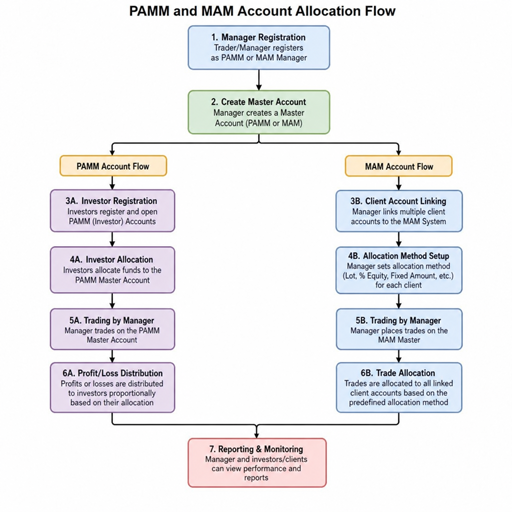
PAMM and MAM structures are ways to connect a professional or lead trader’s activity to multiple investor accounts without manually placing every order in every account. They are commonly discussed in forex and CFD environments, but the core idea is broader: allocation technology, risk controls, reporting, and clear authority determine how managed trading is delivered. This guide explains how each model works, what to look for in a pamm account management platform, and how investors, managers, and brokers can evaluate the risks before committing capital.
What does managed account allocation actually mean?
Managed account allocation means one trading decision is distributed across more than one account according to a defined method. Instead of every participant sending individual orders, a manager trades from a master account or strategy account, and the platform allocates the resulting trades, profit, loss, and fees to connected accounts.
The important point is that allocation is an operational mechanism, not a guarantee of performance. A well-built setup can make trade distribution more consistent, reporting clearer, and administration easier. It cannot remove market risk, manager risk, broker risk, leverage risk, or the possibility that a strategy performs differently in live conditions than it did in a past period.
In practice, PAMM and MAM accounts sit at the intersection of trading, technology, custody, and regulation. The investor wants transparency and control over deposits and withdrawals. The manager wants scalable execution and accurate fee calculations. The broker or platform provider wants reliable trade routing, recordkeeping, and client-level reporting.
PAMM account management in plain language
PAMM stands for Percentage Allocation Management Module. In a PAMM setup, multiple investors allocate capital to a manager’s strategy, and the platform distributes results by percentage share. If one investor represents a larger portion of the strategy’s total allocated capital, that investor receives a proportionally larger share of profits and losses.
This is why pamm account management is often described as pool-like, even though the legal and custody structure depends on the provider and jurisdiction. The investor may keep an individual account relationship with a broker, while the PAMM module handles performance allocation behind the scenes. The key feature is proportional distribution.
A simplified example helps. Suppose a manager is running a strategy with three participants. Investor A contributes 50% of the allocated capital, Investor B contributes 30%, and Investor C contributes 20%. If the strategy earns or loses money during the period, the platform allocates the result according to those percentages after applying the relevant fee rules.
PAMM structures can be attractive when participants want simple proportional exposure to one strategy. They can also simplify performance-fee administration because the system tracks each investor’s share and calculates manager compensation according to the offer terms. However, investors still need to understand how deposits, withdrawals, high-water marks, loss carryforward, and manager fees are handled.
MAM account management in plain language
MAM stands for Multi-Account Manager. A MAM setup allows a manager to place trades from a master interface while the software distributes those trades across multiple client accounts. Compared with PAMM, MAM arrangements often emphasize flexible trade allocation rather than purely percentage-based participation.
That flexibility can matter when accounts differ in size, leverage, instrument availability, risk profile, or lot-size requirements. A manager may need to allocate trades by balance, equity, fixed lot, proportional lot, risk multiplier, or another rule supported by the platform. This makes MAM useful when clients are not all meant to receive identical exposure.
For example, one client may want conservative exposure, another may accept higher risk, and another may have restrictions on certain instruments. A MAM account management system can help the manager apply these settings consistently, provided the platform supports the needed controls. The trade-off is that configuration becomes more complex, and mistakes in allocation settings can have real financial consequences.
MAM is often preferred by money managers who need account-level customization. It can also be helpful for brokerages supporting professional managers, introducing brokers, or advisory teams. As with PAMM, the technology does not validate the strategy. It only determines how the strategy is distributed and recorded.
PAMM and MAM models compared
PAMM and MAM are sometimes discussed as if one is automatically better than the other. In reality, the better model depends on the trading program, the investor base, the compliance framework, and the amount of customization required.
|
Feature |
PAMM model |
MAM model |
|---|---|---|
|
Main allocation style |
Percentage-based participation in a manager’s strategy |
Trade allocation from a master account to multiple accounts |
|
Best suited for |
Investors seeking proportional exposure to one strategy |
Managers needing more account-level control |
|
Customization |
Usually simpler and more standardized |
Often more flexible, depending on software |
|
Administration |
Can simplify profit, loss, and fee allocation |
Can require more detailed configuration and monitoring |
|
Investor experience |
Similar exposure based on capital share |
Exposure may vary by account settings |
|
Key risk |
Investors may overlook manager and strategy risk because allocation feels simple |
Configuration errors or inconsistent settings can create unexpected exposure |
A PAMM setup is usually easier to explain to investors: capital joins a strategy and results are allocated proportionally. A MAM setup may be more powerful for professional management because it can support different risk profiles. The best choice is the one that matches the actual operating model, not the one with the more familiar acronym.
How does a pamm account management platform work?
A pamm account management platform connects investors, managers, and broker infrastructure so that allocation, performance tracking, and reporting happen in a controlled workflow. At minimum, it should define who can trade, which accounts are linked, how allocations are calculated, how fees are charged, and how investors can monitor results.
Most platforms follow a practical sequence. The details vary, but the workflow usually includes onboarding, authorization, allocation setup, execution, monitoring, and settlement of fees or results.
- Manager setup The manager creates or is assigned a strategy profile. This may include a strategy description, fee structure, trading permissions, eligible instruments, risk settings, and reporting rules.
- Investor onboarding Investors open accounts, complete required checks, review documents, and decide whether to allocate funds to a strategy. They should understand the manager’s role, the platform’s role, and the broker’s role before joining.
- Allocation configuration The platform records each investor’s contribution or account linkage. In PAMM, the investor’s share is typically based on the percentage of total allocated capital. In MAM, allocation may use a broader set of rules.
- Trade execution The manager trades the strategy account or master account. The platform then applies the agreed allocation method. Execution quality can be affected by liquidity, latency, account size, order type, and market conditions.
- Performance and fee calculation The system tracks open positions, closed trades, profit, loss, drawdown, and applicable fees. Fee logic should be transparent, especially where performance fees, management fees, or withdrawal timing affect investor outcomes.
- Reporting and investor controls Investors need access to understandable reports showing account value, trading activity, fees, deposits, withdrawals, and current exposure. They should also know whether they can pause, disconnect, or withdraw according to the platform’s rules.
The more money involved, the more important these operational details become. A platform that looks polished on the front end but lacks clear audit trails, account-level reporting, or permission controls can create problems when investors ask basic questions about performance and fees.
Where pamm account management software creates value
Good pamm account management software is valuable because it reduces manual administration and makes allocation rules more consistent. For managers, it can turn a one-account trading process into a scalable operating model. For investors, it can make participation easier to monitor. For brokers, it can standardize reporting and reduce the risk of spreadsheet-based errors.
The software’s value is practical rather than magical. It should help answer basic operational questions quickly: Which accounts are attached? What allocation rule applies? What trades were placed? What fees were charged? What changed after a deposit or withdrawal? If those answers are difficult to find, the software is not doing enough.
Benefits for managers
Managers often care about execution, scalability, and accurate compensation. A proper system can help them trade once and allocate across many accounts according to predefined rules. It can also support performance tracking, client segmentation, and fee reporting.
This matters because manual replication becomes fragile as the number of accounts grows. Small delays, missed orders, or inconsistent lot sizes can lead to different outcomes between clients. Management software helps reduce those inconsistencies, though it still requires oversight and testing.
Benefits for investors
Investors benefit when software gives them clearer visibility into what is happening. They should be able to review performance, open exposure, historical trades, fee deductions, and account activity. The more transparent the reporting, the easier it is to distinguish normal market losses from poor communication or operational weakness.
Investors should not confuse dashboards with due diligence. A clean interface can make a risky strategy look organized. The better question is whether the data is complete, timely, and consistent with account statements.
Benefits for brokers and platforms
Brokers and platform operators use PAMM and MAM systems to support managers while maintaining account records. The system can assist with permissions, investor reporting, allocation logs, and operational workflows. It can also help standardize how strategies are presented to clients.
This is especially important where managed accounts are subject to local rules. In the United States, for example, NFA materials describe registration, disclosure, and conduct obligations for firms and individuals involved in retail forex activities, including those who manage or solicit forex accounts. (nfa.futures.org) In Australia, ASIC treats managed discretionary accounts as a regulated area and publishes guidance on how such services are regulated for retail clients. (asic.gov.au)
Risk is the central issue, not the acronym
The biggest mistake in managed account selection is focusing on whether the setup is called PAMM or MAM while ignoring the risks underneath. Market losses, excessive leverage, poor execution, weak controls, unclear authority, and misleading marketing can harm investors in either structure.
A responsible review should separate four layers of risk:
- Strategy risk: the trading method may lose money, stop working, or behave differently in volatile markets.
- Manager risk: the person or firm may lack discipline, transparency, experience, or proper authorization.
- Platform risk: the software may apply settings incorrectly, report unclearly, or fail to provide adequate audit trails.
- Broker and custody risk: the account structure, withdrawal process, counterparty arrangements, and safeguards may not match investor expectations.
Regulatory expectations also matter. The SEC notes that adviser disclosures are meant to help investors compare advisory businesses, services, conflicts, and compensation arrangements. (sec.gov) SEC custody guidance also emphasizes safeguards around client assets held by qualified custodians or in accounts maintained for clients. (sec.gov) These principles are not a substitute for local legal advice, but they highlight a useful standard: investors should know who controls trading decisions, who holds assets, how conflicts are disclosed, and how fees are calculated.
Managers should be cautious too. If they accept trading authority over other people’s accounts, they may trigger registration, licensing, disclosure, reporting, or marketing obligations depending on the jurisdiction and instruments traded. A technology provider cannot make an unauthorized activity compliant simply by branding it as PAMM or MAM.
How should you read pamm account reviews?
Read pamm account reviews as starting points, not final evidence. Reviews can reveal communication problems, withdrawal concerns, platform usability issues, or repeated complaints, but they can also be biased, outdated, promotional, or written by people who misunderstood the risks.
The best approach is to compare reviews with verifiable documents and account-level data. If reviews praise high returns but do not mention drawdowns, fees, leverage, market conditions, or withdrawal rules, they are incomplete. If negative reviews focus on losses alone, ask whether the losses came from disclosed strategy risk or from misconduct, hidden fees, or operational failure.
Use this checklist when assessing reviews and promotional claims:
- Look for specifics. Useful reviews mention dates, withdrawal processes, reporting quality, fee treatment, customer support, or platform behavior.
- Separate performance from process. A losing month is not automatically a red flag. Refusal to explain losses, missing statements, or changing rules after the fact is more serious.
- Check consistency across sources. Repeated complaints about delayed withdrawals, unclear fees, or strategy descriptions deserve attention.
- Be skeptical of perfect return stories. Any strategy that appears to make steady gains without meaningful drawdown should be examined carefully.
- Ask for official documents. Reviews should never replace agreements, risk disclosures, fee schedules, and account statements.
- Verify the manager and provider. Confirm names, entities, licenses, permissions, and disciplinary history where public registers are available.
A balanced review process accepts that every trading strategy can lose. The question is whether the investor was properly informed, whether the manager acted within the agreed mandate, and whether the platform records support what happened.
Features to expect in a serious platform
A serious pamm account management platform should be built around control, transparency, and repeatability. Attractive dashboards are helpful, but they are secondary to accurate allocation, clear permissions, and reliable reporting.
Important features include:
- Flexible allocation methods: percentage, equity-based, balance-based, lot-based, multiplier-based, or other methods appropriate to the model.
- Investor-level reporting: account value, open trades, closed trades, fees, deposits, withdrawals, and historical performance.
- Manager fee tools: support for management fees, performance fees, high-water marks, hurdle logic, or other agreed structures where applicable.
- Risk controls: drawdown limits, maximum exposure settings, instrument restrictions, leverage limits, and emergency disconnect tools.
- Audit trails: logs showing account connections, setting changes, trade allocations, fee calculations, and administrative actions.
- Permission management: clear distinction between viewing rights, trading rights, administrative rights, and withdrawal authority.
- Operational support: reconciliation tools, error handling, reporting exports, and support workflows for client questions.
The best platform is not always the most complex one. A small manager with one standardized strategy may need a clean PAMM module with excellent reporting. A larger manager serving different risk profiles may need MAM software with deeper configuration. The right choice depends on the operating model.
Due diligence before joining or offering a managed account
Due diligence should happen before funds are allocated, not after a problem occurs. Investors should review the manager, strategy, platform, broker, and legal documents as one connected system. Managers should also review whether the platform can support their obligations to clients.
For investors, the first question is simple: do you understand exactly what authority you are giving away? If a manager can trade your account, you need to know the mandate, the instruments, the risk limits, the fee structure, and how to exit. If you cannot explain the arrangement in plain language, you are probably not ready to join.
For managers, the first question is whether the setup is appropriate for the clients being served. A strategy that is suitable for experienced, high-risk participants may be unsuitable for retail investors expecting stable returns. Marketing should match the real risk profile of the strategy.
Investor due diligence checklist
Before allocating capital, review:
- The legal agreement explaining trading authority, fees, withdrawals, reporting, and termination.
- The manager’s identity and permissions in the relevant jurisdiction, where such registers exist.
- The broker or custodian relationship and whether funds remain in an account under your name.
- The strategy description including instruments, leverage, holding period, and risk controls.
- The full performance history including losing periods, drawdowns, inactive periods, and methodology.
- The fee schedule including performance fees, management fees, platform fees, broker costs, and timing.
- The withdrawal process including notice periods, lockups, open trades, and any conditions.
- The reporting process including how often statements are updated and who to contact about discrepancies.
Manager due diligence checklist
Before using a PAMM or MAM system, managers should confirm:
- Allocation logic matches the strategy and client agreements.
- Risk settings are tested before live use.
- Client categories are clearly separated if different risk levels are offered.
- Fee calculations are documented and explainable.
- Marketing materials avoid exaggerated claims and disclose meaningful risk.
- Regulatory obligations are reviewed with qualified advisers where needed.
- Operational procedures exist for trade errors, platform downtime, and client complaints.
- Records are exportable for audits, reconciliations, and client reporting.
This level of review may feel slow, but it is easier than untangling a dispute after trades have already been placed.
Common mistakes to avoid
Many PAMM and MAM problems begin with unrealistic expectations. Investors may expect professional management to reduce uncertainty, while managers may expect allocation software to solve business, compliance, and communication challenges. Both assumptions are dangerous.
A common investor mistake is chasing recent performance without understanding drawdown. A strategy that performed well in one market environment may struggle in another. Past results should be reviewed for context, not treated as a forecast.
Another mistake is ignoring fees. Managed accounts can include performance fees, management fees, spreads, commissions, swap charges, and platform costs. Even when each cost looks reasonable on its own, the combined effect can materially change the outcome.
Managers can make mistakes too. Over-customizing MAM settings without strong controls can create inconsistent client results. Failing to document allocation rules can make disputes harder to resolve. Promising smooth returns can also create expectations no trading strategy can responsibly support.
Brokers and platforms should avoid treating PAMM and MAM as purely commercial features. If the provider supports managed account structures, clients will expect clarity around authority, reporting, and operational safeguards. Weak documentation can damage trust even when the technology works.
Best practices for sustainable account management
Sustainable managed account operations depend on clarity. Everyone involved should know what the system does, what it does not do, and who is responsible for each decision.
Strong setups usually share several habits:
- Plain-language documentation that explains the model without hiding behind platform jargon.
- Realistic risk communication that describes potential losses as clearly as potential gains.
- Consistent reporting so investors can track activity without relying on informal updates.
- Tested allocation settings before any strategy is made available to clients.
- Defined exit rules so investors know how withdrawals or disconnections work.
- Regular reconciliation between platform data, broker statements, and fee calculations.
- Clear complaint handling for performance questions, trade disputes, and administrative issues.
For investors, the best practice is to start with a level of capital you can afford to risk and increase only after you understand the process. For managers, the best practice is to build operations as if every allocation, fee, and setting may later need to be explained. For brokers and technology providers, the best practice is to make records easy to access and hard to manipulate.
Choosing the right model for your situation
PAMM may be the better fit when the goal is simple proportional participation in one strategy. It is easier to explain, easier to administer, and often suitable when investors are meant to receive similar exposure based on their capital share.
MAM may be the better fit when the manager needs more flexible allocation. If clients have different balances, risk profiles, account currencies, or exposure limits, MAM tools may offer the control needed to manage those differences. That flexibility should come with stronger operational checks.
A practical decision framework is:
- Choose PAMM if the strategy is standardized and investors should participate proportionally.
- Choose MAM if account-level customization is central to the service.
- Choose neither until the legal authority, risk disclosures, custody structure, and reporting process are clear.
- Reconsider the arrangement if the main selling point is high returns rather than transparent process.
The strongest managed account programs are not defined by acronyms. They are defined by suitable clients, realistic expectations, well-tested software, disciplined managers, and documentation that makes the arrangement understandable.
Key takeaways
PAMM and MAM account management can make multi-account trading more efficient, but they should be approached as serious financial infrastructure. PAMM generally emphasizes proportional participation, while MAM generally emphasizes flexible trade allocation across accounts. Both require clear agreements, reliable software, transparent reporting, and careful due diligence.
If you are an investor, do not rely on pamm account reviews alone. Verify the manager, read the documents, understand the fees, and confirm how withdrawals and reporting work. If you are a manager or platform provider, treat pamm account management software as part of a broader responsibility: it should support accurate allocation, clear records, and honest communication.
The right setup is the one that matches the strategy, the clients, and the regulatory environment. When those pieces align, PAMM and MAM structures can support professional account management. When they do not, even the best-looking platform can expose participants to avoidable confusion and risk.
