
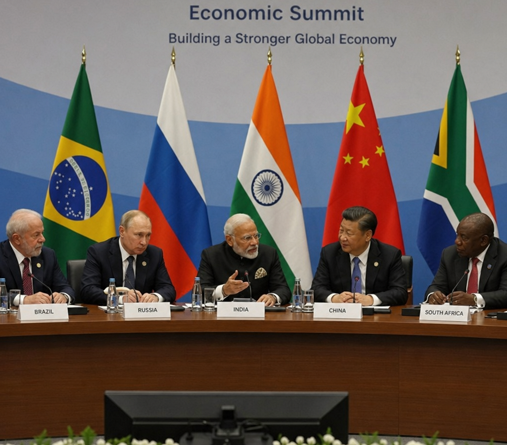
BRICS leaders have kept the idea of a BRICS common currency out of the latest formal summit outcome, choosing instead to continue work on local-currency trade settlement and cross-border payment links. The New Delhi Declaration adopted at the 18th BRICS Summit on September 12, 2026, points to a practical, incremental approach for the brics financial system rather than a euro-style monetary union. For businesses and market watchers following brics currency news, the distinction matters: the bloc is discussing how members pay each other, not launching a single brics currency.
What did BRICS actually decide on currency?
BRICS did not approve, launch, or set a timetable for a common currency at the New Delhi summit. The official declaration says members acknowledged work on payment and messaging interoperability, discussed trade settlements and investments using BRICS local currencies, and asked the BRICS Payment Task Force to keep developing practical cross-border payment solutions. It also stressed respect for national priorities and noted that there is no “one-size-fits-all” approach, language that signals caution rather than a binding currency project.
Indian officials also pushed back on speculation that a shared bloc currency was under active consideration. Sudhakar Dalela, secretary for economic relations in India’s Ministry of External Affairs, said there was currently no proposal to introduce a common BRICS currency, while talks on local-currency settlement would continue as a way to reduce transaction costs. That statement sharpened the central message from New Delhi: the brics economic alliance is focused on payment plumbing, not monetary merger.
The focus shifts to local-currency trade
The most important currency-related development is the continued push for trade settlement in national currencies. In practice, that means more transactions could be settled in rupees, yuan, roubles, reais, rand, dirhams or other member currencies where counterparties, banks and regulators can support the arrangement. This is the policy area behind much of the public debate over a brics trade currency, even though local settlement is not the same as creating one new unit of money.
For exporters, importers and banks, the potential benefit is lower reliance on an intermediate currency in some trade corridors. A transaction that can be invoiced and settled locally may reduce certain conversion costs or settlement frictions, especially where bilateral trade volumes are large and financial channels are deep enough. But the New Delhi language also reflects the limits: trade imbalances, capital controls, currency volatility, hedging needs and uneven financial infrastructure can all make local-currency settlement difficult to scale.
The declaration’s wording keeps the process voluntary and technical. It asks the BRICS Payment Task Force to continue discussions on solutions that are fast, low-cost, accessible, efficient, transparent and safe. That makes the next phase less about political slogans and more about standards, compliance, liquidity, correspondent banking links and payment-system interoperability.
What changed and what did not
The summit clarified the gap between the headline phrase “common currency brics” and the narrower policy work now underway. The bloc is not abandoning its interest in reducing payment friction, but it is not moving as one toward a shared central bank or single legal tender.
Key takeaways from the latest brics currency discussion include:
- No common currency launch: The New Delhi Declaration does not create a new BRICS note, coin, digital token or reserve asset.
- Local currencies remain central: Members continued to discuss trade settlements and investments using existing national currencies.
- Payment infrastructure is the main workstream: The BRICS Payment Task Force remains the vehicle for studying cross-border payment and messaging channels.
- National priorities still matter: The declaration explicitly avoids a uniform model, which is important because member economies have different exchange-rate regimes, capital-account rules and trade positions.
- The New Development Bank has a role: Leaders encouraged the bank to expand local-currency financing and diversify funding sources, linking development finance to the broader push for more resilient BRICS financial channels.
Why the currency debate keeps returning
The BRICS currency debate persists because it sits at the intersection of trade, sanctions risk, development finance and the global role of the U.S. dollar. Several BRICS members have argued for a less dollar-dependent system, while others have shown more caution about turning that goal into a shared currency project. The expanded grouping also includes economies with different strategic priorities, which makes consensus on a single monetary instrument especially difficult.
Recent summit coverage underlined that BRICS now represents a large share of the global population and economic activity, giving its payment agenda geopolitical weight even without a common currency. AP reported from the New Delhi summit that BRICS has expanded to 11 members and represents about half the world’s population, while leaders discussed risks from geopolitical tension, supply-chain shocks and the weaponization of technology and critical minerals.
That scale explains why every reference to local-currency settlement attracts attention. Even limited progress can matter for banks, commodity traders and multinational companies operating across emerging markets. Still, a wider brics financial system would need more than declarations: it would require trusted settlement rules, liquid currency markets, reliable dispute mechanisms, strong anti-fraud controls and the confidence of private-sector users.
What happens next
The next signal to watch is not the unveiling of a brics common currency, but the technical output from finance ministries, central banks, the BRICS Payment Task Force and the New Development Bank. If the process advances, it is likely to appear first through narrower payment corridors, expanded local-currency lending, pilot settlement arrangements or improved interoperability between national payment systems.
For now, the news is measured but significant. BRICS has kept currency reform on the agenda while stepping away from the most dramatic version of the idea. The latest brics currency news shows a bloc trying to make trade settlement cheaper and more resilient, without yet agreeing on the much harder task of building a common currency for BRICS members.
