
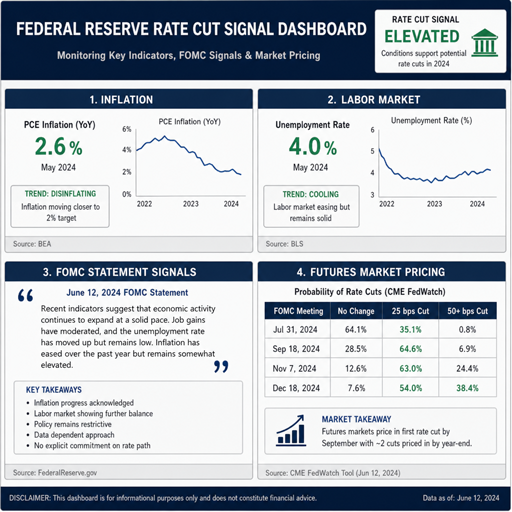
The Federal Reserve does not usually announce a future rate cut in plain language before it happens. Instead, markets read a mix of policy statements, inflation data, labor-market trends, speeches, projections, and futures pricing to judge whether a fed rate cut is becoming more or less likely. This guide explains how those signals work, why Federal Reserve Rate Cut Expectations can change quickly, and how to read federal reserve news without overreacting to every headline.
As of October 7, 2026, it is especially important to separate current expectations from older search terms such as “federal reserve rate cut expectations today november 2025.” In September 2026, the FOMC raised the target range for the federal funds rate to 3.75% to 4.00%, so a November 2025 rate-cut narrative should be treated as historical context, not today’s market setup.
What does a Fed rate cut signal really mean?
A Fed rate cut signal is any official communication, economic trend, or market price that suggests the Federal Reserve may lower its target range for the federal funds rate at a future meeting. The Fed’s main policy lever is the target range for the federal funds rate, which influences short-term borrowing costs across the financial system.
A signal is not the same as a promise. The Federal Open Market Committee repeatedly emphasizes that policy depends on incoming information, the economic outlook, and risks to its goals of maximum employment and price stability. That means even strong rate-cut expectations can fade if inflation looks sticky, growth stays resilient, or financial conditions loosen too much.
The simplest way to think about a rate cut signal is this: the Fed cuts when it believes policy is tighter than the economy needs. That can happen because inflation is cooling, unemployment is rising, credit conditions are tightening, or policymakers want to reduce the risk of an unnecessary slowdown. But the Fed also worries that cutting too soon can reignite inflation expectations, so its language is often careful by design.
How should readers interpret Federal Reserve Rate Cut Expectations today?
Federal Reserve Rate Cut Expectations today should be read as probabilities, not predictions. Futures markets, economist forecasts, and media coverage can show where consensus is leaning, but they update constantly as new data and Fed communication arrive. CME’s FedWatch tool, for example, tracks probabilities implied by 30-Day Fed Funds futures and is updated around current market pricing.
That distinction matters because many articles use confident language around “the next fed rate cut” when the actual market is pricing a range of outcomes. A 70% probability of a cut is not a guarantee; it means the market currently assigns a higher likelihood to that outcome than to alternatives. A single inflation report, payrolls release, banking stress event, or surprisingly hawkish Fed speech can shift that probability.
A practical reading framework is to ask three questions whenever you see federal reserve news:
- Is the signal official or market-implied? An FOMC statement, projections release, or chair press conference carries different weight than a trader survey or strategist note.
- Is the signal about timing or direction? Markets may agree that rates will eventually fall while disagreeing about whether the first cut comes at the next meeting or much later.
- Is the signal supported by data? Rate-cut expectations are more durable when inflation, employment, and growth data all point in the same direction.
- Is the market already priced for it? If investors have already priced in a cut, the bigger reaction may come from the Fed pushing back.
This is why the phrase “federal reserve rate cut expectations today” can be misleading without a timestamp. “Today” changes every trading session. A snapshot from last week, last month, or November 2025 may be useful history, but it is not a current interest rate forecast.
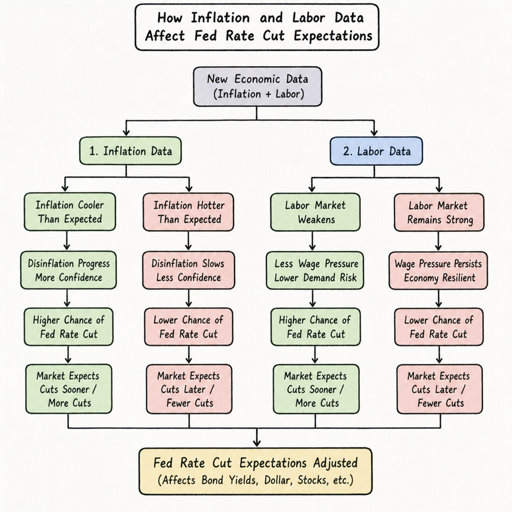
The main signals markets watch before a fed rate cut
Rate-cut expectations usually build through several layers rather than one dramatic announcement. The strongest signal appears when official communication, economic data, and market pricing all point in the same direction.
Inflation trends
Inflation is often the first filter. If inflation is moving toward the Fed’s longer-run 2% goal, policymakers have more room to consider easing. If inflation remains elevated, the Fed may hesitate even when growth slows, because easier policy can stimulate demand and make price pressures harder to control.
The most important point is direction plus confidence. One soft inflation report may encourage markets, but several months of improving data usually carry more weight. Investors also watch whether improvement is broad-based or concentrated in volatile categories.
Labor-market conditions
The Fed has a dual mandate: maximum employment and stable prices. A cooling labor market can increase the case for a rate cut, especially if unemployment rises, job gains slow, or wage pressure eases. But a modest slowdown is not always enough. Policymakers often want to know whether weakness is broadening or simply normalizing from an unusually strong period.
Labor data can create sharp market moves because it affects both sides of the mandate. Strong job growth may reduce near-term cut odds if it suggests the economy can handle higher rates. Weak job growth may lift cut odds, particularly when inflation is also cooling.
FOMC statements and press conferences
The FOMC statement is short, but every word matters. Markets compare the latest statement with the prior version to identify changes in how the Fed describes inflation, employment, growth, and the balance of risks. A shift from emphasizing inflation risk to noting downside employment risk can change the tone quickly.
The press conference adds nuance. The chair may clarify whether policymakers discussed a cut, whether a decision was close, or whether markets are assuming too much. Sometimes the statement sounds neutral while the press conference resets expectations.
The dot plot and Summary of Economic Projections
The Summary of Economic Projections, often called the SEP, shows policymakers’ individual projections for growth, unemployment, inflation, and the federal funds rate. The dot plot is not a promise, but it gives markets a map of how officials see the policy path under their baseline outlook. The Fed’s projections materials also stress uncertainty around those estimates, which is why dots should be read as conditional views rather than a schedule.
The median dot can influence the interest rate forecast because it helps markets judge whether the committee is leaning toward cuts, holds, or hikes. Still, dispersion matters. If the dots are widely spread, officials are divided and future data may have more power to shift the path.
Why November 2025 expectations are a useful case study?
Federal reserve rate cut expectations november 2025 are useful because they show how quickly market confidence can change. In late October 2025, the Fed lowered the target range by 25 basis points to 3.75% to 4.00%, but subsequent November reporting showed that officials supported additional cuts unevenly and were not necessarily committed to a December move.
That episode is a reminder that “the Fed cut last meeting” does not automatically mean “the Fed will cut next meeting.” After one move, policymakers may pause to see how financial conditions, inflation, and hiring respond. Markets may price a sequence of cuts, while officials may prefer optionality.
It also explains why the exact keyword “federal reserve rate cut expectations today november 2025” needs context. If someone searched that phrase in November 2025, they were likely looking for near-term odds around the next FOMC decision. If someone searches it now, they are looking at a historical period that can inform process, not the current policy outlook.
For analysts, the lesson is simple: rate-cut expectations are path-dependent. They reflect what the Fed just did, what it said, what data arrived afterward, and how markets think the committee will balance risks at the next meeting.
A practical checklist for reading federal reserve news
Not every Fed headline deserves the same attention. Some stories summarize old information, some highlight one policymaker’s view, and some reflect a genuine shift in the committee’s reaction function. Use this checklist before drawing conclusions:
- Check the date first. Fed expectations expire quickly. A November 2025 outlook and an October 2026 outlook may describe very different economies.
- Identify the source. Prioritize FOMC statements, minutes, speeches by voting members, SEP materials, and reputable data releases.
- Separate views from votes. A policymaker can discuss rate cuts without voting for one at the next meeting.
- Look for committee-wide language. The statement and minutes usually matter more than a single interview.
- Compare expectations with data. A rate-cut story is stronger when inflation is cooling and labor-market risk is rising.
- Watch financial conditions. If stocks rally, credit spreads tighten, and yields fall, the Fed may worry that markets are doing too much easing for it.
- Avoid single-number certainty. A probability is a live market estimate, not a forecast carved in stone.
This checklist is especially helpful during weeks with major data releases. Headlines often move faster than the underlying economic story. A disciplined process keeps you from treating every comment as a turning point.
How rate cut signals affect everyday financial decisions
Fed signals matter because they influence expectations across loans, savings products, bonds, stocks, and currencies. The federal funds rate is an overnight bank funding rate, but changes in expected policy can ripple through Treasury yields, mortgage rates, credit card rates, auto loans, and business financing. The connection is not always one-for-one, because longer-term rates also reflect inflation expectations, growth expectations, and risk premiums.
For borrowers, a potential fed rate cut can be encouraging, but waiting for lower rates is not always straightforward. Mortgage rates, for example, can move before the Fed acts if bond markets anticipate easier policy. Credit card rates may adjust more directly, but often remain high relative to other forms of credit.
For savers, rate-cut expectations can mean future yields on savings accounts, money market funds, and short-term certificates may decline. A saver who depends on interest income may want to think about maturity timing, liquidity needs, and reinvestment risk rather than simply chasing the highest current yield.
For investors, rate cuts can support valuations if they reduce discount rates and recession risk. But cuts driven by economic stress can send a very different message. The reason for the cut matters as much as the cut itself.
Common mistakes when tracking a fed rate cut
The first mistake is treating futures pricing as the Fed’s plan. Market-implied odds are valuable because they aggregate real-time positioning, but they can overshoot. If the Fed believes markets have priced too much easing, officials may use speeches or press conferences to push back.
The second mistake is focusing only on the next meeting. The bigger question is often the full policy path. One 25-basis-point cut may matter less than whether the Fed expects a long easing cycle, a short insurance cut, or an extended pause.
The third mistake is ignoring the difference between nominal and real rates. If inflation falls while the policy rate stays unchanged, real rates can become tighter. In that environment, the Fed may eventually cut even without an obvious crisis, simply to prevent policy from becoming too restrictive.
The fourth mistake is assuming rate cuts are always bullish. Easier policy can help markets, but if cuts arrive because unemployment is rising quickly or credit stress is spreading, risk assets may struggle. Context turns the same policy move into a different signal.
Turning signals into a clearer interest rate forecast
A good interest rate forecast does not start with a fixed conclusion. It starts with scenarios. The baseline might assume inflation gradually cools and growth slows modestly. A downside scenario might assume labor weakness accelerates. An upside inflation scenario might assume the Fed delays cuts or even signals tighter policy.
To make your forecast more useful, attach each scenario to observable triggers. For example, you might say rate-cut expectations should rise if inflation keeps moderating, unemployment trends higher, and Fed communications shift toward employment risk. Expectations should fall if inflation reaccelerates, financial conditions ease too much, or officials repeatedly argue that policy must stay restrictive.
This scenario-based approach is more realistic than asking whether the next fed rate cut is “coming” or “not coming.” The Fed reacts to conditions. Your forecast should, too.
The bottom line
Understanding Fed rate cut signals means reading probabilities, not chasing certainty. Official statements, SEP projections, labor data, inflation trends, and futures pricing all matter, but none of them should be read in isolation.
When you see phrases like Federal Reserve Rate Cut Expectations or federal reserve rate cut expectations today, ask when the information was published, what data supports it, and whether it reflects the Fed’s own communication or the market’s interpretation. November 2025 is a useful example of shifting expectations, but current decisions require current evidence. The best approach is steady, contextual, and humble: watch the data, read the Fed carefully, and leave room for the outlook to change.
