
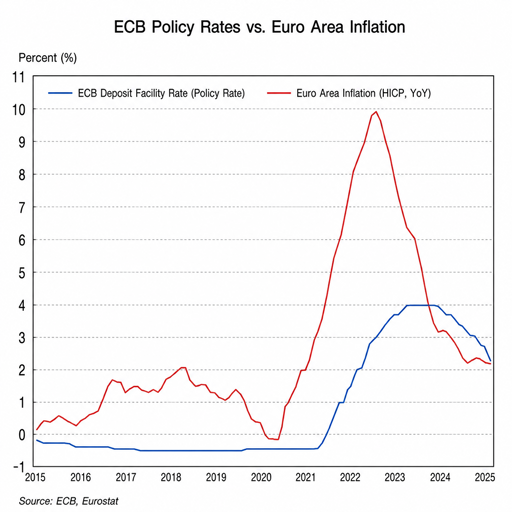
As of October 7, 2026, the European Central Bank’s current policy setting is restrictive again: the Governing Council raised all three key ECB interest rates by 25 basis points at its September 10 meeting, citing renewed inflation pressure and an inflation path still above its 2% medium-term target. The decision lifted the deposit facility to 2.50%, main refinancing operations to 2.65%, and the marginal lending facility to 2.90%, effective September 16, 2026.
This guide explains what that ECB Monetary Policy Stance means, why it changed, how eurozone interest rates affect households and businesses, and what to watch in the next round of central bank decisions.
What is the ECB trying to achieve?
The ECB’s primary job is to maintain price stability in the euro area, which it defines as 2% inflation over the medium term. Its target is symmetric, meaning inflation that is too high and inflation that is too low are both considered undesirable because each can distort spending, saving, investment, wage-setting, and debt decisions.
That “medium-term” phrase matters. The ECB does not try to offset every monthly price move with an immediate rate change. Instead, it looks at whether inflation is likely to return sustainably to target, whether expectations remain anchored, and whether monetary policy is feeding through to credit conditions, demand, and prices.
In practice, this gives the Governing Council room to look through temporary shocks, but not to ignore persistent ones. When price pressures broaden, energy costs jump, or wages and services inflation stay firm, the ECB may keep policy tight even if growth is soft. When inflation cools convincingly and the economy weakens, it may ease.
The current ECB Monetary Policy Stance
The ECB’s latest move was a 25-basis-point increase across its three main rates. The deposit facility rate, often the most closely watched benchmark for short-term money-market pricing, now stands at 2.50%. The main refinancing rate is 2.65%, while the marginal lending facility rate is 2.90%.
Those numbers signal a central bank that still sees inflation risk as too high. The ECB linked its September decision to inflation pressure generated by the Middle East conflict and said inflation was expected to remain above target for an extended period. Its September projections put headline inflation at 3.0% in 2026, 2.5% in 2027, and 2.1% in 2028, with core inflation excluding energy and food at 2.5%, 2.6%, and 2.3% respectively.
The key point for monetary policy analysis is that the ECB is not simply reacting to the last inflation number. It is reacting to the projected inflation path, the balance of risks, and the likelihood that higher prices become embedded through expectations, wages, contracts, and company pricing behavior.
Why did the ECB raise rates now?
The ECB raised rates because inflation pressures re-intensified while the economy proved more resilient than expected. Eurostat’s flash estimate put euro area annual inflation at 3.8% in September 2026, up from 3.2% in August, reinforcing the view that price pressure had not yet returned to a comfortable path toward 2%.
The ECB’s own ecb economic outlook also showed stronger growth than previously expected. September staff projections estimated euro area growth of 0.9% in 2026, 1.4% in 2027, and 1.5% in 2028, with the 2026 and 2027 outlook revised upward because the economy had been more resilient.
That combination is important. If inflation is high but demand is collapsing, a central bank may hesitate because tighter policy can deepen the downturn. If inflation is high and the economy is holding up, policymakers have more room to lean against prices. The September decision reflects that second situation: growth is not booming, but it appears strong enough for the ECB to prioritize inflation control.
How ECB rate changes move through the economy
ECB rate changes do not reduce inflation overnight. They work through financial conditions first, then spending and investment, and finally prices. The process is uneven, and it often affects sectors such as housing, construction, durable goods, and business investment earlier than everyday services.
The transmission chain usually looks like this:
- Policy rates change. The Governing Council adjusts the deposit, refinancing, and lending facility rates.
- Money-market rates respond. Banks and investors reprice short-term lending, cash returns, and funding costs.
- Bank credit conditions adjust. Mortgage rates, business loans, and consumer credit can become more expensive or harder to obtain.
- Demand cools or strengthens. Higher rates tend to reduce borrowing-sensitive spending; lower rates tend to support it.
- Inflation responds with a lag. Weaker demand can reduce companies’ pricing power, while expectations may become more anchored.
For households, the most visible effect is often the cost of variable-rate mortgages, new fixed-rate loans, personal credit, and savings returns. For businesses, tighter policy can mean higher financing costs, stricter lending standards, or delayed investment plans. For governments, higher rates can raise debt-servicing pressure over time as debt rolls over.
The ECB’s toolkit beyond headline rates
Interest rates are the main instrument, but they are not the entire toolkit. The ECB also manages liquidity, balance sheet policies, and operational frameworks that influence how policy reaches the banking system and financial markets.
Two balance sheet points matter in the current stance. The ECB says the asset purchase programme and pandemic emergency purchase programme portfolios are declining at a measured and predictable pace because the Eurosystem is no longer reinvesting principal payments from maturing securities.
That balance sheet runoff is not the same as a rate hike, but it can still contribute to tighter monetary conditions. When the central bank holds fewer bonds over time, private investors absorb more duration and market pricing can adjust. The effect is usually more gradual than a policy-rate decision, which is why the ECB emphasizes predictability.
Reading monetary policy trends without overreacting
Monetary policy trends are best read as a sequence, not a single headline. A 25-basis-point increase tells you what the ECB did; the statement, projections, and data-dependence language tell you how policymakers are thinking.
A useful reading framework includes:
- Inflation outlook: Is the projected path moving back to 2%, or drifting above it?
- Underlying inflation: Are services, wages, and core measures easing, or staying sticky?
- Growth resilience: Is tighter policy weakening activity enough to reduce price pressure?
- Transmission strength: Are borrowing costs and credit conditions changing in the real economy?
- Risk balance: Are shocks mainly inflationary, recessionary, or both?
- Communication: Is the ECB guiding markets, or emphasizing meeting-by-meeting flexibility?
The September communication was explicit on this last point: the Governing Council said it would follow a data-dependent, meeting-by-meeting approach and would not pre-commit to a particular rate path.
That makes incoming data especially important. Markets may still price expected future moves, but those expectations can change quickly when inflation, wage, growth, or geopolitical data shift.
What does this mean for consumers, savers, and borrowers?
For consumers, the current ECB stance generally means borrowing remains more expensive than in an easy-money environment, while savings products may offer better returns than during periods of very low rates. The effect varies by country because mortgage structures, bank competition, tax systems, and household debt levels differ across the euro area.
Borrowers should focus less on predicting the exact next ECB meeting and more on resilience. If a household or company can only manage its debt under one narrow rate scenario, it is exposed. Fixed versus variable borrowing decisions should be assessed against income stability, cash buffers, refinancing timelines, and the possibility that rates stay elevated longer than expected.
Savers face a different trade-off. Higher deposit returns can help, but inflation can still erode purchasing power if nominal interest earned is below price growth. That makes real returns, liquidity needs, and risk tolerance more important than the headline rate on a single account.
What businesses should monitor
Businesses should treat ecb rate changes as both a financing signal and a demand signal. Higher rates can increase the cost of capital, but they can also tell management that central bankers expect inflation and demand conditions to remain firm enough to warrant restraint.
A practical business checklist includes:
- Review refinancing dates for loans, leases, and credit facilities.
- Stress-test interest expense against rates staying high or rising modestly further.
- Separate input-cost inflation from demand strength before raising prices.
- Watch customer payment behavior for early signs of strain.
- Reassess capital expenditure using realistic financing assumptions.
- Monitor exchange-rate exposure if imports, exports, or dollar-priced commodities matter.
The best response is not automatically to cut investment. It is to distinguish productive investment from speculative expansion, protect liquidity, and avoid assuming that the next policy move will quickly reverse current conditions.
Signals to watch before the next ECB decision
The next central bank decisions will depend on whether the data confirm or challenge the September policy logic. The ECB will be watching inflation, growth, wages, credit, financial markets, and geopolitical risk together rather than relying on one indicator.
Investors and businesses should pay particular attention to:
- monthly HICP inflation and its energy, food, goods, and services components;
- wage settlements and labor-market tightness;
- bank lending volumes and credit standards;
- oil, gas, and electricity prices;
- survey indicators for consumer and business confidence;
- revisions to ECB staff projections;
- language changes in the monetary policy statement.
If inflation remains well above target and growth holds up, the ECB may keep policy restrictive. If inflation falls faster than projected and credit conditions tighten sharply, the case for pausing or easing would become stronger. The important point is that the reaction function is conditional, not mechanical.
Key takeaways
The current ECB Monetary Policy Stance is shaped by above-target inflation, resilient growth, and a renewed need to keep expectations anchored. September’s 25-basis-point rate increase pushed key eurozone interest rates higher and showed that the Governing Council remains focused on returning inflation to 2% over the medium term.
For readers following monetary policy analysis, the main lesson is to look beyond the rate announcement. The inflation forecast, growth outlook, balance sheet path, and data-dependent language all matter. In the current environment, the ECB is signaling vigilance: it is prepared to adjust policy as needed, but it is not offering a fixed road map for where rates go next.
