
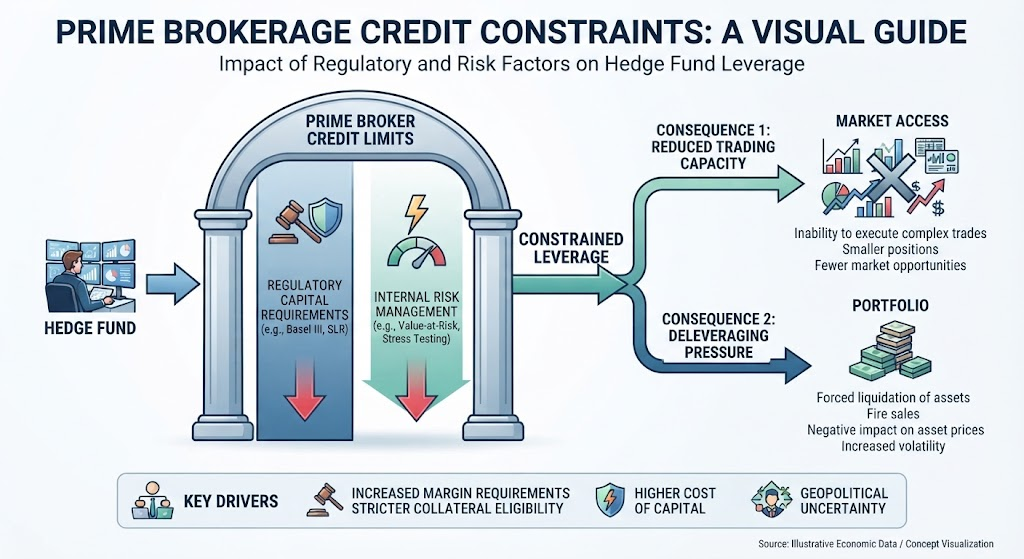
Prime brokerage credit constraints are moving back into focus as hedge funds keep leverage elevated while banks become more selective about balance-sheet use, margin terms, and client profitability. The latest public dealer survey data does not show a broad shutdown in credit availability, but it does point to a market where access to capital depends more heavily on strategy, collateral quality, relationship depth, and risk management discipline.
What is changing for funds?
For many institutional investors, the change is not a simple “credit crunch.” It is a more segmented financing market: favored, scalable, well-collateralized strategies can still obtain institutional financing, while smaller funds and non-equity strategies face tougher conversations around margin requirements, haircuts, tenor, and available leverage. The Federal Reserve’s September 2026 Senior Credit Officer Opinion Survey found that hedge fund price terms were mostly unchanged over the prior three months, with one respondent reporting somewhat tighter terms, one reporting somewhat easier terms, and 15 of 17 reporting no material change. Nonprice terms showed a similar pattern, with one respondent reporting some tightening and 16 reporting no change.
The practical takeaway is that prime brokerage credit constraints are becoming more about allocation than absence. Banks are not necessarily pulling back across the board; they are deciding which balances, trades, and clients deserve scarce balance sheet. That matters because capital access is often the difference between holding a position through volatility and cutting risk at the worst possible time.
Dealer data shows stability, but leverage remains high
The September survey also showed that additional unused financial leverage available to hedge funds under existing agreements was unchanged across all 17 responding dealers. At the same time, hedge funds were still pushing for better terms: 23.5% of respondents said negotiation efforts for more favorable price and nonprice terms had increased somewhat over the prior three months.
That combination helps explain the current tone of the market. Credit availability has not collapsed, but funds are more sensitive to incremental changes in financing cost and collateral treatment. A stable credit line can still feel restrictive if gross exposure is high, volatility rises, collateral values move, or a prime broker raises internal return hurdles.
The longer-run leverage picture remains important. In the same September 2026 survey, a majority of responding dealers described hedge fund leverage as above the midpoint of its 10-year range: 6.7% said it was near the highest level, 6.7% said it was considerably above the midpoint, and 53.3% said it was somewhat above the midpoint. Equity-oriented hedge fund leverage looked even more elevated, with 61.5% of respondents describing it as somewhat above the midpoint and 15.4% placing it near the highest level or considerably above the midpoint.
Strong prime brokerage revenues mask uneven access
The pressure on funds comes even as prime brokerage has been a major earnings engine for large banks. Reuters reported in July 2026 that Goldman Sachs posted a record quarter for its prime business, with equity financing revenue up 91% from a year earlier, while JPMorgan’s markets revenue rose sharply, led by the equity markets unit that includes prime brokerage.
Those figures can make the sector look broadly flush with financing. Yet record revenue does not mean every fund receives more balance sheet. For banks, higher client activity can increase revenue while also sharpening the need to ration capital among the most attractive clients and transactions. For hedge funds, the result is a competitive financing environment in which pricing, margin transparency, collateral efficiency, and operational quality carry greater weight.
A July 2026 report from Acuiti and TS Imagine, summarized by Traders Magazine, found that prime brokers have become more selective since Basel III implementation and that the effect has been most acute for smaller funds and strategies outside equities. The report said 55% of firms had experienced multiple leverage reductions or tighter margin requirements over the previous five years, while 57% had switched or considered switching prime brokers because of financing costs or leverage terms.
Why credit constraints are persisting
The drivers are structural as much as cyclical. Prime brokers must manage counterparty risk, capital rules, liquidity exposure, operational complexity, and concentration across clients that may hold correlated positions. When hedge funds use short-term financing to support large gross books, even a modest increase in haircuts or a change in eligible collateral can force rapid deleveraging.
Regulators are also watching leverage outside the banking system more closely. The Financial Stability Board’s 2025 final report on leverage in nonbank financial intermediation recommended stronger risk identification, monitoring, counterparty credit risk management, and cross-border cooperation. It specifically urged authorities to ensure implementation of Basel Committee guidance for bank leverage providers and to review disclosure practices between leveraged nonbanks and their financing providers.
In the United States, reporting rules remain part of the policy debate. In April 2026, the SEC and CFTC proposed amendments to Form PF, the confidential reporting form used by certain registered private fund advisers, including advisers that are also registered with the CFTC as commodity pool operators or commodity trading advisors. The proposal is framed as a burden-reduction measure, but the broader reporting framework continues to shape how regulators monitor private fund leverage, counterparty exposure, and financing risk.
Margin pressure changes portfolio behavior
Margin requirements are not just back-office details. They influence position sizing, trade selection, liquidity buffers, and expected returns. A strategy that looks attractive before financing may become less compelling after higher haircuts, shorter maturities, or less favorable collateral treatment.
The Office of Financial Research’s Hedge Fund Monitor explains the mechanism clearly: leveraged hedge funds depend on creditors’ willingness and ability to keep lending, while declines in collateral and asset values can trigger margin calls that force funds to use liquid assets and may weaken short-term funding resilience. That is why elevated leverage combined with short-term funding draws closer inspection.
The Treasury basis trade remains a useful example. Reuters reported in September 2026 that hedge funds had become less enthusiastic about the trade as returns narrowed, Treasury dynamics shifted, and earlier concerns about margin calls and forced selling remained part of the market discussion. The article noted that hedge funds still held significant positions, even as net short positions in two-year Treasury futures had fallen from earlier highs.
The winners are likely to be operationally prepared funds
Funds with robust risk management are better positioned in this environment because prime brokers increasingly value transparency, predictability, and clean collateral workflows. That does not guarantee easier credit, but it can improve a fund’s ability to negotiate margin methodology, demonstrate liquidity readiness, and diversify financing relationships before stress arrives.
Key areas now drawing attention include:
- Margin model transparency: Funds want clearer explanations of how haircuts, concentration limits, and stress scenarios feed into financing terms.
- Collateral mobility: Managers need to know which assets can be pledged, moved, substituted, or monetized quickly without disrupting the portfolio.
- Counterparty diversification: Reliance on one prime broker can create capital access risk if that broker changes appetite, tightens limits, or reprices exposure.
- Liquidity forecasting: Funds are modeling larger and faster collateral calls, especially for strategies with basis, credit, rates, or derivatives exposure.
- Return on balance sheet: Prime brokers are favoring relationships that combine financing demand with broader trading, clearing, derivatives, and operational revenue.
These priorities are likely to shape manager behavior into year-end. Funds that can show discipline around leverage, scenario analysis, and collateral governance may have more room to negotiate. Funds that cannot may find that credit constraints appear suddenly, even when market-wide financing conditions look stable.
What happens next
The next phase will depend on volatility, bank capital capacity, and regulators’ tolerance for leverage in core markets. U.S. agencies have already modified enhanced supplementary leverage ratio standards for the largest banking organizations, with the OCC noting that an overly binding leverage ratio can discourage low-risk activity such as Treasury market intermediation.
That could support dealer balance-sheet capacity in some markets, but it does not remove the need for careful client-level risk controls. Prime brokers still have to decide where credit availability produces acceptable returns after capital, liquidity, operational, and counterparty costs.
For hedge funds, the message is clear: capital access is becoming a strategic capability, not merely a financing line item. In a market where broad credit terms appear stable but leverage remains high, the funds best prepared for tighter margin requirements may be the ones least disrupted if conditions change.
