
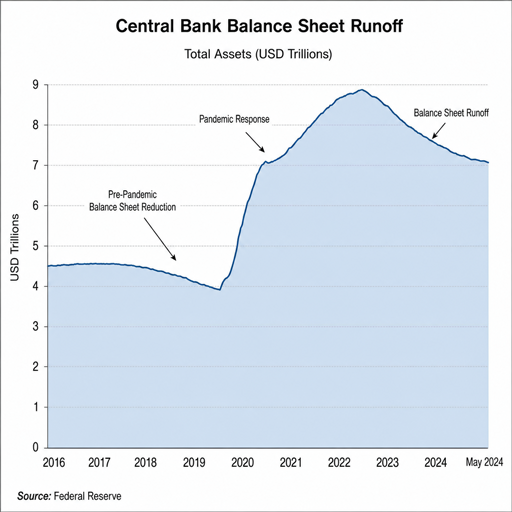
Quantitative tightening is one of the quieter but powerful ways a central bank can influence financial conditions after periods of large-scale asset purchases. A QT wind-down is the process of slowing, pausing, or ending that balance sheet reduction so the financial system has a more stable supply of reserves and liquidity. For investors, businesses, and borrowers, the key question is not only when QT stops, but how the shift affects interest rates, market liquidity, and confidence across the economy.
What is a quantitative tightening wind-down?
A quantitative tightening wind-down is the gradual reduction or conclusion of a central bank’s QT program. During quantitative tightening, the central bank allows bonds and other assets on its balance sheet to mature without fully replacing them, which removes reserves from the banking system over time. A wind-down slows that process, often by lowering the monthly runoff pace, increasing reinvestments, or eventually holding the balance sheet broadly steady.
QT is often described as the reverse of quantitative easing, but the effects are not always symmetrical. Quantitative easing injects liquidity during periods of stress or weak demand; quantitative tightening removes some of that support once policymakers believe the economy can function with less accommodation. The wind-down phase matters because withdrawing liquidity too quickly can create strain, while ending too early may leave monetary policy more stimulative than intended.
In practical terms, a QT wind-down is a transition from “actively reducing support” to “maintaining a more neutral balance sheet position.” It does not automatically mean interest rates will fall, credit will become easy, or markets will rally. It simply means one channel of monetary restraint is being reduced.
The mechanics behind QT and balance sheet runoff
Central banks typically hold government bonds, mortgage-backed securities, or other high-quality assets acquired through earlier asset purchase programs. When these securities mature, the issuer repays principal. Under QT, the central bank may choose not to reinvest all of that principal, shrinking its asset holdings and reducing reserves in the financial system.
A wind-down changes the pace of that shrinkage. Policymakers may decide that the banking system is approaching a level of reserves that is “ample” but no longer excessive. Because that level is difficult to observe in real time, central banks usually prefer a gradual approach. Moving slowly gives markets time to adjust and gives policymakers room to respond if liquidity conditions deteriorate.
A QT wind-down can take several forms:
- Lower runoff caps: The central bank reduces the maximum amount of securities allowed to mature without reinvestment each month.
- Partial reinvestment: Some maturing securities are replaced, slowing the decline in asset holdings.
- Full reinvestment: The balance sheet is kept roughly stable, ending active QT.
- Portfolio adjustment: The central bank may shift the composition of holdings over time, such as favoring shorter-term or government securities.
- Operational support: Standing lending facilities, repo operations, or reserve management tools may be used to prevent temporary funding pressure.
These choices shape the flow of reserves, but they also influence expectations. Markets pay close attention because balance sheet policy affects the background supply of liquidity even when headline policy rates stay unchanged.
Why does the wind-down matter for markets?
The wind-down matters because market liquidity depends not only on investor demand, but also on the amount of cash and reserves circulating through the financial system. When reserves become scarcer, short-term funding markets can become more sensitive, bid-ask spreads may widen, and investors may demand more compensation for holding riskier assets. A controlled QT wind-down is designed to reduce the chance that liquidity pressure turns into broader financial instability.
This is especially important because QT works in the background. Interest rate decisions are visible and widely discussed, while balance sheet changes can feel technical. Yet both are part of monetary policy. If QT continues while interest rates are already restrictive, the combined effect may tighten financial conditions more than intended.
For bond markets, a slower runoff can reduce one source of upward pressure on yields. For equity markets, improved liquidity conditions may support risk appetite, although earnings, valuations, and economic growth still matter. For banks, a wind-down may help stabilize reserve levels and funding costs, particularly if deposit flows are uneven.
The market reaction depends on context. If a wind-down is seen as prudent reserve management, it may calm investors. If it is interpreted as a response to hidden stress, it may raise new concerns. Communication from the central bank is therefore almost as important as the technical adjustment itself.
QT, interest rates, and monetary policy are connected
Quantitative tightening and interest rates are separate tools, but they influence the same financial environment. Policy rates affect the price of short-term money directly. QT affects the quantity and distribution of reserves, which can influence liquidity, term premiums, and funding conditions.
A central bank may wind down QT while keeping policy rates steady if it wants to separate liquidity management from inflation control. This distinction is important. Ending or slowing QT is not always a sign of easier monetary policy in the traditional sense. Policymakers may still want restrictive interest rates while also ensuring the financial plumbing has enough liquidity to function smoothly.
Think of it as two levers:
- The interest rate lever influences borrowing costs, savings incentives, currency values, and demand.
- The balance sheet lever influences reserves, market liquidity, and the availability of cash-like assets in the system.
When inflation is the main concern, central banks may rely more heavily on interest rates. When financial stability risks rise, they may adjust the balance sheet approach without necessarily abandoning their inflation objective. This balance is delicate because a policy mix that is too tight can contribute to economic contraction, while a policy mix that is too loose can reignite inflation pressure.
Signs policymakers may be preparing to slow QT
Central banks rarely change course without watching a range of signals. They look for evidence that reserves are moving from abundant to merely adequate, and they monitor whether funding markets are behaving normally. A QT wind-down often becomes more likely when liquidity indicators show increased sensitivity or when policymakers want to avoid abrupt market disruption.
Useful signals include:
- Short-term funding pressure: Money market rates moving unexpectedly above policy targets can suggest reserves are becoming scarcer.
- Bank reserve trends: A faster-than-expected decline in reserves may prompt a slower runoff pace.
- Repo market stress: Rising demand for secured overnight funding can indicate liquidity is unevenly distributed.
- Treasury or government bond market functioning: Poor auction demand, wider spreads, or reduced dealer capacity can attract policy attention.
- Credit conditions: Tighter lending standards and weaker loan growth may show that monetary restraint is feeding into the real economy.
- Economic data softness: Slowing employment, weaker output, or falling investment can raise concern about excessive tightening.
None of these signals alone guarantees a policy shift. Central banks typically look for patterns rather than isolated market moves. The goal is to avoid overreacting to normal volatility while still preventing preventable stress.
Financial stability is the main reason to move carefully
Financial stability is about keeping markets, banks, and payment systems functioning even when economic conditions are difficult. QT can support long-term policy normalization, but it also reduces the cushion of reserves available to absorb shocks. A wind-down helps manage that trade-off by slowing the drain before scarcity becomes disruptive.
Liquidity problems can spread quickly because financial institutions are interconnected. If one part of the market struggles to obtain funding, participants may sell assets, reduce lending, or hoard cash. That behavior can tighten conditions further, creating a feedback loop that affects businesses and households.
A careful wind-down does not remove all risk. It does, however, give policymakers more control over the pace of adjustment. It also reassures markets that the central bank is watching the operational side of monetary policy, not just inflation and growth headlines.
Potential effects on businesses, borrowers, and investors
A QT wind-down can influence everyday financial decisions, even if the process begins inside central bank balance sheets. Businesses may notice changes through credit availability, bond yields, bank lending conditions, or investor appetite for new issuance. Borrowers may not see immediate relief, but a less aggressive liquidity drain can reduce some background pressure on financing markets.
For investors, the implications are more nuanced. Slower QT can support market liquidity, but it does not erase valuation risk or guarantee lower yields. Asset prices still depend on earnings, inflation expectations, fiscal policy, and global capital flows. The best response is to understand the direction of policy rather than assume a single outcome.
A practical checklist for interpreting a QT wind-down includes:
- Separate liquidity from rate policy. Slower QT may stabilize markets while interest rates remain restrictive.
- Watch the central bank’s language. Phrases about ample reserves, market functioning, or operational readiness can be meaningful.
- Track credit conditions. If banks remain cautious, the real-economy impact may stay tight even after QT slows.
- Look beyond the first market reaction. Initial rallies or selloffs can reverse once investors digest the policy mix.
- Consider recession risk. If the wind-down is driven by economic contraction fears, the signal may be defensive rather than bullish.
What happens after QT ends?
After QT ends, the central bank generally moves into a balance sheet maintenance phase. That means it may reinvest maturing securities to keep asset holdings stable or allow only small adjustments consistent with long-term reserve demand. The system may still operate with a smaller balance sheet than during periods of emergency support, but the active drain of reserves has stopped.
The next phase depends on economic conditions. If inflation remains elevated, policymakers may keep interest rates high even after ending QT. If growth weakens sharply, they may eventually consider rate cuts or other support tools. If markets are stable and the economy is expanding, the central bank may simply maintain its balance sheet and let rate policy carry most of the workload.
The most important takeaway is that a QT wind-down is not a single switch from tight to easy policy. It is a recalibration. The central bank is trying to preserve control over inflation while reducing the risk that liquidity scarcity creates unnecessary financial stress.
Key takeaways for understanding the QT wind-down
A quantitative tightening wind-down is best understood as a shift in the pace of monetary restraint. It slows the reduction of reserves, supports smoother market functioning, and helps protect financial stability when liquidity becomes more sensitive. It may influence interest rates and investor sentiment, but it does not automatically change the broader policy stance.
For readers following monetary policy, the most useful approach is to focus on the full picture: policy rates, balance sheet runoff, market liquidity, credit conditions, and economic momentum. QT is technical, but its effects can be practical. When the wind-down begins, the message is usually clear: the central bank still wants discipline, but it also wants the financial system to keep working without unnecessary strain.
