
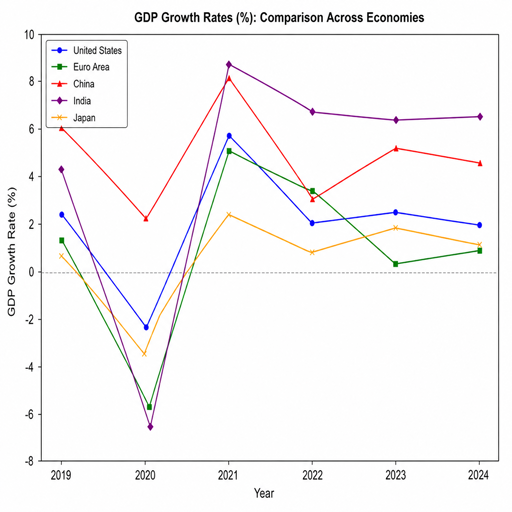
Gross Domestic Product, or GDP, is one of the most widely used ways to understand the size and direction of an economy. But the real insight often comes from comparing how quickly different economies, regions, or sectors are growing. GDP growth differentials help turn raw economic movement into a clearer story about momentum, opportunity, risk, and long-term competitiveness.
For investors, analysts, business leaders, policymakers, and curious readers, understanding these differentials is more useful than looking at one growth figure in isolation. A country growing steadily may look strong until it is compared with peers growing faster, or it may look weak until the broader global context shows everyone is slowing.
What are GDP growth differentials?
GDP growth differentials are the gaps between the GDP growth rates of two or more economies, regions, industries, or time periods. Instead of asking only whether an economy is growing, this analysis asks how its growth compares with another benchmark. That benchmark might be a neighboring country, a global average, a previous year, an industry peer group, or a long-term trend.
For example, if one economy expands while another slows, the difference between their growth rates can reveal changing competitive conditions. A small gap may suggest similar economic momentum, while a widening gap may point to stronger investment, better productivity, different policy choices, demographic advantages, or exposure to faster-growing sectors.
This is why gdp growth differentials matter in practical decision-making. They help explain relative performance, not just absolute performance. In economics, relative movement can be just as important as the direction of movement itself.
GDP growth rates tell a relative story
GDP growth rates show how much an economy’s output changes over a given period, usually expressed as a percentage. On their own, they provide a snapshot of expansion or contraction. In comparison, they become a tool for understanding whether that performance is strong, weak, stable, or unusual.
A 2% growth rate might appear modest in a fast-growing emerging market context but healthy in a mature economy with slower population growth. Likewise, a 5% growth rate may seem impressive until inflation, low starting levels, or post-recession recovery effects are considered. Good growth rate analysis always asks what is being compared, over what period, and under what conditions.
The most useful comparisons often include:
- Year-over-year performance: How current output compares with the same period in the previous year.
- Quarter-over-quarter movement: How short-term momentum is changing.
- Peer economy comparisons: How one country or region is performing against similar markets.
- Historical averages: Whether current growth is above, below, or close to normal.
- Sector-level contributions: Which parts of the economy are driving or limiting growth.
This broader view prevents overreaction to one data point. It also helps identify whether growth is broad-based and durable or concentrated in a narrow part of the economy.
Why do GDP growth differentials matter?
GDP growth differentials matter because they reveal shifts in economic strength that single-country figures can hide. When one economy grows faster than another for an extended period, the gap can influence investment flows, currency expectations, trade relationships, labor markets, and business expansion decisions. The differential becomes a signal of where demand may be building and where pressure may be rising.
For businesses, a gdp comparison can help prioritize markets. A company planning international expansion may not simply choose the largest economy; it may look for economies where demand is growing faster than competitors expect. Faster GDP growth can indicate rising household income, expanding infrastructure, stronger business confidence, or increasing public investment, though each of these requires deeper review.
For investors, growth differentials can shape asset allocation. Stronger relative growth may support corporate earnings, credit demand, or market sentiment. However, fast growth can also come with overheating risks, policy tightening, or external vulnerabilities. The goal is not to assume that faster growth is always better, but to understand what is driving the difference.
For policymakers, these gaps can highlight structural strengths and weaknesses. If a region consistently lags behind comparable areas, the issue may involve workforce development, productivity, infrastructure, regulation, investment levels, or industry mix. GDP growth differentials do not provide the full diagnosis, but they point to where the deeper questions should begin.
The main drivers behind growth gaps
GDP growth differentials rarely come from one cause. They usually reflect a combination of structural, cyclical, and policy-related factors. Understanding those drivers helps make the comparison more meaningful.
Productivity and innovation
Productivity measures how efficiently labor, capital, and technology are used to produce goods and services. Economies that improve productivity can grow without simply adding more workers or using more resources. Innovation, digital adoption, better logistics, skilled labor, and efficient management can all support higher output over time.
When productivity growth differs across economies, GDP growth rates can diverge even if population trends or investment levels look similar. This makes productivity one of the most important long-term explanations for persistent growth differentials.
Demographics and labor force trends
Population growth, age structure, migration, and labor force participation all influence economic potential. A growing working-age population can support higher output if jobs, skills, and investment keep pace. In contrast, aging populations may face slower labor force growth and greater pressure on public budgets.
Demographics do not determine destiny, but they shape the baseline. Economies with weaker demographic trends may still grow strongly through productivity gains, automation, or higher participation, but the path is often more demanding.
Investment and capital formation
Public and private investment can widen or narrow growth differentials. Infrastructure, factories, housing, energy systems, telecommunications, and research capacity all affect how much an economy can produce. When investment is sustained and well allocated, it can raise future growth potential.
However, investment quality matters as much as quantity. Spending that creates useful capacity can support long-term growth, while poorly targeted investment may add debt without improving productivity.
Trade, commodities, and external demand
Some economies are highly exposed to global demand, commodity prices, tourism, manufacturing supply chains, or financial flows. When external conditions are favorable, growth may accelerate quickly. When demand weakens or prices shift, the same exposure can become a drag.
This is why a gdp comparison should account for the structure of each economy. A commodity exporter, a service-based economy, and a manufacturing hub may react very differently to the same global environment.
A practical framework for growth rate analysis
Growth rate analysis becomes more reliable when it follows a consistent process. Rather than comparing headline numbers casually, use a structured approach that keeps context visible.
- Define the comparison clearly. Decide whether you are comparing countries, regions, sectors, or time periods. A vague comparison can lead to vague conclusions.
- Use the same measurement basis. Make sure the figures are comparable, such as real GDP growth versus nominal GDP growth, annual versus quarterly data, or seasonally adjusted versus unadjusted figures.
- Check the starting point. Economies recovering from a downturn may show temporarily high growth from a low base. This can exaggerate perceived strength.
- Separate short-term noise from long-term trend. One strong quarter may not change the underlying path. Multi-period comparisons are usually more useful.
- Look at the drivers. Identify whether growth is supported by consumption, investment, exports, government spending, or inventory changes.
- Consider sustainability. Ask whether the growth pattern depends on temporary stimulus, debt expansion, commodity gains, or one-off events.
- Compare with peer groups. A growth number becomes more meaningful when placed beside similar economies or regions.
This checklist helps avoid a common mistake: treating GDP growth as a scoreboard rather than a diagnostic tool. The number matters, but the explanation behind it matters more.
GDP comparison across economies and regions
A useful GDP comparison does not always mean comparing the largest economies in the world. Often, the better comparison is between economies with similar income levels, geographic conditions, trade exposure, or development stages. Comparing a mature, high-income economy with a rapidly industrializing one may be interesting, but it can be misleading if the structural differences are ignored.
Regional comparisons can be especially helpful. Within a single country, different states, provinces, or cities may grow at different speeds because of industry concentration, migration, housing availability, infrastructure, education levels, or local policy. These internal gdp growth differentials can influence where businesses hire, where households move, and where governments focus development efforts.
Sector comparisons add another layer. An economy may grow slowly overall while technology, healthcare, energy, or professional services expand rapidly. Alternatively, headline GDP may look strong because of one booming sector while other parts of the economy remain weak. Looking beneath the aggregate figure helps separate broad economic health from narrow momentum.
Common mistakes when interpreting GDP growth differentials
GDP data is valuable, but it is easy to overread it. A careful analyst treats the figures as a starting point, not a final answer.
Common mistakes include:
- Ignoring inflation: Nominal growth can look strong even when real purchasing power is not improving.
- Overlooking population growth: Total GDP may rise while GDP per person grows slowly or declines.
- Comparing unlike economies: Different development stages, resource bases, and institutions can make direct comparisons less meaningful.
- Focusing only on speed: Faster growth may come with financial instability, environmental pressure, or unsustainable borrowing.
- Missing revisions: GDP estimates can change as better data becomes available.
- Assuming growth benefits everyone equally: National growth can coexist with regional inequality or uneven income gains.
These cautions do not make GDP useless. They make interpretation more responsible. The best analysis uses GDP alongside employment, wages, productivity, inflation, investment, trade, fiscal data, and quality-of-life indicators.
Turning GDP insights into better decisions
The practical value of GDP growth differentials lies in the decisions they support. A business may use them to screen expansion markets, estimate demand conditions, or understand regional momentum. An investor may use them to compare macroeconomic backdrops. A policymaker may use them to identify where support, reform, or infrastructure planning is needed.
The key is to connect the differential to a real question. If one region is growing faster, ask whether that growth is broad-based, profitable, inclusive, and sustainable. If another is lagging, ask whether the cause is temporary weakness or a deeper structural issue. Numbers become useful when they lead to better questions and better judgment.
Key takeaways
GDP growth differentials are a practical way to understand relative economic momentum. They show how growth in one economy, region, sector, or period compares with another, making headline GDP data more useful and more actionable.
The strongest analysis looks beyond the gap itself. It examines GDP growth rates, the quality of growth, the economic structure behind the numbers, and the conditions that may affect future performance. Whether used for market research, investment thinking, public policy, or general economic understanding, growth rate analysis works best when it combines comparison with context.
In the end, GDP is not just about how large an economy is. It is about how that economy is changing, what is driving the change, and how its path compares with the world around it.
