
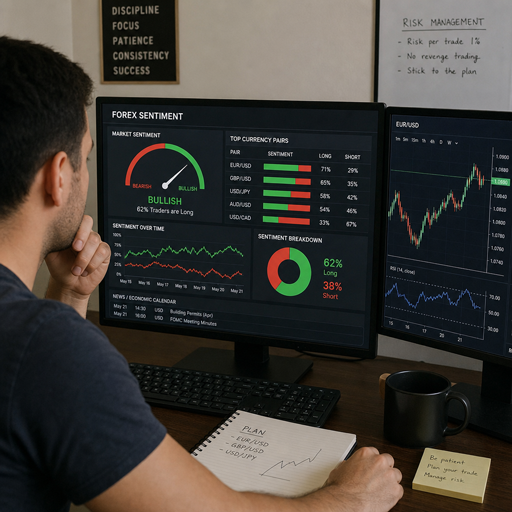
Forex market sentiment indicators help traders understand how market participants are positioned, what they may be feeling, and where crowd behavior could influence price movement. Used alongside technical and fundamental analysis, they can add context to a currency pair’s trend, reversal risk, or breakout potential. They do not predict the future on their own, but they can help you avoid trading in a vacuum.
What do Forex market sentiment indicators actually show?
Forex market sentiment indicators show the market’s bias toward a currency pair by measuring positioning, volatility, price behavior, or trader opinion. In simple terms, they help answer whether traders are broadly bullish, bearish, cautious, overconfident, or uncertain. That matters because currency prices are not moved by charts alone; they are moved by decisions, expectations, fear, greed, and reactions to new information.
Sentiment is especially useful in forex because the market is decentralized. There is no single exchange where every open position is visible. Instead, traders use different market sentiment tools to build a practical picture from available data, such as broker positioning, futures market reports, volatility measures, news flow, and price momentum.
A strong sentiment reading does not automatically mean you should follow the crowd. Sometimes it confirms a trend. Other times it warns that a move may be overcrowded and vulnerable to a reversal. The skill is not simply finding sentiment data, but learning how to interpret it in context.
Why sentiment matters in forex trading
Currency pairs often move before the full economic story becomes obvious. Traders price in expectations about interest rates, inflation, growth, risk appetite, and central bank policy. Forex sentiment analysis helps you understand how much of that expectation may already be reflected in the market.
For example, if most traders are already heavily bullish on a currency pair, there may be fewer new buyers left to push the price higher. That does not mean the pair must fall, but it does suggest caution. A bullish trend can continue for longer than expected, yet extreme optimism can make the market more sensitive to disappointing news.
Sentiment can also help during uncertain conditions. When price action is choppy and technical signals are mixed, forex trader sentiment may reveal whether retail traders are leaning strongly one way or whether the market is waiting for a clearer catalyst. This can help you decide whether to reduce position size, wait for confirmation, or avoid a low-quality setup.
The main types of trading sentiment indicators
There is no single perfect sentiment gauge. Most traders combine several trading sentiment indicators to get a more balanced view. Each one captures a different part of market psychology.
Retail positioning data
Retail positioning shows how individual traders are positioned through a broker or trading platform. It may show the percentage of traders who are long or short a particular pair. If 75% of retail traders are long EUR/USD, for instance, that suggests a strong bullish retail bias.
Many traders use retail sentiment as a contrarian signal, especially when positioning becomes extreme. This is because retail traders often try to call tops and bottoms too early, hold losing trades too long, or trade against strong trends. However, retail sentiment should not be used mechanically. A crowded long position is more meaningful when it appears near resistance, after an extended rally, or during weakening momentum.
Futures positioning reports
Institutional positioning can be tracked through futures market data, especially for major currencies. These reports can show whether large speculators, commercial participants, or leveraged funds are increasing long or short exposure. While this data may not cover the entire spot forex market, it can still provide insight into broader market positioning.
The main drawback is timing. Futures positioning reports are usually delayed, so they are better for medium-term context than short-term trade entries. They are most useful when identifying major shifts in positioning over time, not when trying to scalp a five-minute chart.
Volatility and risk indicators
Volatility-based forex market indicators can also reflect sentiment. When traders are calm, volatility may contract. When fear rises, volatility often expands quickly. In forex, this can appear during central bank announcements, geopolitical shocks, inflation surprises, or sudden changes in risk appetite.
Risk-sensitive currencies can also act as sentiment clues. For example, some currencies tend to strengthen when global investors seek safety, while others may perform better when markets are comfortable taking risk. These relationships change over time, but they can still provide useful background for interpreting currency moves.
News and economic expectation tools
News sentiment is harder to quantify, but it matters. A currency may rise not because the current data is excellent, but because the data is better than expected. Likewise, a currency may fall after seemingly positive news if traders had already priced in an even stronger outcome.
Economic calendars, analyst expectations, central bank commentary, and financial headlines all contribute to sentiment. The key is to focus on surprise and reaction, not just the headline number. If price fails to rally on good news, that can be a sentiment warning.
How can traders use sentiment without following the crowd?
Traders can use sentiment effectively by treating it as context rather than a standalone signal. The goal is not to copy what most traders are doing, but to understand whether the crowd’s positioning supports your trade, conflicts with it, or warns that the move may be stretched.
A practical approach is to compare sentiment with trend, support and resistance, and upcoming catalysts. If sentiment is mildly bullish and price is breaking above a key level with strong momentum, sentiment may support continuation. If sentiment is extremely bullish but price is failing to make new highs, the setup may carry higher reversal risk.
Use this simple checklist before acting on sentiment:
- Is sentiment extreme or only slightly biased? Mild readings are often less meaningful than heavily one-sided positioning.
- Does the sentiment match the trend? Trend-following conditions and contrarian conditions require different decisions.
- Where is price on the chart? Sentiment near major support or resistance can be more useful than sentiment in the middle of a range.
- Is there a major event ahead? Central bank decisions, inflation data, and employment reports can quickly reset positioning.
- Are multiple tools confirming the same idea? A single indicator can mislead; agreement across several tools is stronger.
- What would prove the trade wrong? Sentiment does not replace risk management or invalidation levels.
This process keeps sentiment grounded. It also helps prevent a common mistake: seeing a dramatic sentiment reading and entering a trade without a plan.
Popular market sentiment tools for forex traders
Different traders prefer different tools depending on their strategy, platform, and time horizon. Short-term traders may focus on broker positioning and volatility. Swing traders may care more about futures positioning, macro expectations, and trend structure.
Common market sentiment tools include:
- Broker sentiment dashboards These show how clients of a specific broker are positioned. They are easy to read and useful for retail bias, but they represent only that broker’s client base.
- Commitment of Traders-style positioning data This can help identify how larger market participants are positioned in currency futures. It is better for broader context than quick entries.
- Volatility indicators Tools such as average true range, implied volatility references, and volatility bands can show whether the market is calm, unstable, or expanding into a new phase.
- Economic calendars and central bank trackers These help traders understand upcoming events that may shift expectations. Sentiment often changes sharply when policy language or economic data surprises the market.
- Technical momentum tools Momentum indicators are not pure sentiment tools, but they can reveal whether buyers or sellers are acting with conviction.
- News sentiment and headline monitoring Fast-moving news can change the emotional tone of the market. This is particularly relevant during crises, elections, major policy announcements, or unexpected economic releases.
No tool is complete by itself. A broker dashboard may show retail traders are heavily short, but the trend may be losing strength. A volatility spike may suggest fear, but it may also occur during a healthy breakout. Combining tools helps you avoid overreacting to one piece of information.
Using forex market sentiment indicators on MT4
Many traders look for forex market sentiment indicators MT4 because MetaTrader 4 remains a familiar platform for charting and execution. MT4 can support custom indicators, scripts, and dashboard-style tools that display sentiment-related information, depending on the data source and broker setup.
However, it is important to understand what an MT4 sentiment indicator is actually measuring. Some tools may display broker client positioning. Others may visualize volatility, trend strength, or correlation. Some may rely on external data feeds. Before using any indicator, check where the data comes from, how often it updates, and whether it fits your trading timeframe.
A useful MT4 workflow might look like this:
- Start with the higher-timeframe trend on the currency pair.
- Mark obvious support, resistance, and recent swing highs or lows.
- Check sentiment readings to see whether positioning is balanced or extreme.
- Review upcoming news events that could affect the pair.
- Use your entry method only if the broader context supports the trade.
- Define stop loss, target, and position size before entering.
This keeps the platform from becoming cluttered with signals. The best forex market sentiment indicators are the ones you understand well enough to use consistently.
Common mistakes when reading forex trader sentiment
Sentiment can be powerful, but it is easy to misuse. The biggest mistake is assuming that the crowd is always wrong. In strong trends, the majority may be positioned correctly for a long time. Fighting that trend too early can be expensive.
Another mistake is ignoring timeframe. A sentiment reading may be useful for a multi-day view but nearly irrelevant for a very short-term trade. If your trade is based on a 15-minute setup, weekly positioning data may provide background, but it should not dominate your entry decision.
Traders also get into trouble when they use sentiment without risk controls. Even an excellent reading can fail. Markets can stay crowded, emotional, or irrational longer than expected. Position sizing, stop placement, and patience still matter.
Finally, avoid adding too many indicators that all say similar things. More tools do not always mean better analysis. If several indicators are simply different versions of momentum, they may create false confidence rather than real confirmation.
A balanced way to include sentiment in your trading plan
Sentiment works best as one layer of a complete trading process. Start with market structure, then add sentiment, then consider news and risk. This order helps you avoid chasing opinions while still respecting the psychology behind price movement.
A balanced trading plan might define how you use sentiment in advance. For example, you might decide not to buy a currency pair when retail long positioning is extremely high and price is stalling near resistance. Or you might use extreme retail bearishness as supporting evidence for a long trade only when price breaks above a key technical level.
The point is consistency. When sentiment rules are vague, they become easy to bend after the fact. When they are written into your process, they can help you make calmer decisions.
Key takeaway
Forex market sentiment indicators can give traders a valuable window into positioning, emotion, and crowd behavior. They are most useful when combined with technical levels, macro context, volatility, and disciplined risk management. Instead of treating sentiment as a magic signal, use it as a practical filter that helps you understand when a trade has support, when it is crowded, and when patience may be the better decision.
