
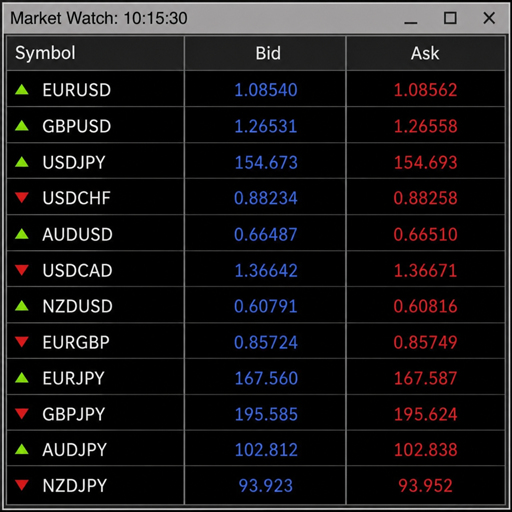
Liquidity in forex is the ease with which a currency pair can be bought or sold without causing a meaningful change in its price. For traders, major currency pairs liquidity affects spreads, execution speed, slippage, stop placement, and whether a strategy works in real market conditions. This guide explains how liquidity forms, why the majors usually trade more smoothly than crosses or exotics, and how to read forex market depth with practical discipline.
What does liquidity in forex actually mean?
Liquidity in forex means there are enough willing buyers and sellers at or near the current price for trades to be executed efficiently. A liquid pair usually has tight bid-ask spreads, frequent price updates, deep order availability, and enough participation from banks, funds, market makers, brokers, corporations, and other traders to absorb normal order flow.
Liquidity is not the same as direction. A pair can be highly liquid and still move sharply when new information hits the market. The difference is that, in a liquid market, there is typically more two-way interest and more capacity for orders to be matched; in a thin market, even a moderate order or sudden news shock can move price more aggressively.
In practical terms, liquidity answers three questions:
- Can you enter or exit near the price you see? Liquid pairs tend to reduce the gap between quoted and executed price.
- How much does trading cost? Better liquidity often means tighter spreads, though commissions, broker markup, and market conditions still matter.
- How stable is the order book? Stronger forex market depth can help absorb routine buying and selling, but depth can disappear during stress.
Why major pairs usually have deeper liquidity
Major currency pairs are generally more liquid because they involve the world’s most widely used currencies, especially the US dollar. The Bank for International Settlements reported that OTC FX turnover averaged $9.6 trillion per day in April 2025, and the US dollar was on one side of 89.2% of all FX trades, underscoring why dollar-based majors dominate global trading activity.
That dominance matters because the dollar is used as a funding currency, reserve currency, trade-invoicing currency, and vehicle currency. Many non-dollar exchanges are still routed through the dollar in practice, which concentrates liquidity around pairs such as EUR/USD, USD/JPY, GBP/USD, USD/CHF, AUD/USD, USD/CAD, and NZD/USD.
Major pairs also benefit from overlapping participation. A single pair can attract central banks, commercial banks, hedge funds, asset managers, multinational companies, high-frequency market makers, and retail traders. The more varied the participants, the more continuous the flow of bids and offers tends to be.
The main drivers of major currency pairs liquidity
Currency trading volume
Currency trading volume is one of the clearest signs of liquidity, but it needs context. Forex is a decentralized over-the-counter market, so there is no single exchange volume figure like there is for a listed stock. Instead, analysts often rely on institutional surveys, broker-level volume, futures data, liquidity provider feeds, and observed spread behavior.
The BIS 2025 survey shows that spot FX accounted for $3 trillion per day, or 31% of global FX turnover, while FX swaps remained the largest instrument at $4 trillion per day, or 42% of turnover. For spot traders, that distinction matters because “forex volume” includes more than simple spot buying and selling; hedging, funding, and swap activity also shape overall liquidity conditions.
Session overlap
Liquidity changes throughout the trading day. The London session is especially important because London is a major FX hub, and the London-New York overlap often brings heavy institutional activity. Liquidity can also rise during the Tokyo session for yen pairs, during local market hours for commodity-linked currencies, and around major economic releases.
A pair may be liquid overall but less efficient at certain times. EUR/USD may trade tightly during active European and US hours, while spreads can widen late in the New York afternoon or around the daily rollover. For strategies that depend on precise entries, time of day is not a minor detail; it is part of execution quality.
News and macro events
Liquidity can increase or fracture around scheduled announcements. Before a central bank decision, inflation release, employment report, or geopolitical shock, participants may pull quotes or widen spreads to manage risk. Once the news is public, trading volume may surge, but the first reaction can be fast and uneven.
This is why traders should not assume that a major pair is always easy to trade. Major pairs usually have the best liquidity, but “best” does not mean “unlimited.” In fast markets, slippage can occur even in EUR/USD or USD/JPY.
Market structure and dealer behavior
Forex liquidity is supplied by a network of dealers, electronic communication networks, liquidity providers, prime brokers, and market makers. These participants stream prices, hedge exposures, internalize flow, and adjust spreads based on risk. When volatility rises, they may quote smaller sizes or widen spreads, reducing usable depth even if headline turnover is high.
The BIS noted that inter-dealer trading represented 46% of global FX turnover in April 2025, while trading with other financial institutions represented 50%. This helps explain why institutional flows, not only retail demand, are central to how liquidity of major currency pairs forex markets behaves.
The Reserve Bank of Australia’s summary of the 2025 BIS results noted that AUD/USD remained the sixth most traded currency pair globally and accounted for around 5% of all FX transactions, illustrating how even a smaller major can still represent substantial global activity.
How do spreads, slippage, and market depth connect?
Spreads, slippage, and market depth are different ways of seeing the same liquidity problem: how much it costs to trade now. The spread is the visible difference between the bid and ask, market depth is the available size at nearby prices, and slippage is the difference between the expected execution price and the actual fill.
A tight spread does not always mean deep liquidity. A broker may show a narrow quote for a small trade, but larger orders may consume several price levels. That is why institutional traders focus heavily on depth, execution algorithms, and market impact, while retail traders should still watch how their platform performs during volatile periods.
Consider a simple example. If EUR/USD shows a very tight spread during the London-New York overlap, a small market order may fill close to the displayed price. If the same order is placed seconds after a surprise inflation release, the displayed price may change before execution, and the fill may be worse than expected. The pair did not stop being a major; the usable liquidity changed.
Reading forex market depth without overtrusting it
Forex market depth shows available bids and offers at different price levels, often through a depth-of-market tool, order book, or liquidity ladder. It can help traders understand where visible liquidity sits, how quickly levels refresh, and whether the market is balanced or one-sided.
However, depth is only a snapshot. In OTC forex, no platform shows the entire global market. Your view depends on your broker, venue, liquidity providers, account type, and technology. Visible depth can also change rapidly because orders are added, canceled, internalized, or routed elsewhere.
Use market depth as a decision aid, not a promise. It can help confirm whether conditions look orderly, but it should not replace risk controls or a tested trading plan.
A practical reading checklist:
- Check the spread first. A widening spread often signals thinner immediate liquidity.
- Look at size near the top of book. More available size near the current bid and ask may support smoother execution.
- Watch refresh behavior. Healthy liquidity often replenishes after trades; fragile liquidity may vanish.
- Compare normal and event conditions. Depth before payrolls, CPI, or central bank decisions may not reflect post-release conditions.
- Review actual fills. Your execution history is often more useful than theoretical depth.
The best times to trade liquid major pairs
Major pairs are usually most liquid when their related financial centers are active. For EUR/USD and GBP/USD, European hours and the London-New York overlap often matter most. For USD/JPY, Tokyo participation and US rate-sensitive flows both play important roles. For AUD/USD and NZD/USD, Asia-Pacific hours can be more relevant than they are for European pairs.
That said, “most liquid” does not always mean “best.” Some strategies need volatility, while others need calm execution. A breakout trader may welcome the activity around a major data release; a range trader may prefer periods when spreads are tight and price movement is steadier.
A useful approach is to map liquidity against your strategy:
- Scalping: prioritize tight spreads, fast execution, and active sessions.
- Day trading: focus on session overlaps and scheduled news windows.
- Swing trading: care less about second-by-second depth, but still avoid poor entries during illiquid rollover periods.
- Hedging: consider not only spot liquidity but also forward points, swap costs, and execution size.
Common mistakes when judging liquidity
Many traders treat major pair liquidity as a constant. It is better to think of it as a condition that expands and contracts. The pair name matters, but so do the hour, event calendar, broker model, order size, and volatility regime.
Avoid these mistakes:
- Assuming tight spreads guarantee good fills. Execution can still slip when prices move quickly.
- Ignoring rollover. Spreads may widen around the daily rollover, even in major pairs.
- Using market orders during major news without a plan. The deepest pairs can still move abruptly.
- Comparing brokers only by advertised spreads. Commission, slippage, rejection rates, and fill quality also affect total cost.
- Trading larger size without testing depth. A size that works in calm markets may behave differently in stressed conditions.
Building a liquidity-aware trading routine
A simple routine can help turn liquidity from an abstract concept into a practical filter. Before placing a trade, check the session, spread, event calendar, and recent execution behavior. If any of those conditions look abnormal, reduce size, wait, use limit orders, or skip the trade.
For active traders, keeping a basic execution journal is valuable. Record the pair, time, spread, order type, expected price, actual fill, and market condition. Over time, this reveals which pairs and sessions deliver the cleanest execution for your strategy.
For longer-term traders, liquidity still matters because entry and exit quality can affect risk-reward. A swing trade in a major pair may not require watching every tick, but entering during a thin period or immediately before a major policy announcement can create unnecessary slippage.
Key takeaways
Major currency pairs usually offer the strongest liquidity in forex because they concentrate global currency trading volume, institutional participation, and constant two-way demand. The US dollar remains central to this structure, and most of the highest-turnover pairs include it.
Still, liquidity is dynamic. It changes by session, news event, volatility level, broker venue, and order size. The best traders do not simply ask whether a pair is “liquid”; they ask whether liquidity is suitable for the trade they are about to place.
Use major pairs as a starting point, not a shortcut. Combine awareness of forex market depth, spread behavior, slippage, and timing so your execution supports your strategy instead of quietly working against it.
