
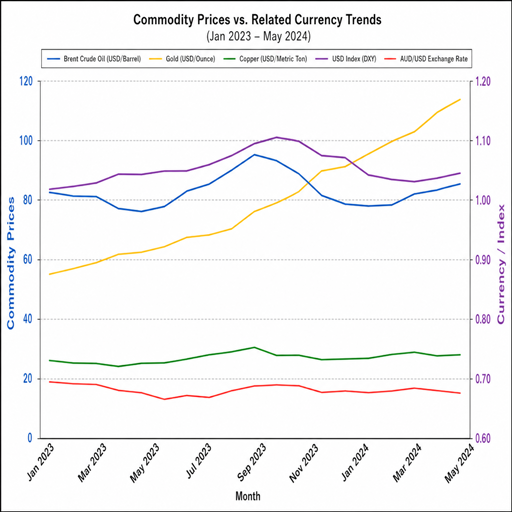
Commodity-linked currencies are national currencies that tend to move with the price cycles of major exported raw materials such as oil, metals, agricultural goods, or energy products. Their performance matters because commodity markets can influence inflation, trade balances, central bank policy, and investor appetite for risk. For traders and investors, understanding these relationships can make currency trading more informed, especially when building forex strategies around macro trends rather than short-term noise.
What are commodity-linked currencies?
Commodity-linked currencies, often called commodity currencies, are currencies from economies where raw materials make up a meaningful share of exports, government revenue, business investment, or national income. When key commodity prices rise, these economies may receive stronger export income, improved trade balances, and greater foreign demand for their currency. When commodity prices fall, the same currencies can weaken if markets expect slower growth, lower revenue, or softer investment.
Common examples often discussed by traders include the Australian dollar, Canadian dollar, and New Zealand dollar. The Australian dollar is frequently associated with metals and bulk commodities, the Canadian dollar with energy and oil, and the New Zealand dollar with agricultural exports. These relationships are not automatic or perfect, but they are useful starting points for analyzing performance.
The main forces behind performance
The performance of commodity-linked currencies is shaped by more than the price of one raw material. A currency may react to commodity demand, but it also responds to interest rates, inflation, employment data, government policy, and global risk sentiment. This is why successful analysis combines commodity market awareness with broader economic indicators.
A rise in oil prices, for example, may support an energy-exporting country’s currency if investors believe higher prices will improve export revenue. But if higher oil prices also increase inflation pressure, reduce consumer spending, or trigger policy uncertainty, the currency reaction may be mixed. In currency trading, the market often moves on expectations before official data confirms the trend.
Key drivers include:
- Export prices: Higher prices for major exports can improve national income and trade conditions.
- Terms of trade: A country benefits when the prices of its exports rise relative to its imports.
- Interest rate expectations: If stronger commodity income leads to inflation pressure, traders may anticipate tighter monetary policy.
- Global growth: Commodity demand often rises when manufacturing, construction, and transport activity are strong.
- Risk appetite: Commodity currencies may weaken when investors move away from growth-sensitive assets.
- Political and supply shocks: Strikes, sanctions, weather events, and production disruptions can affect both commodities and currencies.
Why do commodity markets affect currency trading?
Commodity markets affect currency trading because export revenue, capital flows, and investor expectations can all shift when raw material prices move. If global buyers need more of a country’s resources, demand for that country’s currency may increase through trade and investment channels. At the same time, traders may buy or sell the currency based on what they expect commodity prices to mean for future growth.
This connection is especially important for macro-focused forex strategies. Rather than looking only at chart patterns, traders study how oil, copper, iron ore, dairy, gold, or agricultural prices interact with exchange rates. The aim is not to predict every tick, but to understand whether the currency is being supported by real economic momentum or merely reacting to short-term speculation.
However, commodity investments and currency positions are not identical. Buying a commodity-linked currency does not give direct exposure to a commodity price. It adds additional layers, including central bank policy, domestic economic data, liquidity, and geopolitical risk. That difference can create opportunities, but it can also create unexpected divergence.
Important economic indicators to watch
Economic indicators help traders judge whether commodity price moves are translating into stronger or weaker currency performance. A commodity rally may look positive at first, but the currency impact depends on whether it improves the wider economy.
Useful indicators include:
- Trade balance data A strengthening export position can support a commodity currency, especially when higher prices are matched by stable or rising shipment volumes.
- Inflation readings Commodity price increases can lift input costs and consumer prices. If inflation rises too quickly, central bank expectations may change.
- Central bank statements Policy guidance often matters more than past data. Traders watch whether officials view commodity-driven inflation or growth as temporary or persistent.
- Employment and wage data Strong labor markets may confirm that commodity strength is supporting domestic activity beyond the export sector.
- Purchasing managers’ indexes Manufacturing and services surveys can show whether demand is improving or weakening before official growth numbers arrive.
- China and global demand data For many resource exporters, demand from large industrial economies can influence commodity prices and currency sentiment.
Performance patterns traders commonly analyze
Commodity-linked currencies often show recognizable patterns, but these patterns should be treated as tendencies rather than fixed rules. The market’s reaction depends on whether commodity moves are expected, surprising, temporary, or part of a broader cycle.
Positive commodity cycle
During a strong commodity cycle, exporters may benefit from higher revenues and stronger capital inflows. Their currencies can appreciate if investors expect improved growth, better fiscal conditions, or tighter monetary policy. This environment may favor trend-following forex strategies, but traders still need to watch for crowded positioning and sudden reversals.
Commodity price shock
A sudden price spike can create a fast currency move, especially in energy or agricultural markets. Yet shocks may be hard to trade because liquidity, headlines, and policy responses can change quickly. A move that initially supports an exporter’s currency may reverse if markets fear demand destruction or financial stress.
Global slowdown
When global growth expectations weaken, commodity-linked currencies can come under pressure. Even if some commodity prices remain firm, investors may reduce exposure to growth-sensitive currencies. In these periods, safe-haven flows and interest rate expectations may dominate commodity fundamentals.
How can traders use commodity-linked currencies in forex strategies?
Traders can use commodity-linked currencies by combining commodity trend analysis, macroeconomic indicators, and disciplined risk management. The goal is to build a reasoned view of whether a currency’s performance is aligned with underlying economic conditions. A practical strategy should define what confirms the trade, what invalidates it, and how much risk is acceptable.
A basic framework might look like this:
- Identify the relevant commodity link. Match the currency to the commodity exposure that matters most for that economy.
- Check the broader macro backdrop. Review inflation, rates, employment, trade data, and growth expectations.
- Compare currency movement with commodity movement. If the currency is not responding as expected, investigate why.
- Watch central bank language. Monetary policy can overpower commodity signals.
- Use technical levels for timing. Fundamentals may shape direction, while charts can help with entry and exit planning.
- Control position size. Commodity currencies can move sharply during news events and risk-off markets.
Common mistakes to avoid
One common mistake is assuming that a commodity currency must rise whenever its associated commodity rises. In reality, currencies reflect many variables at once. If interest rate expectations, political risk, or global sentiment move in the opposite direction, the currency may ignore or even move against the commodity signal.
Another mistake is treating commodity investments and forex positions as interchangeable. A trader holding a commodity futures position faces different risks from someone trading a currency pair. Contract structure, leverage, funding costs, and policy exposure can all change the outcome.
Traders should also avoid relying on a single indicator. A strong export price may look bullish, but weak domestic demand or cautious central bank commentary can reduce the currency impact. The best analysis looks for confirmation across multiple signals.
A practical checklist for analysis
Before trading commodity-linked currencies, review the following:
- Which commodities matter most to the economy?
- Are prices rising because of strong demand or limited supply?
- Is the country’s trade balance improving or worsening?
- What is the central bank likely to do next?
- Are global investors seeking risk or avoiding it?
- Is the currency already pricing in the commodity move?
- Where are the key technical support and resistance levels?
- What event could quickly invalidate the trade idea?
Bringing the pieces together
Commodity-linked currencies offer a useful way to connect forex markets with real economic activity. Their performance can reflect changing demand for energy, metals, food, and raw materials, but it also depends on interest rates, growth expectations, and investor sentiment. For anyone involved in currency trading, the most effective approach is not to follow commodity prices blindly, but to interpret them within a broader macro framework.
Used carefully, commodity currencies can strengthen forex strategies by adding context and improving trade selection. The key is to stay flexible, compare signals, and respect risk. Commodity markets can create powerful trends, but currencies respond to the whole economy, not just one price on a screen.
