
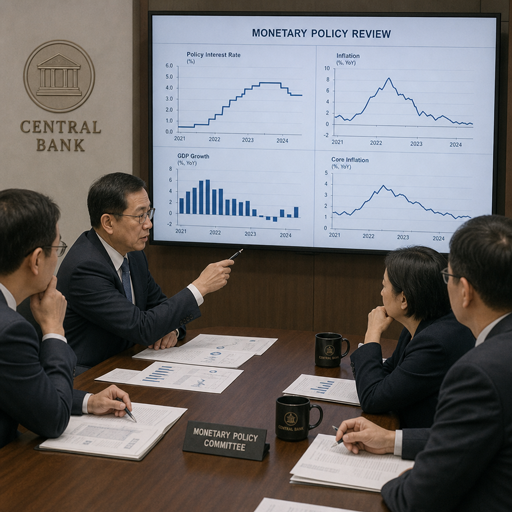
A fresh debate over a central bank dovish pivot is building, but the latest policy signals point to a cautious turn rather than a broad rush into interest rate cuts. As of October 7, 2026, major central banks are balancing weaker growth risks against inflation that remains above target in several economies. The result is a complicated monetary policy shift: more patience, fewer automatic hikes, and only limited room for central bank easing.
What changed in central bank policy signals?
The main change is not that a dovish central bank bloc has suddenly emerged; it is that policymakers are becoming more explicit about moving meeting by meeting as inflation, energy prices, labor data, and financial conditions evolve. In the United States, the Federal Reserve raised the target range for the federal funds rate by 25 basis points to 3.75%–4.00% on September 16, citing elevated inflation and resilient economic activity. Yet subsequent commentary reported by Reuters suggested some Fed officials favored taking more time before another increase, reducing market expectations for an October hike.
That distinction matters. A dovish stance does not always mean immediate interest rate cuts. It can mean a central bank is less willing to tighten further, more sensitive to downside growth risks, or prepared to ease later if inflation data cooperate. For households, businesses, and investors, the practical message is that the path of borrowing costs is becoming more data-dependent, not necessarily cheaper overnight.
The pivot is cautious, uneven, and conditional
The clearest theme across recent announcements is caution. The Federal Reserve’s September projections showed a median federal funds rate path of 4.1% for both 2026 and 2027, easing only gradually to 3.9% in 2028 and 3.6% in 2029. Those projections also placed median PCE inflation at 3.7% for 2026 before moving closer to 2% in later years, underscoring why policymakers may hesitate to declare victory on price stability.
In the euro area, the European Central Bank took an even more visibly hawkish step on September 10, raising its three key interest rates by 25 basis points. The ECB said the Middle East conflict continued to generate inflation pressures and projected headline inflation of 3.0% in 2026, 2.5% in 2027, and 2.1% in 2028. That makes the phrase “central bank dovish pivot” harder to apply globally without qualification.
The Bank of England has also resisted a simple easing narrative. In June, its Monetary Policy Committee voted 7–2 to hold Bank Rate at 3.75%, with two members preferring a 25-basis-point increase to 4.00%. The minutes pointed to falling but still uncertain energy prices, a loosening labor market, and the risk that higher energy costs could feed into wages and prices.
Together, these signals show a pivot in tone more than a synchronized pivot in action. Policymakers are acknowledging that higher rates are weighing on borrowers and growth, but they are also warning that renewed inflation pressure could keep policy restrictive for longer. That is why the current debate is best described as a conditional monetary policy shift rather than a confirmed global easing cycle.
At a glance: what the latest signals mean
- Central bank easing remains possible, but not automatic. Rate cuts are more likely if inflation continues moving toward target and labor markets weaken, but recent statements show policymakers still see upside inflation risks.
- A dovish stance can start with a pause. When officials say they need more data before tightening again, markets may treat that as dovish even if policy rates remain high.
- Energy prices remain a key swing factor. The ECB and Bank of England both linked recent decisions to the inflation effects of the Middle East conflict and energy volatility.
- Borrowers may not feel relief immediately. Mortgage, credit, and business loan rates typically respond with delays and may stay elevated if bond yields or inflation expectations remain firm.
- Investors are watching guidance as closely as decisions. Reuters reported that comments from Fed officials reduced expectations for an October hike, showing how communication itself can move rate expectations.
Why markets are reading a dovish turn into cautious language
Financial markets often react before central banks actually cut rates. If policymakers shift from “more hikes may be needed” to “we can wait for more data,” traders may price lower odds of near-term tightening. That is why a central bank dovish pivot can appear first in bond yields, currency moves, equity valuations, and futures markets rather than in the official policy rate.
The Reuters report on October 1 captured that dynamic in the Fed context. It said remarks from senior Fed policymakers helped push investors away from expectations of an October increase, even while markets still saw a possible December move. This is not full-scale economic stimulus; it is a recalibration of the expected path for monetary policy.
For risk assets, that difference is important. A pause can support sentiment by reducing the fear of immediate tightening. But if inflation remains high, the same pause can be fragile, because one strong inflation reading or renewed energy shock can quickly revive expectations for higher rates. In other words, markets may trade the possibility of central bank easing before central banks are ready to deliver it.
Inflation remains the obstacle to interest rate cuts
The strongest argument against rapid interest rate cuts is still inflation. The Fed said in September that inflation remained elevated and that its rate increase was intended to support a timelier return to the 2% goal. The ECB also said inflation was likely to remain above its 2% target for an extended period, while the Bank of England warned that second-round effects in wages and prices become more concerning the longer higher energy prices persist.
That creates a difficult trade-off. If central banks keep policy too tight for too long, they risk amplifying a slowdown in hiring, investment, and consumer spending. If they ease too soon, they risk reigniting inflation expectations and undermining credibility built during the previous tightening cycle.
This is why the current dovish stance is measured. Policymakers are not ignoring growth risks; they are asking whether those risks are large enough to outweigh still-high inflation. Until the answer becomes clearer, the most likely posture from many major central banks is patience rather than aggressive economic stimulus.
Policy snapshot across major central banks
|
Central bank |
Latest referenced policy signal |
Why it matters |
|---|---|---|
|
Federal Reserve |
Raised the federal funds target range to 3.75%–4.00% on September 16, 2026. |
The move pushed back against a simple rate-cut narrative, even as later official commentary reportedly encouraged markets to wait for more data. |
|
European Central Bank |
Raised key rates by 25 basis points on September 10, 2026. |
The ECB’s decision shows inflation concerns can still outweigh growth worries in the euro area. |
|
Bank of England |
Held Bank Rate at 3.75% in June, with a 7–2 vote and two members seeking an increase. |
The split highlights how policymakers are balancing softer labor conditions against inflation and energy risks. |
|
Global policy backdrop |
CFR’s tracker follows 54 countries and classifies policy as tightening or easing based on recent or expected rate moves. |
The global picture is mixed, making it risky to describe the current phase as one uniform easing cycle. |
The table shows why the phrase “central bank dovish pivot” needs context. The direction of travel may be less hawkish than earlier in the inflation cycle, but recent decisions still include hikes and holds. A true easing phase would require a broader set of central banks to move from restrictive policy into confirmed rate reductions.
What this means for businesses and consumers
For businesses, the immediate implication is planning uncertainty. Financing costs may stop rising as quickly if policymakers pause, but companies should not assume cheaper credit will arrive on a fixed schedule. Capital spending decisions may need to account for a longer period of elevated rates, especially in sectors sensitive to debt costs or consumer demand.
For consumers, the picture is similar. A dovish central bank message can eventually translate into lower mortgage and loan rates, but the pass-through depends on market rates, lender pricing, credit risk, and the timing of actual policy moves. Savers may also see deposit returns remain higher for longer if central banks delay cuts.
For investors, the main challenge is separating tone from action. A softer statement can lift rate-sensitive assets in the short term, but durable market moves usually require confirmation from inflation data, employment trends, and central bank decisions. The current environment rewards attention to the entire policy path rather than any single headline.
What happens next
The next phase will depend on whether inflation cools without a sharp hit to growth. If price pressures ease and labor markets weaken, the case for central bank easing and eventual interest rate cuts will strengthen. If energy costs rise again or core inflation remains sticky, policymakers may keep rates restrictive or even consider further increases.
The most important signals to watch are inflation expectations, wage growth, unemployment, lending conditions, and central bank language around risk balance. When officials begin emphasizing downside risks as much as inflation risks, the dovish stance will look more durable. Until then, the global monetary policy shift remains tentative.
For now, the story is not a clean return to easy money. It is a cautious pivot away from automatic tightening, with central banks keeping their options open. That may be enough to change market pricing, but it is not yet the same as broad economic stimulus or a synchronized wave of interest rate cuts.
