
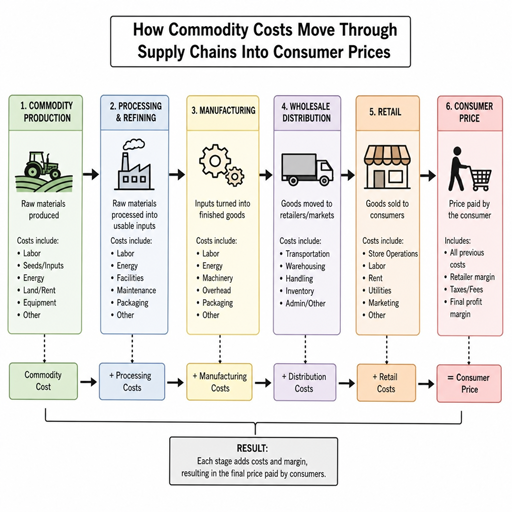
Commodity price inflation describes the rise in prices for raw materials such as energy, metals, grains, and other inputs that move through supply chains. When these costs climb, the effects rarely stay confined to commodity markets; they can influence production budgets, consumer prices, margins, wages, and investment decisions. Understanding the link between a commodity price index and inflation helps businesses, investors, and policy watchers separate temporary volatility from pressures that may become harder to absorb.
What drives commodity price inflation?
Commodity price inflation is usually driven by a mix of supply constraints, demand shifts, currency movements, logistics costs, and expectations about future scarcity. A drought can affect agricultural output, geopolitical tension can disrupt energy supply, and a construction boom can lift demand for metals. Because commodities are globally traded, local price pressures can also reflect conditions far outside a company’s home market.
Unlike many finished goods, commodities often react quickly to new information. Weather forecasts, shipping disruptions, inventory reports, and policy announcements can change market pricing before the physical shortage or surplus is fully visible. That makes commodity price trends especially important for businesses that buy raw inputs, manage long production cycles, or operate with thin margins.
A practical way to think about the drivers is to group them into four categories:
- Physical supply: production levels, harvest yields, mining output, energy capacity, and transportation bottlenecks.
- End-user demand: consumption from manufacturers, utilities, food producers, construction firms, and households.
- Financial conditions: interest rates, exchange rates, credit availability, and speculative positioning.
- Policy and regulation: tariffs, export controls, subsidies, sanctions, environmental rules, and strategic reserves.
No single factor explains every move. The challenge is identifying which driver is dominant and whether it is likely to fade, intensify, or spread into other costs.
How do commodity prices transmit into broader inflation?
Commodity prices transmit into broader inflation when higher input costs are passed from producers to distributors, retailers, and ultimately consumers. The transmission can be direct, such as gasoline prices affecting household energy bills, or indirect, such as higher fuel and fertilizer costs raising the cost of food production. The more widely used the commodity is, the more pathways it has into the broader price level.
Energy is often the clearest example because it touches transportation, heating, electricity, manufacturing, and packaging. A rise in oil or natural gas prices can increase the cost of producing goods and moving them across the supply chain. Food commodities can also move quickly into consumer inflation when processors, restaurants, and grocers face higher replacement costs.
The transmission is not automatic or uniform. Some companies absorb higher costs to protect market share, while others raise prices quickly because contracts allow it or demand remains strong. Timing also matters. Spot market changes may affect some buyers immediately, while firms using fixed contracts may feel the increase months later when agreements reset.
Key transmission channels include:
- Input cost pass-through: Raw materials become more expensive, raising the cost of finished goods.
- Transportation effects: Fuel and freight costs increase the delivered price of many products.
- Substitution effects: Buyers shift to alternative inputs, lifting prices in related markets.
- Expectation effects: Businesses raise prices preemptively if they expect replacement costs to keep rising.
- Wage and margin pressure: Workers seek higher pay to keep up with living costs, while firms adjust prices to defend margins.
This is why inflation and commodities are closely watched together. A temporary spike may be manageable, but persistent increases across multiple commodity groups can make inflation more durable.
Reading a commodity price index and inflation signals
A commodity price index tracks a basket of raw material prices, often across energy, metals, agriculture, and sometimes livestock or industrial inputs. It gives analysts a broad view of whether commodity markets are generally rising, falling, or diverging by sector. The relationship between a commodity price index and inflation is useful, but it should be interpreted carefully.
An index can rise because one heavily weighted category surges, even if other commodities are stable. Energy-heavy indexes, for example, may move sharply when oil or gas prices change. A broader index may show a more balanced picture, but it can still hide important differences between food, metals, and fuel.
For business planning, the index is best used as a signal rather than a complete answer. If the index is rising, procurement teams should ask which inputs are responsible, whether suppliers are exposed to those inputs, and how quickly contract prices could adjust. If the index is falling, companies should still check whether their specific materials are benefiting or whether local shortages, freight costs, or supplier terms are keeping prices elevated.
A useful review process includes:
- Comparing the broad index with the company’s actual input basket.
- Watching whether price moves are concentrated or widespread.
- Looking at currency exposure if inputs are priced globally.
- Checking contract reset dates and supplier escalation clauses.
- Separating spot market volatility from sustained trend changes.
In other words, an index can show the weather, but each business still needs to know where it is standing.
Current commodity market trends to monitor
Commodity market trends often form around recurring themes: supply resilience, energy transition, climate risk, inventory levels, and geopolitical uncertainty. These forces can influence both short-term volatility and longer-term investment decisions. Even when headline inflation cools, commodity-specific pressures may remain active in sectors where supply is difficult to expand quickly.
Energy markets are especially important because they influence other commodities through production and transportation costs. Metals are closely tied to construction, manufacturing, infrastructure, and clean-energy investment. Agricultural commodities are sensitive to weather patterns, water availability, fertilizer costs, and trade flows. Each category has its own cycle, yet stress in one market can spill into another.
Businesses should also watch the difference between price level and price volatility. A high but stable price can sometimes be planned around. A rapidly shifting price is harder to manage because it complicates quoting, budgeting, purchasing, and inventory decisions. That is why many companies monitor commodity price trends alongside supplier lead times, order backlogs, and customer demand.
The most useful trend questions are practical ones:
- Are prices rising because demand is strong or because supply is constrained?
- Are inventories rebuilding or being drawn down?
- Are freight, insurance, or financing costs amplifying the move?
- Are suppliers changing payment terms, minimum orders, or delivery timelines?
- Are customers willing to accept price adjustments, or is demand weakening?
Trends matter most when they change decisions. A chart is only valuable if it helps a company negotiate, hedge, redesign, substitute, or communicate more effectively.
Commodity price forecast work is scenario-based
A commodity price forecast should not be treated as a single-point prediction. Commodity markets are too sensitive to weather, conflict, policy, production disruptions, and demand swings for one forecast to carry all planning needs. A better approach is to build scenarios that show how different price paths would affect costs, margins, and cash flow.
For example, a manufacturer might model a base case, an upside cost case, and a downside cost case for its most important inputs. The base case reflects current expectations. The upside case examines what happens if supply tightens or energy costs rise. The downside case considers weaker demand or improved supply. This approach is more useful than asking for one perfect number.
Good forecasting also distinguishes between leading, coincident, and lagging signals. Futures curves, inventory data, and supplier quotes may offer early clues. Current spot prices show today’s market conditions. Reported inflation data often arrives later and may reflect price changes that have already moved through part of the chain.
A practical commodity forecast process should include:
- Input mapping: Identify which commodities matter most to revenue, margins, and operations.
- Exposure sizing: Estimate how much a price move changes total cost.
- Scenario design: Model realistic high, middle, and low price environments.
- Trigger points: Define when to renegotiate, hedge, buy forward, or adjust pricing.
- Review cadence: Update assumptions regularly, especially around contract renewals or seasonal risk periods.
The goal is not certainty. The goal is preparedness.
How can businesses hedge against commodity price shocks and inflation?
Businesses can hedge against commodity price shocks and inflation by combining financial tools, commercial agreements, operational flexibility, and pricing discipline. The right mix depends on the company’s size, cash flow, supplier base, customer contracts, and risk tolerance. There is no universal hedge, because every organization has a different exposure profile.
Financial hedges, such as futures or options, may help some firms manage price risk, but they require expertise, governance, and careful alignment with actual physical needs. For many companies, commercial and operational hedges are just as important. Long-term supplier contracts, indexed pricing, inventory planning, product redesign, and diversified sourcing can reduce the impact of sudden increases.
Here is a practical checklist for how to hedge against commodity price shocks and inflation:
- Map the exposure first. Know which commodities affect your cost base directly and indirectly.
- Match hedge timing to business timing. A hedge that expires before supplier prices reset may not protect the real risk.
- Use contract language carefully. Escalation clauses, caps, collars, and review periods can share risk more transparently.
- Diversify suppliers where possible. Alternative sources can reduce dependency on one region, route, or producer.
- Build pricing mechanisms into customer agreements. Index-based adjustments can protect margins when input costs move sharply.
- Avoid over-hedging. Locking in more volume than the business needs can create a different kind of financial risk.
- Review working capital needs. Higher commodity costs can increase inventory value and cash requirements.
The most resilient companies do not rely on one protective move. They create a system that connects procurement, finance, operations, and sales.
Turning commodity insight into better decisions
Commodity price inflation becomes easier to manage when teams stop treating it as a distant macroeconomic issue and start translating it into business-specific exposure. A rising commodity price index may signal pressure, but the real question is how that pressure moves through your suppliers, contracts, logistics, pricing, and customers.
The best response is disciplined rather than reactive. Track the inputs that matter, monitor commodity market trends, build scenarios instead of relying on one commodity price forecast, and decide in advance which actions fit each scenario. When inflation and commodities move together, speed and clarity matter.
The main takeaway is simple: commodity markets are volatile, but their impact does not have to be mysterious. With better visibility, flexible contracts, and thoughtful hedging, businesses can turn commodity price trends from a source of surprise into a manageable part of planning.
