
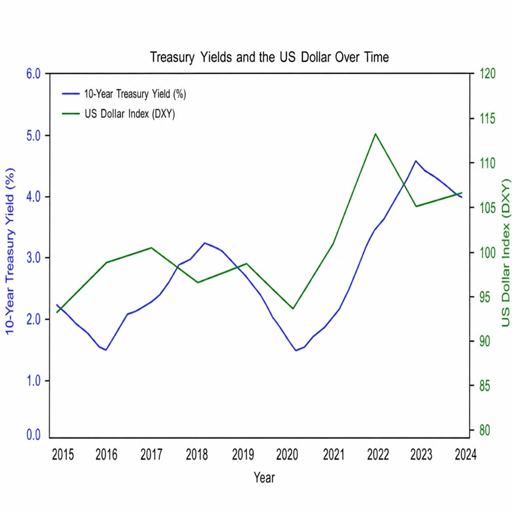
US Treasury yields are one of the main reference points global traders use to price the dollar, evaluate risk, and compare returns across currencies. When US bond rates rise or fall, the move can ripple through forex markets because it changes the relative appeal of holding dollars versus other currencies. The practical takeaway is simple: the us treasury yields forex impact is strongest when yield moves shift expectations for US interest rates, growth, inflation, or global risk appetite.
How do US Treasury yields affect forex markets?
US Treasury yields affect forex markets by changing the return investors can earn on dollar-denominated assets and by signaling what markets expect from the Federal Reserve, inflation, and economic growth. A rise in US yields can support the dollar when it makes US assets more attractive than comparable foreign assets, while falling yields can pressure the dollar if investors expect lower future returns. The relationship is not automatic, though, because currencies also react to risk sentiment, foreign central bank policy, commodity prices, and positioning.
The most direct channel is the interest-rate differential. If US rates rise while rates in Europe, Japan, the UK, or emerging markets do not rise as much, global investors may demand more dollars to buy Treasury bills, notes, bonds, money-market instruments, or other dollar assets. Federal Reserve research notes that a surprise rise in US interest rates relative to foreign rates usually leads to dollar appreciation, and that higher longer-term US yields can encourage international portfolio rebalancing toward US assets.
That is why forex traders watch both the absolute level of yields and the gap between US yields and foreign yields. A higher 10-year Treasury yield matters, but it matters more if German Bunds, Japanese government bonds, or UK gilts are not moving in the same direction. In practice, the dollar’s response often depends on whether US yields are rising for “good” reasons, such as stronger growth, or “bad” reasons, such as sticky inflation or fiscal-risk concerns.
The treasury yield curve shows what part of the market is moving
The treasury yield curve compares yields across different maturities, from short-term bills to long-term bonds. Treasury describes its daily par yield curve as a curve that relates par yield to time to maturity, using market bid prices on recently auctioned Treasury securities gathered around 3:30 p.m. each business day.
For forex, the shape of the curve often matters as much as the level. Short-term yields tend to respond more closely to Federal Reserve policy expectations. Long-term yields reflect a broader mix: expected future short rates, inflation expectations, term premium, government borrowing needs, and demand from domestic and foreign investors.
A few curve signals are especially useful:
- Front-end yields, such as 3-month to 2-year rates: These often react quickly to Fed decisions, inflation surprises, payrolls data, and interest rate forecast changes.
- Intermediate yields, such as 5-year rates: These can capture the market’s view of the next phase of the policy cycle, including whether rates may stay restrictive or eventually decline.
- Long-end yields, such as 10-year to 30-year rates: These often reflect inflation credibility, growth expectations, fiscal supply concerns, and global demand for duration.
- Curve steepening: This can mean markets expect stronger growth, higher inflation, more Treasury supply, or lower short-term rates in the future.
- Curve flattening or inversion: This can suggest tighter policy, growth worries, or expectations that the Fed may eventually need to cut.
As of the Federal Reserve’s H.15 release for September 24, 2026, nominal Treasury constant maturity rates showed the 2-year at 4.85%, the 10-year at 5.11%, and the 30-year at 5.40%, placing long rates above the front end in that snapshot. This kind of upward-sloping curve can shape forex interpretation differently than a deeply inverted curve, because it points attention toward long-term inflation, term premium, and bond-supply dynamics rather than only near-term Fed policy.
Why US interest rates matter beyond the bond market
US interest rates sit at the center of global finance because the dollar remains a dominant funding, invoicing, and reserve currency. When US rates rise, the cost of dollar funding can rise for borrowers around the world. That can tighten financial conditions outside the United States, especially for borrowers with dollar liabilities but revenues in another currency.
The Fed’s September 16, 2026 statement raised the target range for the federal funds rate by 1/4 percentage point to 3.75%–4.00%, citing elevated inflation and the aim of returning inflation to its 2% goal. This kind of policy move can affect forex before and after the announcement: before, through expectations priced into yields; after, through confirmation, surprise, or guidance.
Forex markets do not wait for policy meetings alone. They constantly reprice based on speeches, inflation reports, labor data, retail sales, credit conditions, and global risk events. That is why us treasury yields news can move currency pairs even on days when there is no Fed decision. A hot inflation print may lift two-year yields and the dollar within minutes; a weaker labor report may push yields lower and weigh on the dollar if traders bring forward rate-cut expectations.
Yield moves can strengthen or weaken the dollar for different reasons
A common mistake is assuming “higher yields always mean a stronger dollar.” Often they do, but the reason behind the yield move matters.
When yields rise because US growth looks stronger than expected, the dollar may benefit from both higher returns and confidence in US assets. When yields rise because inflation looks sticky, the dollar may still rise if traders expect tighter Fed policy. But if yields rise because investors demand more compensation for long-term debt, fiscal uncertainty, or inflation risk, the dollar reaction can become less clean.
The opposite is also true. Falling yields can weaken the dollar when they point to easier Fed policy. Yet in a severe global risk-off environment, Treasury yields may fall because investors seek safety, while the dollar can also rise because investors want liquidity. This is one reason forex traders should avoid reading Treasury yields in isolation.
A practical framework is to ask what is driving the move:
- Growth: Are yields rising because economic data are stronger?
- Inflation: Are yields rising because inflation expectations or real yields are moving higher?
- Fed expectations: Is the front end repricing future hikes or cuts?
- Risk sentiment: Are investors buying dollars for safety even as yields fall?
- Global comparison: Are US yields moving more than yields in other major economies?
- Positioning: Are traders crowded into one dollar view that could reverse quickly?
This framework keeps the us treasury yields forex impact grounded in cause and effect rather than in a simple one-line rule.
The forex impact differs across major currency pairs
Treasury yields can influence nearly every currency pair, but the effect varies by country, central bank, and market structure.
EUR/USD
EUR/USD often reacts to the spread between US Treasury yields and euro-area government bond yields. If US yields rise faster than comparable European yields, the dollar side of the pair can gain support. But the pair also responds to European Central Bank expectations, eurozone growth, energy prices, and political risk.
USD/JPY
USD/JPY is highly sensitive to rate differentials because Japanese yields have often been low relative to US yields. When US yields rise and Japanese yields remain comparatively anchored, the dollar can become more attractive versus the yen. However, policy shifts in Japan or rapid carry-trade unwinds can make USD/JPY especially volatile.
GBP/USD
GBP/USD reflects both US yield moves and UK-specific forces. A rise in US yields may support the dollar, but sterling can resist if UK yields rise as well or if UK growth surprises positively. Traders usually compare Bank of England expectations with Fed expectations rather than looking at Treasuries alone.
Emerging-market currencies
Emerging-market currencies can be more vulnerable when US yields rise sharply. Higher US returns can pull capital away from riskier markets, increase dollar funding stress, and make external debt more expensive. Still, countries with high real yields, strong external balances, or credible central banks may hold up better than peers.
What does the latest interest rate forecast imply?
The latest official Fed projections are not a promise, but they show policymakers’ estimated path under their assumptions. In the September 2026 Summary of Economic Projections, the median projected appropriate federal funds rate was 4.1% for 2026 and 2027, 3.9% for 2028, and 3.6% for 2029; the Fed also emphasized that the future path of rates is subject to considerable uncertainty.
For forex traders, the implication is not simply “rates stay high” or “rates fall later.” The more important point is whether incoming data push market pricing above or below that path. If inflation remains firm and markets price a higher-for-longer Fed, front-end yields can rise and support the dollar. If growth slows or inflation cools faster than expected, yields may fall as traders price a lower rate path.
An interest rate forecast should therefore be treated as a scenario map, not a trading signal. Markets move when expectations change. A forecast that is already fully priced may have little impact, while a small surprise can create a large move if traders are positioned the wrong way.
Carry trades add another layer to Treasury yield moves
Carry trades involve borrowing in a lower-yielding currency and investing in a higher-yielding currency or asset. US yields can make the dollar either a target currency or a funding currency depending on the global rate environment. When US yields are high relative to peers, dollar assets can attract carry-seeking investors; when volatility rises, those trades can unwind quickly.
Recent BIS research highlights that carry trade activity can shape exchange-rate responses to monetary policy, and that leveraged investors’ currency strategies can amplify moves when positions are unwound. This matters because forex reactions to Treasury yields are not just about long-term investors calmly reallocating portfolios. They can also reflect hedge funds, macro traders, and leveraged accounts cutting exposure under pressure.
In calm markets, higher-yielding currencies may benefit from carry demand. In stressed markets, investors may reduce risk, buy back funding currencies, or rush into dollar liquidity. That is why a yield advantage can support a currency for months and then reverse sharply when volatility spikes.
A practical checklist for reading US bond rates in forex
If you follow US financial markets, it helps to use a repeatable checklist instead of reacting to every tick in yields. The goal is to connect US bond rates with the broader market story.
- Start with the 2-year Treasury yield: It is often the cleanest read on near-term Fed expectations.
- Check the 10-year yield: It gives a broader view of growth, inflation, and term premium.
- Compare with foreign yields: A dollar move usually depends on relative rates, not US rates alone.
- Separate nominal and real yields: Rising nominal yields driven by inflation can mean something different from rising real yields.
- Watch the yield curve: Steepening and flattening can tell different stories about growth and policy.
- Read the data calendar: CPI, payrolls, Fed meetings, Treasury auctions, and major global central bank decisions can all change the setup.
- Observe risk appetite: Equity weakness, credit stress, or geopolitical shocks can override the normal yield-dollar relationship.
- Respect positioning: If traders are crowded long dollars, even supportive yield news may trigger profit-taking.
This checklist is useful for investors, analysts, and businesses with currency exposure. It does not predict every move, but it reduces the risk of confusing a yield headline with the underlying driver.
Businesses and investors should focus on exposure, not prediction
For companies, the Treasury-yield and forex link matters because currency swings can affect import costs, export competitiveness, overseas revenues, and hedging decisions. A US importer paying in euros or yen may care less about the exact 10-year yield and more about whether dollar strength is likely to change purchase timing or hedge ratios. A multinational with foreign earnings may watch whether higher US yields translate into a stronger dollar that reduces translated revenue.
For investors, the key is understanding that yield moves can affect both portfolio returns and currency returns. Buying a foreign bond may look attractive on yield alone, but currency moves can overwhelm the income advantage if the position is unhedged. Conversely, hedging can reduce or eliminate the yield pickup because forward currency pricing reflects interest-rate differentials.
The best approach is to define the exposure first. Are you exposed to the dollar through revenues, costs, assets, liabilities, or trading positions? Once that is clear, Treasury yields become one input in a broader decision rather than a single forecast to chase.
Key takeaway
US Treasury yields influence forex through rate differentials, Fed expectations, global capital flows, and risk sentiment. The impact is usually strongest when US yields move differently from foreign yields or when the market is forced to reprice the path of US interest rates. Watch the curve, compare relative yields, and focus on the reason behind the move. That is the most reliable way to interpret the us treasury yields forex impact without turning every bond-market headline into a false signal.
