
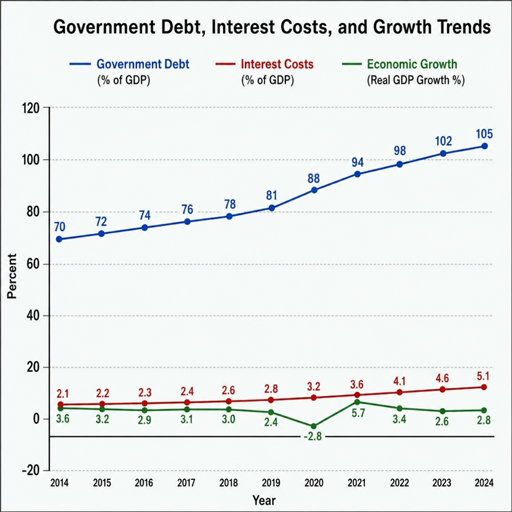
Sovereign debt sustainability is the ability of a government to meet its current and future debt obligations without resorting to disruptive policy changes, default, or excessive inflation. When debt risks rise, the effects rarely stay inside government balance sheets; they can shape borrowing costs, investor confidence, public services, private-sector credit, and long-term economic stability. This article explains what drives sovereign debt stress, how to recognize warning signs, and what practical debt management and economic policy choices can improve fiscal health.
What makes sovereign debt sustainability so important?
Sovereign debt sustainability matters because public borrowing is both a tool and a constraint. Used well, sovereign debt can help finance infrastructure, stabilize the economy during downturns, respond to emergencies, and spread the cost of long-lived investments across generations. Used poorly, or accumulated under weak growth and high interest costs, it can narrow policy choices and make public finance more fragile.
The core issue is not simply whether debt is “high” or “low.” A government with strong institutions, credible economic policy, deep local capital markets, and steady growth may carry a larger debt stock more safely than a country with volatile revenues, short debt maturities, or heavy foreign-currency obligations. Sustainability depends on the relationship between debt, growth, interest rates, fiscal balances, investor trust, and the government’s capacity to adjust when conditions change.
For citizens and businesses, this may sound technical, but the practical consequences are familiar. Rising sovereign debt risks can lead to higher taxes, lower public investment, reduced social spending, weaker exchange rates, tighter credit, or inflationary pressure. In severe cases, debt distress can trigger restructuring, capital flight, banking-sector stress, and prolonged uncertainty.
The mechanics behind debt sustainability
At the center of sovereign debt sustainability is a simple dynamic: debt becomes easier to manage when an economy grows faster than the interest rate the government pays, and harder to manage when borrowing costs outpace growth. Fiscal balances also matter. If a government consistently spends more than it collects before interest payments, debt tends to rise unless growth or inflation offsets the increase.
Economists often focus on three moving parts:
- The debt stock: how much sovereign debt already exists relative to the size of the economy.
- The interest-growth gap: whether borrowing costs are higher or lower than nominal economic growth.
- The primary balance: whether the government runs a surplus or deficit before interest payments.
These factors interact. A country with moderate debt can still face trouble if interest rates jump, its currency weakens, or revenue collapses. A country with high debt can remain stable if investors trust its institutions, maturities are long, and the economy continues to expand. That is why sustainability analysis is more than a debt-to-GDP ratio; it is a judgment about resilience under stress.
Key risk drivers that weaken fiscal health
Debt problems usually emerge through a combination of pressures rather than one isolated shock. The most important risks often build quietly during good times, then become visible when growth slows or financing conditions tighten.
Slow growth and weak revenue
A growing economy makes public finance easier to manage because tax revenues tend to rise, social pressures may ease, and the debt burden becomes smaller relative to national income. When growth slows, the opposite happens. Revenues disappoint, spending demands rise, and debt ratios can climb even if the government avoids major new programs.
This is why economic stability and fiscal health are connected. A country cannot rely only on spending cuts or tax increases if the productive base is stagnant. Sustainable debt management often requires policies that support investment, employment, productivity, and credible long-term growth.
Rising interest costs
Interest payments are one of the clearest channels through which debt pressure affects the budget. As rates rise, governments may have to devote more revenue to servicing past borrowing, leaving less room for health care, education, infrastructure, defense, or social support. This can create difficult trade-offs even before a crisis appears.
The danger is greater when debt has short maturities, because old debt must be refinanced more often at current market rates. Long maturities can provide breathing room, while short-term funding can make a government more exposed to sudden shifts in investor sentiment.
Exchange-rate and foreign-currency exposure
Borrowing in foreign currency can be useful when domestic capital markets are limited, but it creates a major vulnerability. If the local currency depreciates, the cost of servicing foreign-currency sovereign debt rises in local terms. This can quickly damage fiscal health, especially when export earnings or foreign reserves are weak.
Countries with a large share of local-currency debt generally have more flexibility, but that does not make them risk-free. If investors fear inflation, policy instability, or financial repression, they may demand higher yields or shorten the maturities they are willing to hold.
Political and institutional uncertainty
Debt sustainability relies heavily on credibility. Investors, citizens, and businesses look for signs that leaders can make consistent decisions, collect revenue fairly, control wasteful spending, and adapt when conditions change. Political gridlock, weak budget processes, corruption, or sudden policy reversals can raise risk even when headline debt numbers appear manageable.
Strong institutions do not eliminate hard choices, but they make adjustment more predictable. Predictability reduces panic, and reduced panic lowers the chance that a liquidity problem becomes a solvency problem.
How can policymakers spot rising sovereign debt risks?
Policymakers can spot rising sovereign debt risks by looking beyond the debt ratio and monitoring a broader set of fiscal, market, and institutional indicators. The goal is to identify whether debt dynamics are becoming less flexible, whether financing conditions are deteriorating, and whether the government still has room to respond to shocks without undermining economic stability.
A practical risk dashboard may include:
- Debt-to-GDP direction: Is the ratio stable, falling, or rising persistently?
- Interest payments as a share of revenue: Is debt service crowding out essential spending?
- Average maturity of debt: Does the government face large refinancing needs soon?
- Currency composition: How much sovereign debt is owed in foreign currency?
- Primary balance trend: Is the fiscal position improving or weakening before interest costs?
- Investor base: Is debt held mainly by stable domestic institutions, foreign investors, or short-term speculative buyers?
- Contingent liabilities: Could state-owned enterprises, banks, pensions, or guarantees move onto the public balance sheet?
- Policy credibility: Are budget plans realistic, transparent, and politically deliverable?
No single metric gives a complete answer. A country may have a high debt ratio but low refinancing risk, or a low debt ratio with dangerous foreign-currency exposure. The most useful approach is to combine quantitative indicators with judgment about institutions, market access, and the government’s willingness to adjust.
The difference between liquidity stress and solvency stress
Debt sustainability discussions often become clearer when separating liquidity from solvency. Liquidity stress means a government may struggle to roll over debt or meet near-term payments even though its long-term position could be viable. Solvency stress means the debt burden is likely too large to repay under realistic assumptions without major restructuring, inflation, or prolonged austerity.
This distinction matters because the policy response differs. A liquidity problem may be addressed through temporary financing, credible fiscal commitments, central bank support within a sound framework, or international assistance. A solvency problem requires deeper action: fiscal restructuring, debt reprofiling, stronger revenue measures, spending reforms, or formal renegotiation with creditors.
The challenge is that liquidity and solvency can feed each other. If investors fear default, they demand higher yields. Higher yields worsen the fiscal outlook. A worsening outlook makes default fears more plausible. Breaking this loop requires credible action before market confidence disappears.
Domestic debt is not automatically safer
It is tempting to assume that local-currency domestic debt is always safer than external debt. In many ways, it is more flexible: governments may have deeper relationships with domestic banks, pension funds, and central banks, and they avoid direct exchange-rate risk. However, domestic debt can still create serious problems.
If banks hold large amounts of government bonds, sovereign stress can weaken bank balance sheets. If governments pressure domestic institutions to absorb more debt, private credit may be crowded out. If central banks finance deficits too aggressively, inflation expectations may rise. In other words, domestic debt may reduce one kind of risk while increasing others.
A healthy public finance strategy considers the whole financial system. Debt management should aim for a balanced maturity profile, a reliable investor base, transparent issuance, and coordination with monetary policy that preserves price stability.
Policy choices that support sustainable public finance
Improving sovereign debt sustainability is not only about cutting spending. It is about building a fiscal framework that can finance priorities, withstand shocks, and maintain trust. The strongest strategies usually combine discipline with growth-oriented reforms.
Useful policy measures include:
- Medium-term budget planning Annual budgets are necessary, but they can encourage short-term thinking. A medium-term fiscal framework helps governments show how today’s choices affect future debt, revenue, and spending commitments.
- Better revenue systems Sustainable public finance requires reliable revenue. This may involve broadening the tax base, reducing evasion, improving administration, and designing taxes that are fair enough to maintain public support.
- Spending reviews Not all spending has the same value. Regular reviews can identify inefficient subsidies, duplicated programs, weak procurement, or low-impact projects while protecting essential services and productive investment.
- Prudent debt management Governments can reduce refinancing risk by lengthening maturities, diversifying investors, limiting foreign-currency exposure where possible, and maintaining transparent issuance calendars.
- Growth-enhancing reforms Debt becomes more sustainable when the economy becomes more productive. Policies that improve infrastructure, education, labor-market participation, competition, and investment conditions can strengthen long-term repayment capacity.
- Shock buffers Fiscal reserves, contingency planning, and realistic risk assessments help governments respond to recessions, disasters, or financial shocks without immediately losing market confidence.
The right mix depends on each country’s circumstances. A commodity exporter, an aging advanced economy, and a low-income country with large infrastructure needs will not face the same constraints. Still, the principle is shared: credible policy reduces risk before markets force painful adjustment.
What role does economic policy play in reducing debt risk?
Economic policy reduces debt risk by aligning fiscal decisions, monetary stability, financial-sector resilience, and long-term growth. A government cannot manage sovereign debt effectively if the rest of the policy framework sends conflicting signals, such as promising fiscal consolidation while expanding unfunded commitments or relying on inflation to erode obligations.
Coordination matters, but independence and credibility matter too. Fiscal authorities need realistic budgets. Central banks need the ability to maintain price stability. Financial regulators need to monitor banks’ exposure to government debt. Statistical agencies need to provide reliable data. When these parts work together, investors and citizens can better assess the country’s true fiscal health.
Good economic policy also recognizes timing. Cutting too sharply during a downturn can deepen recession and weaken revenues, while delaying adjustment for too long can make the eventual correction more painful. The art is to choose a path that is credible, socially durable, and supportive of recovery.
Why transparency strengthens debt sustainability
Transparency is one of the most underrated tools in debt management. When governments publish clear data on debt stocks, maturities, guarantees, fiscal risks, and budget assumptions, they reduce uncertainty. Lower uncertainty can support investor confidence and improve democratic accountability.
Hidden obligations are especially dangerous. Guarantees to public companies, public-private partnership commitments, pension promises, bank rescue risks, and local government debts may not always appear in headline figures. When these liabilities surface suddenly, they can damage trust and force abrupt policy changes.
Transparent reporting does not make debt disappear, but it makes the risks easier to manage. It also helps citizens understand the trade-offs behind fiscal choices. That public understanding is essential because debt sustainability is ultimately political as well as financial.
Practical checklist for assessing sovereign debt sustainability
For analysts, investors, journalists, and policy teams, a structured review can make the issue easier to evaluate. The following checklist is a useful starting point:
- Start with the trend, not the snapshot. A stable high debt ratio may be less worrying than a lower ratio rising quickly.
- Compare interest costs with revenue. This shows how much fiscal space is being absorbed by past borrowing.
- Review refinancing needs. Large near-term maturities can create stress even if long-term fundamentals look manageable.
- Separate local and foreign-currency debt. Currency mismatches can transform exchange-rate moves into fiscal shocks.
- Examine growth assumptions. Debt plans built on optimistic growth forecasts may fail quickly.
- Identify off-balance-sheet risks. Guarantees, state firms, banks, and pensions can change the debt picture.
- Assess institutional credibility. Strong rules, transparent data, and consistent policymaking improve resilience.
- Consider social and political feasibility. A fiscal plan that cannot be implemented is not a sustainable plan.
This checklist does not replace detailed analysis, but it prevents a narrow focus on one headline figure. Sovereign debt sustainability is a system-wide question, and the warning signs often appear in the connections between fiscal accounts, markets, and institutions.
The human side of sovereign debt decisions
Debt sustainability is sometimes discussed as if it were only a spreadsheet problem. It is not. Fiscal choices affect wages, pensions, public employment, infrastructure, household costs, business confidence, and future opportunity. A technically sound plan that ignores social realities may fail because people will not support it.
That does not mean difficult choices can always be avoided. It means governments should explain trade-offs clearly, protect the most vulnerable where possible, and prioritize reforms that improve the quality of spending rather than relying only on broad cuts. The stronger the public mandate, the easier it becomes to sustain responsible policy over time.
This is also why economic stability has value beyond financial markets. Stable public finance can help families plan, businesses invest, and governments respond when crises occur. When debt risks are ignored, the adjustment often arrives later, faster, and with fewer options.
A balanced approach to debt management
Sovereign debt is not inherently bad. Many countries rely on it to build assets, smooth shocks, and support development. The risk begins when borrowing becomes disconnected from repayment capacity, when policy credibility weakens, or when short-term financing hides long-term pressure.
A balanced debt management strategy asks practical questions: What is the debt financing? How vulnerable is the debt profile to interest-rate, currency, and refinancing shocks? Are fiscal plans realistic? Are institutions strong enough to adjust when assumptions change? These questions create a more useful conversation than simply labeling debt as too high or acceptable.
The long-term objective is not zero debt. It is resilient public finance: a system in which governments can fund priorities, honor obligations, respond to shocks, and maintain the confidence of citizens and creditors.
Final takeaway
Sovereign debt sustainability risks grow when debt, interest costs, weak growth, poor transparency, and uncertain economic policy reinforce one another. They fall when governments combine credible fiscal planning, sound debt management, stronger institutions, and policies that support durable growth.
For anyone evaluating fiscal health, the most important lesson is to look beneath the headline number. Sustainable sovereign debt depends on flexibility, trust, and the capacity to adapt before pressure becomes crisis.
