
Agricultural commodities forex exposure is the impact exchange-rate movements can have on the cost, revenue, margin, and cash flow of businesses that produce, trade, process, finance, or consume farm products across currencies. It matters because grains, oilseeds, livestock, dairy, sugar, coffee, cocoa, cotton, and inputs such as fertilizer are often priced, benchmarked, financed, or settled in a currency different from the one used to pay local costs. This guide explains where FX exposure appears, how it interacts with commodity price fluctuations, and how currency risk management can support better decisions in agriculture.
What does FX exposure mean for agricultural commodities?
FX exposure in agricultural commodities means a business is financially affected when one currency strengthens or weakens against another currency connected to its purchases, sales, debt, or operating costs. A farmer may sell a crop linked to a global dollar price while paying wages, land rent, fuel, and local taxes in a domestic currency. An importer may agree to buy grain in U.S. dollars but sell flour, feed, or packaged food in a local market. In both cases, the commodity price and the exchange rate move together to shape the final margin.
The exposure is not limited to companies that directly trade currencies. Any agricultural business with cross-border pricing, imported inputs, export revenue, foreign-currency loans, or contracts tied to global benchmarks can carry currency risk. Even a purely domestic operation may be indirectly affected when local market prices follow export parity, import parity, or global reference prices converted into local currency.
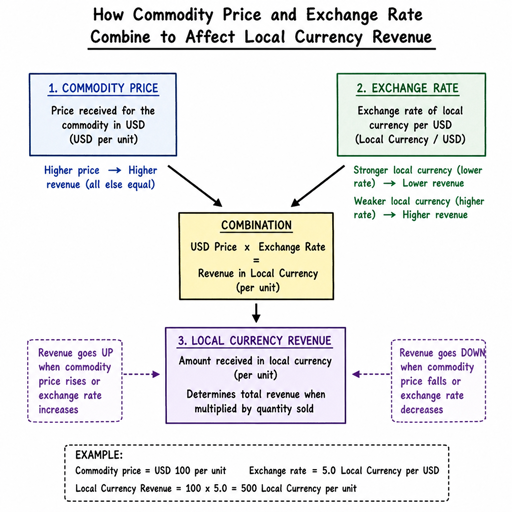
A simple way to think about it is this: commodity price fluctuations determine the global value of the product, while FX movements determine how that value translates into the business’s home currency. If both move against the business at the same time, the financial impact can be much larger than either movement alone.
Why currency risk matters in agriculture
Risk in agriculture is already broad. Weather, yields, pests, logistics, policy changes, financing costs, and market demand can all affect results. Currency risk adds another layer because it can change the local-currency value of a crop, shipment, or input after operational decisions have already been made.
Agricultural timing makes this especially important. Production decisions may be made months before harvest, and export or procurement contracts may be negotiated well before physical delivery. During that period, exchange rates can change enough to alter whether a transaction is profitable, even if the commodity price itself behaves as expected.
FX exposure can influence:
- Sales revenue: Exporters receiving foreign currency may earn more or less in local currency depending on exchange rates at settlement.
- Input costs: Imported fertilizer, seed technology, machinery, fuel, chemicals, and packaging may become more expensive when the domestic currency weakens.
- Working capital: Seasonal borrowing can become harder to manage when payables and receivables are in different currencies.
- Competitiveness: A weaker local currency can make exports more attractive but can also raise imported input costs.
- Contract performance: Fixed-price contracts can become strained if currency changes were not considered when pricing the deal.
The practical implication is clear: agricultural businesses need to evaluate margin, not just headline commodity prices. A rising crop price may not improve profitability if the relevant currency movement increases costs or reduces converted revenue.
Common sources of agricultural commodities forex exposure
FX exposure often enters through several channels at once. Mapping these channels helps a business see which risks are real, which are indirect, and which can be managed through operational or financial tools.
Export sales and foreign-currency revenue
Exporters commonly face exposure when goods are priced or paid in a foreign currency. If a local cooperative, trader, or processor agrees to sell commodities in dollars, euros, or another major currency, the local-currency value of that receivable may change before payment arrives. A favorable exchange-rate move can improve returns, but an unfavorable move can reduce expected cash flow.
This risk is more acute when margins are narrow or when the business has already locked in purchase prices from farmers. The exporter may know the commodity quantity and the foreign-currency sales price but still be uncertain about the final amount received in local currency.
Imported inputs and production costs
Many agricultural producers rely on imported or globally priced inputs. Fertilizer, crop protection products, machinery parts, irrigation equipment, animal feed additives, fuel, and packaging materials may be quoted in foreign currency or priced locally based on import replacement cost. A weaker domestic currency can raise input costs even before the next planting or feeding cycle begins.
This creates a timing challenge. Producers may sell output later in the season, but input costs may be fixed or paid earlier. If input purchases and output sales are exposed to different currencies or different timing windows, the business may not have a natural offset.
Commodity benchmarks and local pricing
Many agricultural commodities are influenced by global benchmarks, even when final trades happen locally. A local buyer may calculate prices using a global reference price, freight adjustments, quality premiums, local taxes, and the exchange rate. This means FX exposure can be embedded in the local price formula.
For example, a domestic grain price may rise because the local currency weakened against the currency used for international pricing. That may benefit sellers, but it can pressure millers, feed manufacturers, and livestock producers that buy the grain locally.
Foreign-currency borrowing and trade finance
Agriculture often requires seasonal finance. If a business borrows in a foreign currency because the interest rate appears attractive or because the loan is connected to export flows, it must consider whether revenue will be available in the same currency. If not, debt service can become more expensive in local-currency terms when exchange rates move unfavorably.
Trade finance, inventory finance, and letters of credit can also create timing gaps. The exposure may begin when the transaction is agreed, not only when cash changes hands.
How FX and commodity price fluctuations interact
Currency risk and commodity risk should not be treated as separate issues when they affect the same margin. The landed cost of an imported commodity, the local-currency value of an export, or the profitability of a processing spread can depend on both variables at the same time.
Consider an importer that buys soybeans in dollars and sells animal feed in local currency. If soybean prices rise while the local currency weakens, the local cost of soybeans may increase sharply. Passing that cost to customers may not be immediate or fully possible, especially in competitive or regulated markets. The result is margin compression.
For an exporter, the relationship can work differently. A weaker domestic currency may lift local-currency revenue from foreign sales, partly offsetting a lower global commodity price. But that benefit may be reduced if imported inputs, freight, storage, or financing costs rise at the same time.
A practical exposure formula
A simplified way to frame the issue is:
Local-currency commodity value = foreign-currency commodity price × exchange rate, adjusted for basis, freight, quality, taxes, and contract terms.
This formula is not a full pricing model, but it helps teams ask the right questions. Which currency drives the benchmark? Which currency drives costs? Which exchange rate is used in the contract? When is the rate fixed? Who carries the risk if the rate changes before settlement?
Who is most exposed to currency risk in agriculture?
The most exposed businesses are those with a mismatch between the currency of revenue and the currency of costs, debt, or inventory. This can include farmers, cooperatives, exporters, importers, processors, food manufacturers, feed producers, distributors, and lenders. The size of the exposure depends less on the company’s label and more on how its contracts, pricing formulas, and cash flows are structured.
A farmer in an export-oriented region may be exposed even without signing an export contract. A processor selling domestically may be exposed if raw materials are tied to international prices. A trader may be exposed for only a short period, but the exposure can be large because volumes are high.
The following comparison shows how different participants may experience FX exposure:
|
Participant |
Typical exposure |
Main concern |
|---|---|---|
|
Producer |
Output linked to export prices; inputs linked to imports |
Protecting planting margins and cash flow |
|
Exporter |
Foreign-currency receivables and local-currency procurement |
Maintaining margin between purchase and sale |
|
Importer |
Foreign-currency payables and local-currency sales |
Controlling landed cost and customer pricing |
|
Processor |
Raw materials and finished goods priced on different bases |
Preserving processing margins |
|
Lender or financier |
Borrower cash flows affected by FX |
Repayment capacity and collateral value |
Measuring exposure before managing it
Good currency risk management starts with measurement. A business cannot choose the right action until it knows where the exposure begins, when it ends, and how large it may become. The goal is not to forecast exchange rates perfectly; it is to understand how exchange-rate changes would affect the business under realistic scenarios.
A useful exposure review should identify:
- Currencies involved: List the currencies used for sales, purchases, debt, freight, insurance, and major inputs.
- Timing of cash flows: Note when contracts are priced, when goods are delivered, and when payments are received or made.
- Pricing formulas: Check whether prices are fixed, floating, benchmark-linked, or converted using a future exchange rate.
- Natural offsets: Identify whether foreign-currency revenue can pay foreign-currency costs or debt.
- Open exposure: Calculate the net amount still vulnerable after offsets.
- Margin sensitivity: Model how profit changes if the exchange rate moves by a chosen amount.
This process should be repeated when market conditions, crop plans, borrowing arrangements, or customer contracts change. Exposure is not static in agriculture because quantities, quality, delivery timing, and basis levels can all shift.
Currency risk management tools and approaches
Currency risk management combines operational discipline with financial instruments. The right approach depends on the business’s size, risk tolerance, contract structure, access to finance, and internal controls. Not every business needs complex hedging, but every business benefits from knowing its exposure.
Natural hedging
A natural hedge occurs when foreign-currency inflows and outflows offset each other. For example, an exporter with dollar revenue may use part of that revenue to pay dollar-denominated freight, imported inputs, or debt. This reduces the need to convert currencies and can lower the amount exposed to exchange-rate changes.
Natural hedging is often the first place to look because it uses the business’s existing cash flows. However, it should not be assumed. Timing matters: dollar revenue arriving after a dollar payable is due may still create a funding gap.
Contract design
Contracts can allocate currency risk clearly. Parties may agree which exchange rate applies, when conversion occurs, whether prices can be adjusted, and how extraordinary movements are handled. Clear contract terms reduce disputes and help each party price the risk more accurately.
Agricultural contracts should be reviewed for currency clauses alongside quality, delivery, basis, and force majeure provisions. A price that looks attractive may be less attractive if the currency conversion method is unfavorable or uncertain.
Forward contracts and hedging instruments
Some businesses use forward exchange contracts or other hedging instruments to lock in a rate for a future payment or receipt. This can provide certainty for budgeting and margin protection. The trade-off is that the business may not benefit from favorable exchange-rate moves on the hedged amount.
Financial hedging requires governance. A business should define who can hedge, what exposures can be hedged, what documentation is required, and how results are monitored. Hedging should support commercial activity, not become a separate speculative activity.
Pricing buffers and margin planning
Some businesses manage FX exposure by building currency assumptions into pricing, setting minimum margin thresholds, or using shorter quote validity periods. This is common where formal hedging is impractical or where transaction sizes are small. It does not eliminate risk, but it makes the risk visible in commercial decisions.
A processor, for example, may update customer prices more frequently when exchange rates are volatile. An importer may quote with a clear expiry time so that a sudden currency move does not turn a profitable sale into a loss.
Building a practical FX risk framework
A strong framework does not have to be complicated. It should make exposure visible, assign responsibility, and connect currency decisions to commodity procurement, sales, and finance. The best frameworks are practical enough to use during busy seasons, not only during annual planning.
Use this checklist as a starting point:
- Define risk appetite: Decide how much margin volatility the business can tolerate before action is required.
- Create an exposure register: Track open receivables, payables, inventory positions, and loans by currency and date.
- Align commodity and FX decisions: Avoid hedging the commodity price while leaving the currency leg unmanaged, or vice versa.
- Set approval limits: Establish who can approve contracts, hedges, and exceptions.
- Stress-test scenarios: Review what happens if the commodity price falls, the domestic currency weakens, or both occur together.
- Monitor counterparties: Consider whether customers, suppliers, and borrowers are also vulnerable to currency movements.
- Review after settlement: Compare expected and actual results to improve future pricing and hedging decisions.
This framework helps teams move from reactive decisions to planned risk management. It also improves communication between procurement, sales, treasury, finance, and operations.
Common mistakes to avoid
One common mistake is focusing only on the commodity price. A trader may celebrate locking in a favorable crop price but overlook the exchange rate used to convert the sale. Another mistake is assuming that a weaker domestic currency is always good for agriculture because it supports exports. That may be true for some sellers, but it can hurt businesses that rely on imported inputs or foreign-currency debt.
Businesses also run into trouble when they hedge quantities that later change. Agriculture involves yield uncertainty, quality variation, shipment delays, and production risks. Hedging a larger amount than the final physical exposure can create a new risk rather than reducing an existing one.
A third mistake is leaving currency terms vague in contracts. If the exchange rate source, conversion date, settlement currency, or adjustment mechanism is unclear, both parties may interpret the economics differently. Clear documentation is a risk control, not just an administrative detail.
Turning FX awareness into better decisions
Agricultural commodities forex exposure is manageable when it is identified early and treated as part of the full commercial margin. The objective is not to remove every possible risk in agriculture, because agriculture will always involve uncertainty. The objective is to understand which currency risks the business is accepting, which ones it can offset, and which ones should be priced, hedged, or contractually assigned.
A practical next step is to review upcoming sales, purchases, input needs, and financing obligations by currency and date. From there, businesses can estimate open exposure, test the effect of commodity price fluctuations and exchange-rate moves, and decide whether natural hedging, contract changes, pricing adjustments, or formal hedging tools are appropriate. The result is clearer planning, stronger margin discipline, and fewer surprises when global agricultural markets and currency markets move at the same time.
