
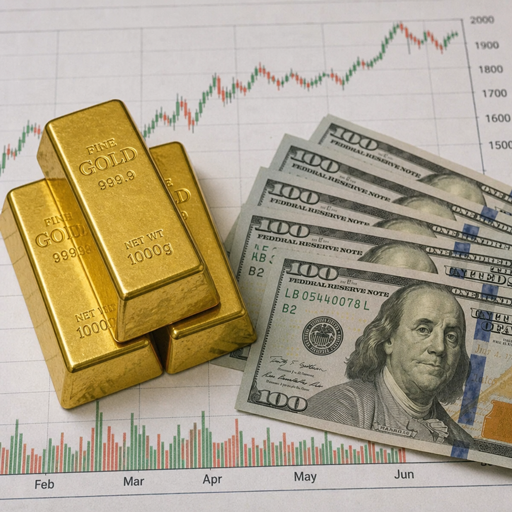
Gold and the U.S. dollar are two of the most watched forces in global markets, and their relationship can influence how investors interpret risk, inflation expectations, and currency strength. The gold prices and US dollar correlation is often described as inverse, but real-world gold price dynamics are more nuanced than a simple “dollar up, gold down” rule. Understanding the gold dollar relationship helps traders, long-term investors, and market observers read gold price fluctuations with more context.
How does the U.S. dollar affect gold prices?
The U.S. dollar affects gold because gold is commonly priced in dollars on global markets, meaning changes in the dollar can alter gold’s relative cost for buyers using other currencies. When the dollar strengthens, gold may become more expensive internationally, which can reduce demand and pressure prices. When the dollar weakens, gold may become more affordable for non-dollar buyers, sometimes supporting higher gold prices.
This is the basic foundation of the usd gold correlation. However, the relationship is not automatic. Gold can rise alongside the dollar during periods of market stress, and it can fall even when the dollar is soft if investors are favoring other assets. The key is to treat currency movement as one important input, not the whole explanation.
The usual inverse relationship
In many market environments, gold and the U.S. dollar move in opposite directions. This happens partly because both assets can compete for attention as stores of value. A stronger dollar can make cash and dollar-denominated assets more attractive, while a weaker dollar can push investors to look for alternatives that may better preserve purchasing power.
Gold price trends often reflect this tug-of-war. If the dollar is rising because interest rates are expected to stay higher, gold may face pressure because it does not provide income like bonds or savings products. If the dollar is falling because investors expect looser monetary conditions, gold may gain support from concerns about inflation or currency depreciation.
Still, “inverse” does not mean “perfect.” Market correlations shift over time. The gold prices and US dollar correlation can strengthen, weaken, or temporarily break depending on what is driving currency moves in the first place.
Why the gold dollar relationship is not always simple
Gold responds to more than exchange rates. It is also influenced by interest-rate expectations, central bank policy, inflation concerns, geopolitical risk, jewelry demand, investment flows, and broader market sentiment. A dollar move caused by calm economic optimism may affect gold differently from a dollar move caused by fear.
For example, if investors rush into the U.S. dollar as a safe-haven currency during a crisis, they may also buy gold for protection. In that case, both can rise together. On the other hand, if the dollar strengthens because yields are rising and investors see better returns in interest-bearing assets, gold may struggle.
This is why gold market analysis should begin with the cause behind the dollar’s movement. A chart can show direction, but context explains meaning.
Factors that can weaken the correlation
Several forces can interrupt the typical usd gold correlation:
- Real interest rates: When inflation-adjusted yields rise, gold may become less attractive because it offers no coupon or dividend.
- Risk sentiment: In periods of fear, investors may seek both gold and the dollar, creating positive correlation for a time.
- Central bank activity: Official buying or selling can influence demand beyond currency effects.
- Inflation expectations: Gold may attract interest when investors worry that money will lose purchasing power.
- Physical demand: Jewelry, technology, and bar-and-coin demand can affect gold price dynamics, especially across major consuming regions.
These factors do not cancel the dollar’s importance. They simply explain why gold price fluctuations often require a wider lens.
What should investors watch besides the dollar?
Investors should watch interest rates, inflation expectations, bond yields, market volatility, and central bank commentary alongside the dollar. A rising dollar may pressure gold, but if inflation anxiety or geopolitical risk is also rising, the gold price response may be mixed. A falling dollar may support gold, but weak investment demand or higher real yields can limit the upside.
A practical approach is to compare several signals rather than relying on one. The dollar index may show currency strength, while bond yields reveal opportunity cost. Inflation data can suggest whether gold is being viewed as a hedge, and market volatility can show whether safe-haven demand is active.
A simple checklist can make gold market analysis more useful:
- Check the dollar trend. Is the dollar strengthening, weakening, or moving sideways?
- Look at real yields. Are inflation-adjusted returns becoming more attractive or less attractive?
- Review risk sentiment. Are investors seeking safety or taking more risk?
- Watch inflation expectations. Is the market worried about future purchasing power?
- Compare gold’s chart behavior. Is gold confirming the currency signal or resisting it?
When several signals point in the same direction, gold price trends may look clearer. When signals conflict, expect more uneven movement.
Reading gold price fluctuations with context
Short-term gold price fluctuations can be noisy. A single economic report, central bank speech, or currency spike may trigger movement that fades quickly. Longer-term trends usually depend on whether the broader environment supports demand for gold as a store of value, portfolio diversifier, or safe-haven asset.
For traders, the gold dollar relationship can help identify potential pressure points. If the dollar breaks higher and yields rise at the same time, gold may face resistance. If the dollar weakens while inflation concerns build, gold may attract more attention.
For long-term investors, the correlation is better used as a risk-awareness tool than a prediction machine. Gold can behave differently across economic cycles, and its role in a portfolio depends on goals, time horizon, and risk tolerance. The dollar is essential to watch, but it should not be the only factor guiding decisions.
Common mistakes in interpreting usd gold correlation
One common mistake is assuming the inverse relationship works every day. Correlation describes a tendency, not a guarantee. Gold and the dollar can move together when investors are responding to the same macroeconomic shock.
Another mistake is ignoring the difference between nominal and real rates. Gold may react less to headline interest rates than to what those rates imply after inflation. If investors believe inflation will erode returns, gold can remain appealing even when nominal rates appear elevated.
A third mistake is treating gold as only an inflation hedge. Inflation matters, but gold also responds to liquidity, confidence, currency stability, and global demand. Better analysis connects these forces instead of reducing gold to one theme.
A balanced view of gold price trends
The gold prices and US dollar correlation remains one of the most important relationships in financial markets, but it works best as a framework rather than a formula. In many cases, a stronger dollar can pressure gold, while a weaker dollar can support it. Yet interest rates, inflation expectations, risk sentiment, and physical demand can all reshape the outcome.
For clearer gold market analysis, start with the dollar, then ask why it is moving and what other signals confirm or contradict the trend. That balanced view makes gold price dynamics easier to understand and helps separate meaningful trends from short-term noise.
