
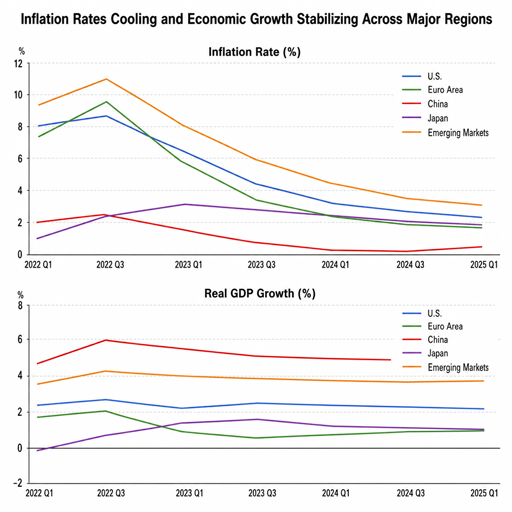
The global inflation recovery is not a clean return to the world that existed before the recent price shocks. It is a slower adjustment in which households, businesses, governments, and investors are learning to operate with higher borrowing costs, more volatile energy and food prices, and uneven economic growth. For readers watching the global economy, the practical question is not only whether inflation rates are falling, but whether real incomes, confidence, and global markets can recover without setting off another wave of instability.
What does global inflation recovery actually mean?
Global inflation recovery means more than a lower headline inflation number. It describes the broader process by which price growth cools, central banks regain confidence, wages and purchasing power stabilize, supply chains adapt, and economies move back toward sustainable growth. In 2026, that recovery remains uneven: the IMF’s July 2026 outlook projected global growth of 3.0% in 2026 and 3.4% in 2027, while global headline inflation was projected to rise from 4.1% in 2025 to 4.7% in 2026 before easing to 3.9% in 2027.
That unevenness matters because inflation does not affect every country, business, or household in the same way. A food price shock can hit lower-income households immediately, while higher interest rates may take longer to affect companies through refinancing costs, investment delays, and weaker demand. A true economic recovery therefore depends on both price stability and the ability of people and firms to plan again.
In practical terms, global inflation recovery has three layers. First, inflation trends must move closer to central bank targets without relying on a recession to do all the work. Second, economic growth must continue enough to support employment and investment. Third, global markets must believe the recovery is durable, not just a temporary pause between shocks.
The inflation shock changed how recovery feels
Earlier inflation shocks were often discussed in terms of one dominant cause: oil prices, overheated demand, loose monetary policy, or currency pressure. The recent global inflation shock was harder to absorb because several forces overlapped. Supply chain disruptions, energy volatility, food price pressure, labor market tightness, fiscal stimulus, geopolitical risk, and changing trade patterns all fed into prices at different times.
That combination made the recovery feel frustrating. Even when headline inflation rates slowed, many households continued to face higher rent, grocery, insurance, transport, and borrowing costs. Businesses saw input prices stabilize in some areas while financing costs, wage bills, and logistics uncertainty remained elevated.
This is why a country can report improving inflation data while consumers still feel squeezed. Inflation measures the rate of price increases, not the full level of prices already reached. If prices rose sharply and then continue rising more slowly, the pressure can still feel intense, especially when wages have not fully caught up.
For companies, the recovery can be just as mixed. A manufacturer may benefit from lower freight costs but struggle with expensive credit. A retailer may see supply availability improve but still face cautious consumers. An exporter may gain from stronger foreign demand but lose margin if currency movements or energy prices shift suddenly.
Key forces shaping inflation trends now
The path from inflation shock to recovery depends on several moving parts. None of them operates in isolation, and each can either support or interrupt the recovery.
Energy and food prices remain powerful drivers
Energy and food prices are especially important because they affect both household budgets and business costs. When fuel prices rise, transport, manufacturing, agriculture, and utilities can all become more expensive. When food prices rise, the effect is immediate and politically sensitive because consumers notice it weekly.
The IMF attributed the projected rise in global headline inflation in 2026 mainly to higher energy and food prices. That is a reminder that even when underlying inflation is improving, fresh supply shocks can delay the recovery and complicate monetary policy.
Interest rates are cooling demand, but slowly
Central banks raised interest rates to reduce inflation pressure, but rate hikes work with a lag. Higher rates affect mortgages, credit cards, business loans, government debt service, real estate, capital spending, and currency values. The full effect can take months or years to pass through an economy.
This creates a difficult balancing act. If rates stay too high for too long, economic growth may weaken more than necessary. If rates fall too quickly, inflation expectations can become unsettled again. The global inflation recovery depends heavily on central banks reading this balance correctly.
Trade and geopolitics are reshaping costs
The global economy is also adjusting to a less predictable trade environment. Companies are diversifying suppliers, building more resilient inventories, and reconsidering where production takes place. These moves can reduce risk, but they may also raise costs compared with the ultra-efficient supply chains of the past.
The OECD’s September 2026 interim outlook warned that the global economy faces heightened risks from extreme weather events that could weaken growth and push inflation higher. This is the new recovery environment: inflation is not only about demand management, but also about resilience against shocks that can arrive from climate, conflict, logistics, or commodity markets.
Economic recovery is uneven across regions
A global average can hide major regional differences. Some economies may be close to price stability, while others still face high inflation, currency pressure, or weak growth. Developed economies often have deeper financial markets and more policy credibility, but they may also be more exposed to aging populations, high debt, and expensive housing. Emerging markets may have stronger growth potential, but they can be more vulnerable to capital outflows, imported inflation, and swings in food or fuel prices.
This unevenness affects global markets because investors compare regions constantly. If one country cuts rates earlier, its currency may weaken. If another keeps policy tight, it may attract capital but slow domestic demand. If commodity exporters benefit from higher prices, import-dependent economies may feel the opposite effect.
For businesses, regional divergence changes strategy. A company selling into multiple markets may see demand recover in one region while another remains under pressure. Pricing, inventory, financing, and hiring decisions need to reflect local conditions rather than a single global narrative.
A useful way to read the recovery is to separate the world into three broad groups:
- Economies nearing stabilization: Inflation is closer to target, wage growth is moderating, and rate cuts may be possible if data continues to improve.
- Economies still absorbing shocks: Food, energy, currency, or fiscal pressures remain strong enough to keep inflation elevated.
- Economies with growth strain: Inflation may be easing, but weak demand, high debt, or investment delays make the economic recovery fragile.
This framework helps avoid a common mistake: assuming that lower global inflation automatically means a synchronized rebound. The recovery is real in some areas, fragile in others, and vulnerable almost everywhere.
How do inflation rates affect global markets?
Inflation rates affect global markets by changing expectations for interest rates, corporate earnings, currencies, bond yields, and consumer demand. When inflation appears persistent, investors often expect tighter monetary policy, which can pressure stocks and raise borrowing costs. When inflation cools in a credible way, markets may price in easier financial conditions, but the reaction depends on whether growth is holding up at the same time.
Bond markets are usually the first to respond. If investors expect inflation to stay high, they demand higher yields to compensate for the loss of purchasing power. Higher yields then affect mortgages, business loans, equity valuations, and government budgets.
Equity markets respond through several channels. Higher input costs can reduce profit margins. Higher interest rates can make future earnings less valuable. Weaker consumers can reduce sales. At the same time, some sectors, such as energy or certain commodity producers, may benefit from price shocks that hurt other industries.
Currency markets also play a major role. Countries with higher interest rates may attract capital, strengthening their currencies. But if inflation is high because policy credibility is weak, the currency may fall instead. For import-dependent economies, a weaker currency can make inflation worse by raising the local cost of imported goods.
For everyday investors, the main lesson is to avoid treating inflation as a single market signal. Inflation can be bad for markets when it forces aggressive rate hikes, but disinflation can also be uncomfortable if it arrives through falling demand and weaker earnings. The healthiest version of global inflation recovery is one in which inflation cools while employment, investment, and productivity remain resilient.
The business impact is bigger than pricing
Many companies responded to the inflation shock by raising prices. That was sometimes necessary, but pricing alone is not a recovery strategy. Customers eventually resist higher prices, competitors adjust, and cost pressures can shift from materials to labor, rent, financing, or technology.
A stronger business response looks at the full operating model. Companies need to understand which costs are temporary, which are structural, and which can be redesigned. They also need to know where customers are becoming more price-sensitive and where value still justifies a premium.
Practical steps include:
- Review supplier exposure. Identify which inputs are vulnerable to energy, currency, logistics, or geopolitical shocks.
- Separate margin problems from demand problems. A product may be profitable but slowing because buyers are cautious, or popular but underpriced relative to costs.
- Use flexible contracts where possible. Indexing some costs or renegotiating terms can reduce the damage from sudden price swings.
- Improve forecasting frequency. Annual planning is often too slow in a volatile inflation environment.
- Protect customer trust. Transparent communication about price changes can matter as much as the changes themselves.
Companies that treat inflation as a finance issue only may miss the bigger strategic picture. Inflation affects brand positioning, customer loyalty, workforce planning, and capital allocation. In a slow recovery, disciplined operators can gain ground because they are better at adapting without overreacting.
Households are still rebuilding purchasing power
For households, the recovery is deeply personal. A falling inflation rate does not automatically restore lost purchasing power. Many families are still comparing today’s bills with what they paid before the shock, and that comparison can shape confidence long after official data improves.
Wages are central to this story. If wages rise faster than prices for a sustained period, households gradually recover spending power. If wages lag, consumers may cut discretionary spending, rely more on credit, delay major purchases, or trade down to cheaper alternatives.
Debt also changes the experience of recovery. Higher interest rates can make variable-rate loans, new mortgages, auto loans, and credit card balances more expensive. Even households with stable incomes may feel less secure if monthly payments rise.
A practical household approach includes:
- Track real spending, not just income. Compare wage growth with actual recurring expenses.
- Reduce exposure to variable-rate debt where possible. Predictable payments can help when rates remain uncertain.
- Rebuild emergency savings gradually. Even small buffers reduce reliance on expensive credit.
- Be cautious with lifestyle inflation. If prices stabilize and income improves, use part of the gain to repair savings.
- Review subscriptions, insurance, and utilities. Sticky costs often rise quietly and stay high.
The emotional side matters too. Inflation shocks can change behavior for years. Consumers may become more value-focused, more skeptical of price increases, and more deliberate about big purchases. Businesses and policymakers both need to account for that shift.
Policy choices will define the next phase
The next phase of global inflation recovery depends on policy coordination, credibility, and timing. Monetary policy gets most of the attention, but fiscal policy, trade policy, energy policy, housing policy, and labor market policy all matter.
Central banks must decide when inflation is contained enough to ease policy without reigniting price pressure. Governments must decide how to support vulnerable households without adding too much demand. Regulators and planners must address supply constraints in housing, energy, infrastructure, and essential goods.
The World Bank’s June 2026 Global Economic Prospects focused on inflation and growth in a still-fragile global environment, underscoring that recovery is not only a central bank story. Durable price stability often requires supply-side improvements: better logistics, more energy resilience, stronger competition, and investment that expands productive capacity.
Bad policy sequencing can prolong the pain. If fiscal stimulus is too broad while inflation remains high, central banks may need to keep rates higher. If austerity is too severe, growth can weaken and social strain can rise. If trade barriers raise input costs, businesses may pass those costs to consumers.
Good policy does not eliminate trade-offs, but it makes them clearer. Targeted support, credible fiscal plans, predictable regulation, and investment in productivity can help economies recover without simply pushing prices higher again.
Signs that recovery is becoming durable
Because the recovery is uneven, it helps to watch a basket of signals rather than one headline number. Inflation alone does not tell the full story. Growth alone can be misleading if it depends on debt or temporary stimulus. Market rallies can reverse quickly if earnings or policy expectations disappoint.
The strongest signs of durable global inflation recovery include:
- Core inflation cooling consistently. This suggests price pressure is easing beyond volatile food and energy categories.
- Wage growth aligning with productivity. Healthy wage gains support households without creating a wage-price spiral.
- Inflation expectations staying anchored. Consumers, firms, and investors believe price stability will return.
- Credit conditions easing carefully. Borrowing becomes less restrictive without encouraging excessive risk-taking.
- Business investment recovering. Companies regain confidence to expand capacity and improve productivity.
- Consumer confidence improving gradually. Households feel able to spend without relying heavily on debt.
- Global trade stabilizing. Supply chains become more reliable, reducing the risk of sudden cost spikes.
No single indicator will flash green everywhere at once. The better test is whether several indicators improve together over multiple quarters. That is when economic recovery becomes more than a data-point rebound and starts to feel real in decisions made by families, companies, and investors.
What could interrupt the global inflation recovery?
The global inflation recovery could be interrupted by renewed energy shocks, food supply disruptions, geopolitical conflict, extreme weather, policy mistakes, or a sharp deterioration in financial conditions. The OECD has highlighted risks that include commodity disruptions and events that could both weaken growth and push inflation higher, a combination that is especially difficult for policymakers.
A renewed inflation shock would be challenging because many economies have less room to respond than they did before. Public debt is higher in many places, households have already absorbed a major price shock, and businesses have spent years adjusting to uncertainty. Another disruption could therefore have a faster effect on confidence.
Financial stress is another risk. Higher rates can reveal weaknesses in banks, real estate, corporate debt, or government finances. If lenders become more cautious, credit can tighten even without additional central bank action. That can slow growth and make recovery feel weaker on the ground.
There is also a risk of premature celebration. If policymakers or markets assume inflation is beaten too early, financial conditions can loosen before price stability is secure. That could make the final stage of disinflation harder and force a more painful adjustment later.
A practical reading of the global economy
The most realistic view of the global economy is neither pessimistic nor complacent. The worst of the initial inflation shock may have passed in many places, but the recovery remains exposed to supply shocks, policy errors, and regional divergence. Global markets are watching not only where inflation rates go next, but whether growth can continue without requiring a new surge in borrowing or stimulus.
For businesses, the right response is disciplined flexibility. Build pricing strategies that reflect customer value, not just cost pressure. Strengthen supplier visibility. Keep balance sheets resilient. Invest in productivity where it reduces recurring costs or improves service quality.
For households, the response is steady rebuilding. Focus on real purchasing power, debt resilience, and savings buffers. Avoid assuming that lower inflation means lower prices across the board. A slower rate of increase is still an improvement, but budgets need time to recover.
For investors, the response is to watch the interaction between inflation, growth, and policy. A soft landing is possible in some regions, but not guaranteed everywhere. Diversification, quality, and attention to debt sensitivity remain important in an environment where inflation trends can shift quickly.
The takeaway
Global inflation recovery is a process, not a finish line. Inflation rates may cool, rise temporarily, and cool again as the world works through energy volatility, food pressures, interest-rate effects, and changing trade patterns. The real test is whether economic growth can continue while households regain purchasing power, businesses protect margins, and global markets rebuild confidence.
The most useful mindset is to look beyond the headline number. A durable recovery will show up in steadier prices, healthier wages, resilient investment, credible policy, and fewer sudden shocks to essential costs. Until then, the global economy is recovering, but it is doing so carefully, unevenly, and with little room for complacency.
