
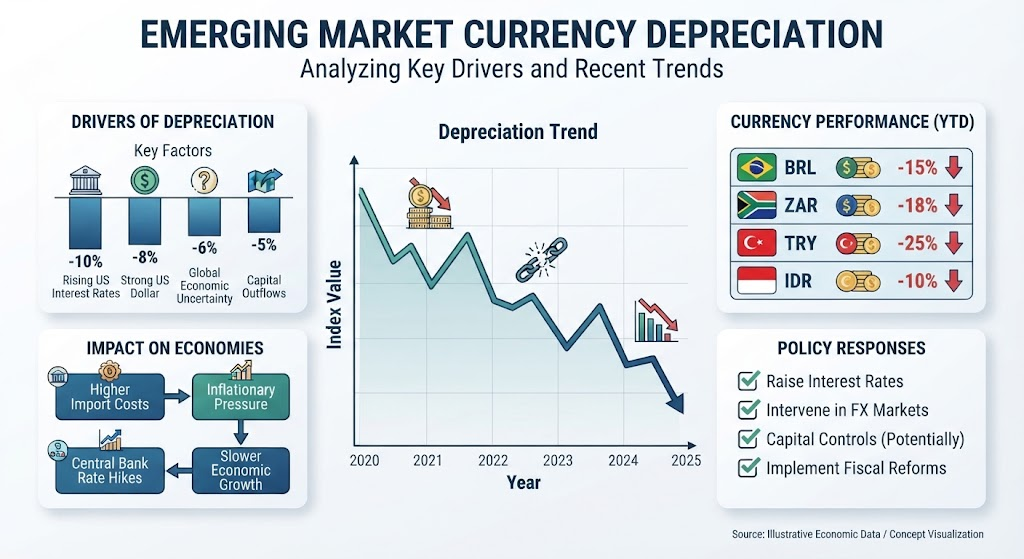
Currency depreciation is back in focus as investors, businesses, and policymakers assess how higher global yields, capital flows, energy costs, and domestic policy choices are reshaping exchange rates. The latest pressure has been most visible across parts of the emerging-market universe, where shifts in the U.S. dollar, foreign-investor positioning, and commodity prices can move quickly through local markets. For companies with cross-border costs and investors exposed to global markets, the issue is no longer theoretical: currency risk is again a central part of financial planning.
Why are currencies depreciating now?
Currencies depreciate when demand for one currency falls relative to another, and the current backdrop shows several forces working at once. Higher yields in major markets can draw capital away from emerging economies, while a stronger dollar raises the cost of servicing dollar-linked debt and importing globally priced goods. At the same time, economic instability, geopolitical stress, and commodity shocks can reduce investor appetite for local assets, making exchange rates more vulnerable to sudden moves.
Recent market signals underline that pressure. Reuters reported that foreign investors pulled money from emerging-market stocks and bonds in September 2026, with the Institute of International Finance attributing the move to a more hawkish U.S. Federal Reserve, higher yields, and a firmer dollar. Emerging Asian currencies also began October on a weaker footing as rising global bond yields eroded regional rate advantages, while investors remained cautious toward several oil-importing Asian currencies because higher crude prices can worsen external balances.
That combination helps explain why Emerging Market Currency Depreciation can accelerate even when domestic economies are still growing. Exchange rates respond not only to local fundamentals, but also to global liquidity, risk appetite, and the alternatives available to international capital. When investors can earn attractive returns in dollar assets, riskier local-currency bonds and equities often need a higher expected return to compete.
The latest pressure is tied to capital flows, yields, and commodities
Currency markets are often described as forward-looking, but in practice they also react to immediate funding conditions. When global investors reduce exposure to emerging-market stocks and bonds, they usually sell local currencies to repatriate funds or rebalance portfolios. That selling can become self-reinforcing if local asset prices fall, volatility rises, and hedging costs increase.
The yield channel is especially important. If U.S. or other advanced-economy yields rise, the relative reward for holding emerging-market currencies can shrink. Countries that previously benefited from a wide interest-rate advantage may suddenly look less attractive, particularly if inflation remains sticky or fiscal accounts appear stretched.
Commodity prices add another layer. For energy importers, higher oil prices can widen trade deficits because more foreign currency is needed to pay for imports. For food or fertilizer importers, price shocks can also feed domestic inflation, increasing social and fiscal pressure. The World Bank’s June 2026 Global Economic Prospects noted that worsening external balances in commodity-importing economies could create currency pressure, especially where international reserves are limited.
The effect is not uniform. Commodity exporters may benefit from higher export revenues, while importers can face a squeeze. Economies with deep local markets, credible monetary frameworks, and adequate reserves often absorb shocks better than economies with large external financing needs.
Key drivers behind depreciation
Several causes of depreciation tend to appear together rather than in isolation. The following drivers are the ones analysts most often monitor when assessing whether a currency move is temporary, orderly, or a sign of deeper strain:
- Interest-rate differentials: When yields rise elsewhere, local-currency assets may become less competitive. This can trigger outflows, especially from bond markets.
- Inflation gaps: If domestic inflation runs above trading partners’ inflation, purchasing power erodes and markets may expect the exchange rate to adjust.
- Current-account pressure: Countries that import more than they export need external financing. If that financing becomes expensive or scarce, the currency can weaken.
- Debt structure: Dollar-denominated debt increases vulnerability because depreciation raises the local-currency cost of repayment.
- Policy credibility: Investors react quickly to uncertainty around central-bank independence, fiscal discipline, and regulatory direction.
- Political and geopolitical risk: Elections, conflict, sanctions, or abrupt policy changes can increase risk premiums and reduce demand for local assets.
- Market depth: Shallow foreign-exchange markets can amplify moves because fewer buyers are available when selling pressure rises.
These factors also influence investment strategies. A currency may look undervalued on trade fundamentals, but still weaken if investors are reducing risk broadly. Conversely, a country with a current-account deficit may stabilize if policy credibility improves and capital inflows resume.
Emerging economies face a sharper feedback loop
Emerging economies often experience depreciation differently from advanced economies because exchange-rate moves pass more quickly into inflation, debt costs, and financial conditions. Many essential imports, including fuel, food, technology, and industrial inputs, are priced in dollars or other hard currencies. When the local currency weakens, importers pay more, businesses face margin pressure, and consumers can see higher prices.
The International Monetary Fund has highlighted the link between exchange rates and financial stability in emerging markets, noting that reliance on dollar funding, shallow local-currency markets, and foreign-investor exit risks can raise currency risk premia and weaken monetary transmission. IMF analysis has also described how financial shocks can produce nominal depreciation and short-run output declines in emerging-market settings.
This is why currency depreciation can become a macroeconomic issue rather than a market headline. A weaker exchange rate may push up inflation, which can force central banks to keep rates higher for longer. Higher rates then raise borrowing costs for households, companies, and governments. If growth slows as a result, investors may demand an even higher risk premium.
Debt levels matter in that loop. The World Bank reported in 2026 that aggregate government debt in developing economies had risen substantially since 2010, increasing vulnerability in countries with less fiscal space. When debt burdens are already high, depreciation can narrow policy choices because governments may need to support growth, control inflation, and reassure creditors at the same time.
Currency depreciation is not always a crisis
Depreciation is often treated as bad news, but the economic reality is more nuanced. A weaker currency can make exports cheaper for foreign buyers, support tourism, and help domestic producers compete against imports. In countries with flexible exchange rates, depreciation can also act as a shock absorber, allowing the currency to adjust instead of forcing all the pressure through employment, wages, or domestic demand.
The challenge is whether the adjustment is orderly. Gradual depreciation that reflects changing fundamentals is different from a disorderly selloff driven by panic, illiquidity, or a loss of confidence. Businesses can plan for the first; the second can disrupt pricing, supply contracts, and financing arrangements.
For policymakers, the trade-off is delicate. Defending a currency too aggressively can burn through reserves and tighten domestic liquidity. Allowing a currency to fall too quickly can fuel inflation expectations and undermine confidence. The right response depends on the cause of the move, the strength of institutions, and the level of external vulnerability.
For investors, depreciation can also create both risk and opportunity. Local-currency bonds may offer attractive yields, but returns can be erased if the currency weakens sharply. Export-oriented equities may benefit from a weaker currency, while companies reliant on imported inputs may suffer. That is why global markets increasingly price currency exposure as a core part of asset allocation rather than a secondary consideration.
What businesses and investors are watching next
For companies, currency risk shows up in practical places: import invoices, supplier contracts, foreign-currency loans, overseas payrolls, and repatriated profits. A U.S.-based company buying inputs from abroad may benefit from a stronger dollar, while an exporter selling into foreign markets may lose price competitiveness if customer currencies weaken. A firm in an emerging economy with dollar debt may see liabilities rise even if its local sales remain stable.
Investors face a parallel set of questions. The return on a foreign bond or equity position depends not only on the asset’s local performance, but also on the exchange rate between purchase and sale. In periods of market volatility, currency moves can dominate the total return.
Common responses include:
- Hedging selected exposures: Futures, forwards, and options can reduce uncertainty, although hedging has costs and may not be practical for every investor or business.
- Diversifying currency baskets: Exposure across multiple currencies can reduce dependence on one macroeconomic story.
- Matching revenues and costs: Companies can reduce natural mismatches by borrowing, invoicing, or sourcing in currencies aligned with cash flow.
- Monitoring reserve adequacy and external debt: Investors often examine whether a country has enough foreign-exchange buffers to manage stress.
- Separating temporary volatility from structural weakness: Short-term moves may reflect global positioning, while sustained depreciation can point to inflation, fiscal, or balance-of-payments problems.
These approaches do not eliminate losses, but they make currency exposure more visible. That visibility is valuable when markets move quickly and policy signals change.
Policy credibility will shape the next phase
Central banks and finance ministries have several tools to address depreciation, but each comes with trade-offs. Interest-rate increases can support a currency by improving returns for investors, yet higher rates can slow growth. Foreign-exchange intervention can smooth disorderly markets, yet reserves are finite. Capital-flow measures can reduce pressure in some cases, but they may also unsettle investors if seen as unpredictable.
The IMF’s 2026 Global Financial Stability Report warned that carry-trade unwinds and capital outflows can amplify currency pressure in emerging markets, particularly when global stress tightens financial conditions. Its related work on exchange-rate drivers emphasized that foreign-exchange intervention may be more appropriate when currency risk premia and market frictions, rather than ordinary macroeconomic adjustment, are driving the move.
Credibility is therefore central. Markets tend to respond better when policymakers explain their objectives, maintain consistent frameworks, and avoid measures that appear improvised. A central bank that is trusted to control inflation has more room to let the exchange rate move. A government with a clear fiscal plan may face less pressure from creditors during periods of global stress.
Still, no country controls all the variables. A sudden rise in global yields, a jump in oil prices, or a geopolitical shock can shift exchange rates even when domestic policy is sound. That is why analysts are watching not only individual currencies, but also the broader interaction among U.S. rates, energy markets, debt sustainability, and cross-border capital flows.
The broader lesson for global markets
The latest wave of currency pressure shows that depreciation is rarely caused by a single event. It is usually the result of overlapping forces: changing interest-rate expectations, inflation dynamics, trade balances, investor confidence, policy credibility, and global risk appetite. In emerging economies, those forces can feed through faster because external financing, imported inflation, and dollar-linked debt play a larger role.
For readers tracking investment strategies, the practical takeaway is clear: exchange rates deserve the same attention as earnings, yields, or economic growth forecasts. Currency risk can reshape returns, change competitive dynamics, and influence policy decisions. In a period of economic instability and recurring market volatility, understanding why currencies depreciate is essential to understanding how global markets move.
