
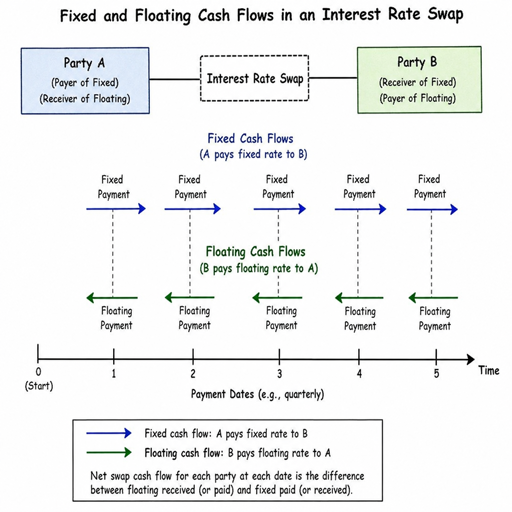
Interest rate swap market pricing is the process of valuing a contract that exchanges one stream of interest payments for another, usually fixed-rate payments for floating-rate payments. It helps borrowers, lenders, investors, and treasury teams understand whether a swap is fairly priced, how its value changes over time, and how it can support interest rate hedging. At its core, swap pricing compares the present value of expected fixed cash flows with the present value of expected floating cash flows.
What does interest rate swap pricing mean?
Interest rate swap pricing means determining the fixed rate, upfront value, or ongoing mark-to-market value of an interest rate swap based on expected future cash flows and current market discount rates. In a typical fixed-for-floating swap, one party pays a fixed rate while receiving a floating rate tied to a reference benchmark; the other party does the reverse. The fair swap rate is the fixed rate that makes the value of both payment legs equal at the start of the transaction.
This matters because interest rate swaps are not priced like simple loans. A loan has stated principal, interest, and repayment terms. A swap, by contrast, is a derivative contract: its value depends on future interest rates, payment dates, discount factors, day-count conventions, and the notional amount used to calculate payments.
In most standard swaps, the notional amount is not exchanged. It is simply the reference amount used to calculate interest. For example, a company might enter into a swap on a $10 million notional amount, paying a fixed rate and receiving a floating rate, without either party exchanging the $10 million itself.
The purpose of interest rate swaps in the market
Interest rate swaps are commonly used to manage exposure to changing interest rates. A borrower with floating-rate debt may use a swap to synthetically convert that exposure into a fixed-rate obligation. An investor holding fixed-rate assets may use a swap to gain floating-rate exposure. Banks, asset managers, insurers, corporations, and public entities may all use swaps for different risk management or portfolio purposes.
The economic goal is often stability. When a company is worried that rising rates could increase debt service costs, interest rate hedging through a pay-fixed, receive-floating swap can create more predictable cash flows. If floating rates rise, the company’s debt expense may increase, but the swap may produce offsetting receipts on the floating leg.
Swaps can also be used to express a market view, adjust duration, or align asset and liability profiles. However, their value can move in either direction after execution. Pricing derivatives requires careful attention to assumptions because even a contract that begins at zero value can become a material asset or liability as market rates change.
Core building blocks of an interest rate swap pricing model
An interest rate swap pricing model is built around projected cash flows and the present value of those cash flows. The exact model can vary by currency, market convention, collateral terms, and benchmark, but the central logic is consistent: estimate what each leg is expected to pay, discount those payments back to today, and compare the results.
Notional amount
The notional amount is the reference balance used to calculate interest payments. If the notional is $50 million and the fixed rate is 4%, the annual fixed interest amount before day-count adjustment would be $2 million. In practice, the actual payment depends on the payment frequency and day-count convention.
Notional can be constant, amortizing, accreting, or customized. A plain-vanilla swap often uses a fixed notional amount throughout the life of the contract. A swap designed to hedge a loan may amortize in line with the expected loan balance.
Fixed leg
The fixed leg is the stream of fixed-rate payments. These payments are usually known once the swap is executed because the fixed rate, notional, payment dates, and day-count convention are specified in the contract. This makes the fixed leg similar to a schedule of bond coupon payments.
The present value of the fixed leg depends on the discount factors assigned to each payment date. Later payments are discounted more heavily than near-term payments. When market discount rates rise, the present value of fixed payments generally falls; when discount rates decline, the present value generally rises.
Floating leg
The floating leg is based on a reference rate that resets periodically. The exact floating payment for a future period is unknown until the reset rate is observed or projected from the forward curve. For valuation, the model uses forward rates implied by the market curve to estimate future floating payments.
A floating leg can reset monthly, quarterly, semiannually, or on another schedule. The payment frequency, reset frequency, spread, and day-count convention all affect pricing. In some swaps, the floating leg may include a fixed spread above or below the reference rate.
Discount curve and forward curve
Modern interest rate swap pricing often distinguishes between the curve used to project future floating rates and the curve used to discount expected cash flows. The forward curve estimates future reset rates, while the discount curve converts future cash flows into present value.
For a simplified explanation, it is enough to say that swap pricing depends on the market’s current term structure of interest rates. A steep curve, flat curve, or inverted curve can each produce different fair fixed rates and different mark-to-market outcomes.
Interest rate swap pricing formula
The basic interest rate swap pricing formula compares the present value of the fixed leg with the present value of the floating leg:
Swap value = PV(floating leg) − PV(fixed leg)
This formula is often shown from the perspective of the fixed-rate payer. If the present value of the floating leg is greater than the present value of the fixed leg, the swap has positive value to the fixed-rate payer. If the fixed leg is worth more, the swap has negative value to that party.
The fixed leg can be expressed as:
PV(fixed leg) = N × fixed rate × Σ(accrual factor × discount factor)
Where:
- N is the notional amount.
- Fixed rate is the contractual swap rate.
- Accrual factor adjusts for the day-count convention and payment period.
- Discount factor converts each future payment into present value.
A simplified fair fixed rate can be expressed as:
Fair fixed rate = PV(floating leg) ÷ [N × Σ(accrual factor × discount factor)]
This is the rate that makes the swap’s initial value approximately zero, excluding costs, credit valuation adjustments, collateral effects, and other deal-specific features. In real market pricing, dealers may also incorporate bid-ask spreads, funding considerations, counterparty risk, capital costs, and operational factors.
How does a swap become fairly priced at inception?
A standard market swap is fairly priced at inception when the present value of expected payments by both sides is equal. That means neither party should owe an upfront payment solely because of the contractual rate, assuming the agreed fixed rate reflects current market conditions. The fixed rate that produces this balance is commonly called the par swap rate.
Imagine a five-year swap where one party pays fixed and receives floating. If the fixed rate is set too high relative to the current curve, the fixed-rate payer is agreeing to overpay compared with expected floating receipts. If it is set too low, the fixed-rate payer receives favorable terms. The pricing process solves for the rate that equalizes the value of the two legs.
After the trade date, the swap’s value changes as the market curve changes. If market fixed rates rise above the contract fixed rate, a pay-fixed swap may lose value because the payer is locked into a rate that is now less attractive than the new market rate. If market fixed rates fall below the contract fixed rate, that same pay-fixed position may gain value because the payer is paying a below-market fixed rate.
A simplified interest rate swap pricing example
Consider a company that wants to hedge floating-rate debt using a three-year pay-fixed, receive-floating interest rate swap. The notional amount is $10 million, payments are annual for simplicity, and the model uses simplified discount factors. This example is intentionally basic; real interest rate swap pricing would typically use actual market curves, exact payment dates, and precise day-count conventions.
Assume the discount factors are:
|
Year |
Discount factor |
|---|---|
|
1 |
0.9600 |
|
2 |
0.9200 |
|
3 |
0.8800 |
Assume the present value of the expected floating leg is $1,065,000. The annuity factor for the fixed leg is the sum of the annual accrual factors multiplied by the discount factors. With annual accrual factors of 1.0, the annuity factor is:
0.9600 + 0.9200 + 0.8800 = 2.7600
The fair fixed rate is:
$1,065,000 ÷ ($10,000,000 × 2.7600) = 3.86%
In this simplified interest rate swap pricing example, a fixed rate of about 3.86% would make the fixed leg and floating leg approximately equal at inception. If the company agreed to pay 4.10% instead, the swap would likely begin with negative value to the company, all else equal. If it agreed to pay 3.60%, the swap would likely begin with positive value to the company, assuming the floating-leg value and discount factors are accurate.
The important lesson is not the specific rate. It is the method: estimate floating cash flows, discount them, calculate the fixed-leg annuity, and solve for the fixed rate that balances the two sides.
Factors that influence market pricing
Interest rate swap pricing changes because the inputs are market-sensitive. A swap that looked balanced yesterday can show a gain or loss today if rates, spreads, or assumptions move. The most important drivers include:
- Yield curve level: Higher market rates generally reduce the present value of fixed payments, though the impact depends on the position.
- Yield curve shape: A steep or inverted curve changes projected floating payments and can affect longer-dated swap rates.
- Time to maturity: Longer swaps usually have more sensitivity to rate changes because more future cash flows remain.
- Payment frequency: Quarterly, semiannual, and annual payment schedules produce different accruals and discounting patterns.
- Day-count conventions: Small calculation differences can matter when notional amounts are large.
- Reference rate and spread: The floating benchmark and any contractual spread directly affect projected floating-leg value.
- Collateral and credit terms: Secured and unsecured swaps may be valued differently because discounting and counterparty risk assumptions can differ.
- Bid-ask spread: The execution price may differ from a theoretical mid-market value.
These factors explain why pricing derivatives is both mathematical and market-driven. The formula provides structure, but the quality of the inputs determines the quality of the output.
Practical steps in a pricing workflow
A disciplined pricing workflow helps reduce errors and makes the result easier to explain. The process does not need to be mysterious, but it does need to be consistent.
- Define the trade terms. Confirm notional, effective date, maturity date, fixed rate, floating benchmark, spread, payment frequency, reset dates, business-day convention, and day-count basis.
- Build or source market curves. Use appropriate forward and discount curves for the currency, tenor, and collateral framework.
- Project floating cash flows. Estimate future reset rates using the forward curve and apply the correct accrual factors.
- Calculate fixed cash flows. Multiply notional by fixed rate and accrual factor for each fixed payment period.
- Discount each cash flow. Apply the relevant discount factor to every expected payment date.
- Compare present values. Subtract PV fixed from PV floating, or reverse the sign depending on the valuation perspective.
- Review sensitivities. Test how value changes if rates move, especially for risk reporting and hedging decisions.
This workflow can support both initial pricing and ongoing mark-to-market valuation. It also creates an audit trail for internal review, lender discussions, accounting support, or risk committee analysis.
Pricing for hedging versus pricing for trading
The same valuation framework can serve different business objectives. A corporate treasury team may focus on whether a swap reduces cash-flow uncertainty. A trading desk may focus on relative value, curve positioning, and execution spread. An accounting team may need consistent valuation support for reporting.
For interest rate hedging, the key question is usually not whether the swap will make money in isolation. The question is whether the swap offsets the intended exposure. A pay-fixed swap may lose value when rates fall, but the borrower may also benefit from lower floating-rate debt costs. Evaluating the hedge and the underlying exposure together gives a clearer picture.
For trading or portfolio management, the swap’s standalone valuation, sensitivity, and curve exposure may be more central. Traders may examine duration, DV01, convexity, basis risk, and relative pricing across maturities. These concepts go beyond the basic interest rate swap pricing formula, but they build on the same present-value foundation.
Common mistakes to avoid
Interest rate swap pricing errors often come from small details that produce large consequences. Before relying on a valuation, review the assumptions behind it.
- Using the wrong curve: A curve that does not match the swap’s currency, tenor, collateral terms, or benchmark can distort value.
- Ignoring accrued interest: Valuation dates between payment dates may require careful treatment of accrued amounts.
- Mixing day-count conventions: Fixed and floating legs may use different conventions, and applying the wrong one changes cash flows.
- Confusing rate direction with value direction: Rising rates do not help every swap position; the effect depends on whether the party pays or receives fixed.
- Overlooking embedded features: Amortization, caps, floors, optional termination rights, and nonstandard reset rules may require more advanced modeling.
- Treating model output as execution price: Market execution may include dealer spread, liquidity considerations, and credit adjustments.
A clean model should make these assumptions visible. If the result cannot be explained in plain language, it may be difficult to defend when market conditions change.
Best practices for interpreting swap values
A swap value is most useful when it is tied to a decision. A positive or negative mark-to-market number by itself does not prove that a swap is good or bad. It shows the present value of the contract compared with current market pricing.
A practical review should include three perspectives. First, compare the contractual fixed rate with the current fair market swap rate for the remaining maturity. Second, examine cash-flow impact under different rate scenarios. Third, evaluate whether the swap still aligns with the original purpose, such as stabilizing interest expense or managing asset-liability duration.
It is also wise to separate valuation from suitability. A swap can be fairly priced and still be inappropriate for a specific borrower or portfolio. Likewise, a swap with a negative mark-to-market value may still be performing its hedging role if it offsets gains or lower costs elsewhere.
Key takeaways
Interest rate swap pricing is based on a straightforward idea: compare the present value of fixed payments with the present value of floating payments. The real complexity comes from the details, including market curves, cash-flow conventions, reset rules, collateral terms, and valuation perspective.
For most readers, the most important concepts are:
- The fair fixed rate is the rate that makes the swap worth approximately zero at inception.
- The basic swap value equals the present value of the floating leg minus the present value of the fixed leg, depending on perspective.
- Market value changes after execution as rates and curves move.
- Interest rate hedging should be evaluated together with the exposure being hedged.
- A reliable interest rate swap pricing model depends on accurate trade terms and appropriate market inputs.
Understanding these principles makes it easier to evaluate quotes, interpret mark-to-market reports, and discuss swap strategy with lenders, advisors, or internal stakeholders. The formulas are important, but the best pricing work connects the math to the business purpose behind the trade.
