
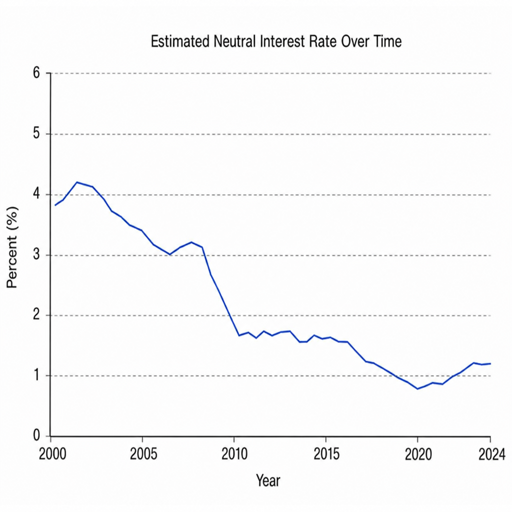
The neutral rate r-star is one of the most important ideas in monetary policy, even though it cannot be observed directly. It represents the real interest rate that would keep the economy near market equilibrium when inflation is stable and output is close to potential. Re-estimating it matters because changing productivity, demographics, fiscal policy, risk appetite, and global savings patterns can all shift the level of rates that feels “neutral” for an economy.
For investors, analysts, business leaders, and policy watchers, a fresh view of r-star helps interpret interest rate trends with more nuance. It does not predict the next central bank move by itself, but it can clarify whether central bank rates are likely restraining growth, stimulating activity, or sitting near economic balance.
What does neutral rate r-star actually mean?
Neutral rate r-star is the estimated real interest rate consistent with an economy operating at full capacity and inflation remaining stable. In simple terms, it is the rate that neither pushes the economy faster nor slows it down. When policy rates are above the neutral interest rate, monetary policy is generally considered restrictive; when they are below it, policy is generally considered accommodative.
The word “estimated” is doing a lot of work. R-star is not printed on a market screen, published in a bond quote, or revealed by a single data point. Economists infer it from models, inflation behavior, labor market conditions, growth potential, financial conditions, and long-run savings and investment dynamics.
That uncertainty is why neutral rate r-star re-estimation is not just an academic exercise. If the estimate is too low, policymakers may think rates are restrictive when they are merely normal. If it is too high, they may underestimate the pressure that elevated borrowing costs are placing on households, firms, and markets.
Why re-estimation matters now
The neutral interest rate can move as the structure of the economy changes. A period of weak productivity, aging populations, cautious investment, and high savings can pull r-star lower. Stronger productivity, larger public borrowing needs, higher investment demand, or a sustained shift in risk preferences can push it higher.
That makes re-estimation especially relevant after periods of economic disruption. When inflation, employment, credit conditions, and government borrowing all change meaningfully, older assumptions about market equilibrium may no longer fit the environment. The same policy rate that looked restrictive under one set of conditions may feel less restrictive under another.
For market participants, the practical issue is not whether a single r-star estimate is “right.” The issue is whether the direction of change is meaningful enough to alter expectations for central bank rates, bond yields, equity valuations, currency trends, and credit spreads.
A higher estimated r-star can imply that rates may settle above the levels investors previously considered normal. A lower estimate can suggest that the economy remains sensitive to relatively modest increases in borrowing costs. Either way, re-estimation affects how people read the distance between current policy and true economic balance.
The difference between nominal rates, real rates, and r-star
R-star is usually discussed as a real rate, meaning it adjusts for inflation. That distinction matters because households and businesses experience nominal borrowing costs, while economists often evaluate monetary policy through inflation-adjusted rates. A nominal rate may look high, but if inflation expectations are also high, the real rate may be less restrictive than it appears.
To think clearly about the neutral rate r-star, it helps to separate three related ideas:
- Nominal policy rate: The stated central bank rate or target range, before adjusting for inflation.
- Real policy rate: The nominal policy rate minus expected inflation over a relevant horizon.
- Neutral real rate, or r-star: The estimated real rate consistent with stable inflation and full-capacity output.
The gap between the real policy rate and r-star is one way to judge the stance of monetary policy. If the real policy rate is meaningfully above r-star, policy is likely leaning against demand. If it is below r-star, policy may be supporting demand. If it is near r-star, policy may be closer to neutral, although the economy can still face shocks from energy prices, financial stress, supply constraints, or fiscal changes.
This is also where communication becomes difficult. Central banks set nominal rates, markets trade nominal yields, and consumers see nominal mortgage, auto, and credit card rates. Yet the policy debate often depends on real rates and expectations, which are harder to observe and easier to misread.
How is the neutral rate r-star re-estimated?
Neutral rate r-star is re-estimated by combining economic models with observed data on inflation, output, employment, productivity, savings, investment, and financial conditions. Because r-star cannot be measured directly, economists use frameworks that infer it from how the economy behaves over time. Different models can produce different estimates, so the result is best viewed as a range rather than a fixed point.
A typical re-estimation process may include several layers of analysis:
- Update the data set. Analysts incorporate new information on inflation, labor markets, real growth, productivity, and financial conditions.
- Review long-run assumptions. They reassess potential output, trend productivity, demographics, savings behavior, and investment demand.
- Estimate the real rate gap. Models compare current real interest rates with the inferred level that would be consistent with economic balance.
- Test sensitivity. Analysts examine how much the estimate changes when assumptions about inflation expectations, output gaps, or trend growth shift.
- Compare model families. Structural models, semi-structural models, market-based indicators, and judgment-based approaches may all be used to avoid overreliance on one method.
- Translate the signal carefully. The final estimate informs policy and market interpretation, but it does not mechanically dictate the next interest rate decision.
The most useful re-estimation work is humble. It recognizes that r-star is surrounded by uncertainty and that the economy can look different depending on the time horizon. A short-run neutral rate may be affected by temporary shocks, while a long-run neutral rate reflects deeper forces such as productivity, demographics, capital demand, and global savings.
Key forces that can push r-star higher or lower
The neutral interest rate changes when the balance between desired saving and desired investment changes. If many people and institutions want to save while investment demand is limited, the neutral rate tends to fall. If investment needs rise or savings become less abundant, the neutral rate may rise.
Several forces are especially important:
- Productivity growth: Faster productivity can raise expected returns on investment, supporting a higher neutral rate. Weak productivity can do the opposite.
- Demographics: Aging populations may increase savings in some phases and reduce labor force growth, often placing downward pressure on r-star.
- Fiscal policy: Persistent government borrowing can raise demand for capital, potentially lifting the neutral interest rate if private savings do not offset it.
- Risk appetite: When investors demand safety, safe asset yields can fall. When risk tolerance shifts, equilibrium rates can move.
- Global capital flows: Open economies are influenced by international savings and investment patterns, not just domestic conditions.
- Inflation credibility: If people believe inflation will remain controlled, real-rate analysis becomes cleaner. If expectations become unstable, neutral-rate estimates become harder to interpret.
None of these forces works in isolation. For example, a country could experience aging demographics that push r-star lower while also facing large investment needs that push it higher. Re-estimation is valuable because it weighs these forces together rather than treating one variable as decisive.
What does re-estimation mean for monetary policy?
Re-estimation changes how central banks judge whether policy is tight, loose, or neutral. If policymakers conclude that r-star has moved higher, they may see a given level of central bank rates as less restrictive than previously thought. If they conclude r-star has moved lower, the same policy rate may appear more restrictive.
This matters because monetary policy works with delays. A central bank that misjudges neutral may keep rates too high for too long, increasing the risk of unnecessary weakness in employment, credit, and investment. It may also keep rates too low for too long, allowing inflation pressure or financial excess to build.
Still, r-star is only one input. Central banks also watch actual inflation, expected inflation, wage trends, credit growth, financial stability, exchange rates, and the resilience of consumer and business spending. A re-estimated neutral rate helps frame the discussion, but it does not replace the need for judgment.
For readers following policy statements, the key is to listen for language about “restrictive,” “neutral,” “real rates,” “longer-run rates,” and “data dependence.” These phrases often reveal how policymakers are thinking about the distance between current rates and the estimated level consistent with economic balance.
Implications for markets and business planning
A shift in the neutral rate r-star can ripple through financial markets because it affects expectations about the future path of rates. Bond investors may reassess fair value for yields. Equity investors may adjust valuation assumptions. Currency traders may revisit interest rate differentials. Credit markets may reprice default risk and refinancing conditions.
Businesses should not treat r-star as a trading signal, but it can improve planning conversations. If the neutral interest rate appears higher than before, companies may need to prepare for a world where financing costs remain firmer even after inflation cools. If r-star appears lower, high rates may be more likely to weigh on demand, making cash flow resilience and debt management more important.
A practical planning checklist can help translate the concept into decisions:
- Review debt maturity schedules. Identify refinancing windows and exposure to floating-rate debt.
- Stress-test borrowing costs. Model scenarios where rates settle above, near, or below prior assumptions.
- Revisit hurdle rates. Make sure investment decisions reflect realistic capital costs.
- Watch demand sensitivity. Higher real rates can affect customers’ ability or willingness to spend.
- Track central bank language. Look for changes in how policymakers describe neutral, restrictive, and accommodative policy.
- Avoid single-number thinking. Use a range of possible neutral-rate estimates rather than one precise figure.
The main benefit is not prediction. It is preparedness. A better understanding of r-star can make rate scenarios more disciplined and less reactive.
Common mistakes when interpreting r-star
The first mistake is treating the neutral rate as directly observable. It is an estimate, and estimates can change when new data arrives or when models are revised. Overconfidence in one number can lead to poor policy analysis and weak investment decisions.
The second mistake is confusing short-term market pricing with long-term economic equilibrium. Markets can move quickly because of positioning, liquidity, sentiment, or risk events. R-star is about the underlying rate consistent with balance over time, not every movement in yields.
The third mistake is ignoring inflation expectations. Since r-star is usually expressed as a real rate, the same nominal rate can have different policy implications depending on expected inflation. This is why two economies with similar central bank rates may face very different monetary conditions.
The fourth mistake is assuming neutral means painless. Even if rates are near neutral, some sectors can still struggle. Housing, banking, venture funding, commercial real estate, and consumer credit can each respond differently to the same broad policy setting.
A useful way to frame the debate
Instead of asking, “What is the exact neutral rate?” it is often better to ask, “Has the balance of evidence shifted?” That question encourages a range-based approach. It also keeps attention on the forces that matter: trend growth, savings, investment, inflation expectations, fiscal conditions, and global capital flows.
A simple framework can make the debate more practical:
- If growth is resilient, inflation pressure persists, and investment demand is strong, a higher r-star estimate may become more plausible.
- If growth softens, inflation expectations remain stable, and credit stress rises, a lower or unchanged estimate may be more convincing.
- If signals conflict, policymakers and markets are likely to place more weight on incoming data and less weight on any single model.
This framing respects uncertainty without making the concept useless. R-star does not need to be perfectly measured to be valuable. It provides a disciplined reference point for discussing whether monetary policy is pushing against the economy, supporting it, or approaching market equilibrium.
The bottom line
Neutral rate r-star re-estimation is a way to refresh our understanding of the interest rate that supports economic balance without fueling inflation or unnecessarily slowing growth. Because the neutral interest rate is unobservable, the best approach is to treat it as a range shaped by productivity, demographics, fiscal choices, global capital flows, and inflation expectations.
For anyone watching interest rate trends, central bank rates, or broader monetary policy, the value of r-star is perspective. It helps explain why the same policy rate can feel restrictive in one environment and closer to neutral in another. The estimate will never be perfect, but when used carefully, it can sharpen decisions, improve scenario planning, and make the rate debate more grounded in the forces that drive market equilibrium.
