
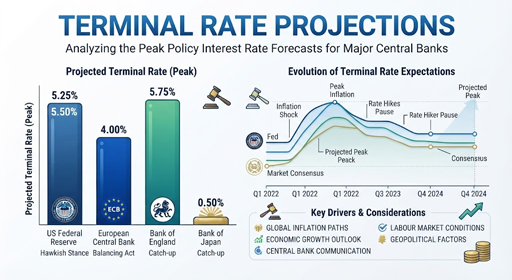
The Federal Reserve’s latest projections have pushed the idea of a “terminal rate” back into the center of economic and market debate. Released after the September 15–16, 2026 Federal Open Market Committee meeting, the new forecasts show policymakers expecting central bank rates to remain higher for longer than they projected in June, with inflation still above target in the near term. For investors, borrowers, lenders, and business planners, Terminal Rate Projections now serve less as a single endpoint and more as a map of how officials believe inflation, growth, and labor conditions may evolve.
The latest Fed projections reset the rate debate
The terminal rate is commonly understood as the peak policy rate in a tightening cycle, or the level at which a central bank believes monetary policy is restrictive enough to bring inflation under control without unnecessary additional increases. In practice, it is not announced as a permanent number. It is inferred from central bank communications, market pricing, economic data, and the path implied by official projections.
The September 2026 Summary of Economic Projections showed a median federal funds rate projection of 4.1% for the end of 2026 and 4.1% again for the end of 2027. The median then moves down to 3.9% in 2028, 3.6% in 2029, and 3.2% over the longer run. Those figures are higher than the June projections, which put the median federal funds rate at 3.8% for 2026, 3.6% for 2027, 3.4% for 2028, and 3.1% over the longer run.
That shift matters because it changes the baseline for interest rate forecasts. A higher projected path suggests policymakers believe inflation pressures require more restraint, that the economy can absorb tighter policy, or both. It also gives financial markets a reference point for judging whether current bond yields, lending rates, equity valuations, and currency moves are aligned with the likely policy path.
Why are terminal rate projections moving now?
Terminal rate projections are moving because the Fed’s latest outlook combines stronger growth, a firmer labor market, and inflation that is still expected to take time to return to 2%. The September projections put median real GDP growth at 2.3% in 2026 and 2.4% in 2027, while the unemployment rate is projected at 4.1% for each year from 2026 through 2029. At the same time, median PCE inflation is projected at 3.7% for 2026 before easing to 2.3% in 2027, 2.1% in 2028, and 2.0% in 2029.
That mix complicates the inflation rate outlook. If growth remains resilient and unemployment stays low, policymakers may see less urgency to cut rates quickly. If inflation cools more slowly than expected, rate hike expectations can return even after markets have started looking for relief. The result is a terminal-rate discussion that keeps shifting with each new inflation report, labor-market release, and Fed communication.
This is why investors often compare the Fed’s “dot plot” with market-based financial market projections. The dot plot reflects each policymaker’s judgment of the appropriate federal funds rate path under their own assumptions. Market pricing reflects what traders collectively expect, adjusted for risk, liquidity, hedging demand, and positioning. When those two signals diverge, volatility can rise because markets must decide whether the Fed will revise its projections or whether asset prices must adjust.
Key figures from the September 2026 outlook
The September update gave markets a clearer sense of where policymakers see policy heading, but it also highlighted uncertainty. The Fed said participants submitted projections based on information available at the meeting and on each participant’s view of appropriate monetary policy. That means the projections are conditional, not promises.
Key points from the latest projections include:
- Federal funds rate path: The median projection is 4.1% at year-end 2026 and 2027, easing only gradually after that.
- Longer-run rate: The median longer-run federal funds rate estimate rose to 3.2%, up from 3.1% in June.
- Inflation outlook: Median PCE inflation is projected at 3.7% in 2026, then 2.3% in 2027, 2.1% in 2028, and 2.0% in 2029.
- Core inflation: Median core PCE inflation is projected at 3.4% in 2026 and 2.5% in 2027, suggesting underlying price pressures remain a concern.
- Labor market: The unemployment-rate projection sits at 4.1% from 2026 through 2029, below the longer-run median estimate of 4.2%.
- Growth: Median real GDP growth is projected at 2.3% in 2026 and 2.4% in 2027, stronger than the Fed’s longer-run median estimate of 2.0%.
For readers tracking fed rate predictions, the most important message is not just the level of the 2026 or 2027 dot. It is the slope of the path. The Fed’s median forecast now implies that rates may stay near current restrictive levels for longer before declining toward the longer-run estimate.
Markets translate projections into borrowing costs
Terminal Rate Projections matter beyond central bank watchers because they influence the pricing of everyday credit. Mortgage rates, auto loans, business credit lines, credit card rates, and corporate bond yields do not mechanically copy the federal funds rate. Still, they are affected by the expected path of policy, inflation risk, and Treasury yields.
When markets expect a higher terminal rate, lenders often demand higher compensation for extending credit. Bond investors may also require higher yields if they believe policy will remain restrictive or inflation will stay elevated. Equity markets can come under pressure because higher discount rates reduce the present value investors assign to future earnings, especially for companies whose profits are expected farther in the future.
For businesses, the practical question is whether financing assumptions still hold. A company planning inventory, hiring, equipment purchases, or refinancing may need to test budgets against a slower decline in central bank rates. For households, the same logic applies to adjustable-rate debt, homebuying plans, and large purchases that depend on financing costs.
The terminal rate is a forecast, not a finish line
The term “terminal” can make the concept sound more final than it is. In economics, the terminal rate is best understood as a moving estimate of the peak or resting point of policy under current conditions. If inflation falls faster than projected, the peak could arrive sooner or lower. If inflation persists, growth accelerates, or financial conditions loosen too much, policymakers may judge that a higher rate is needed.
The Fed’s own materials underline that projections depend on assumptions and are surrounded by uncertainty. Participants submit forecasts based on their individual views of appropriate policy, and the longer-run projections represent where variables may converge over time in the absence of further shocks.
That uncertainty is especially important for interest rate forecasts. A terminal-rate estimate can shift after a single major inflation surprise, a labor-market break, a financial-stability concern, or a change in fiscal and global conditions. For this reason, economists typically watch the direction and distribution of projections rather than relying only on the median.
What to watch next
The next phase of the rate debate will depend on whether incoming data confirm the Fed’s September assumptions. Inflation readings will carry the most direct weight, particularly measures that show whether underlying services and core price pressures are cooling. Labor-market data will also matter because steady employment gives policymakers more room to focus on inflation.
Investors will also watch whether financial conditions tighten or loosen after the Fed’s message. If markets rally strongly and borrowing costs fall, officials may worry that policy is not restrictive enough to slow inflation. If credit conditions tighten sharply, the case for additional hikes could weaken even if inflation remains above target.
For now, the September projections point to a higher-for-longer policy path. The central takeaway is straightforward: terminal rate estimates are not just technical central-bank language. They are a live signal about the cost of money, the inflation rate outlook, and the assumptions driving financial market projections across the economy.
