
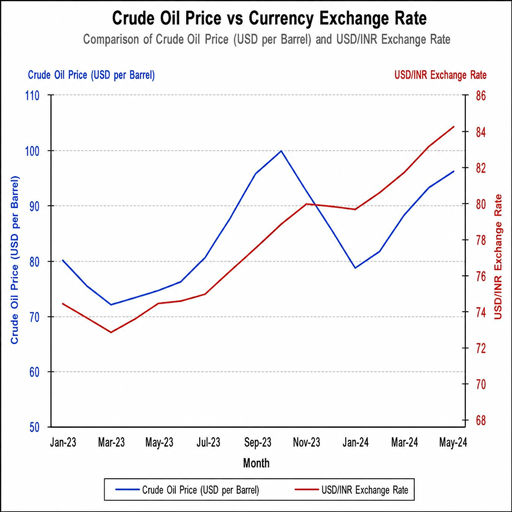
Crude oil is more than an energy commodity. Because it affects trade balances, inflation expectations, government revenue, and investor sentiment, oil market volatility can quickly show up in currency exchange rates. Understanding the crude oil volatility impact on currency markets helps traders, businesses, and analysts read risk more clearly instead of treating oil price fluctuations as isolated events.
When oil prices move sharply, the effect is rarely limited to energy companies. Importers may face higher costs, exporters may gain revenue, central banks may adjust their tone, and forex volatility may rise as markets reprice growth and inflation risks.
How does crude oil volatility impact currency markets?
Crude oil volatility impacts currency markets by changing the economic outlook for countries that either depend heavily on oil exports or consume large amounts of imported energy. When oil rises, exporters may benefit from stronger trade income, while importers may face pressure from higher import bills and inflation. When oil falls, those relationships can reverse, although the final currency reaction also depends on interest rates, growth expectations, risk appetite, and broader market conditions.
The crude oil volatility impact on currency values is strongest when oil price moves are sudden, persistent, or tied to a major supply-and-demand shock. A small daily move may be absorbed by the market, but a sharp shift in crude oil trends can force investors to reassess national budgets, corporate earnings, consumer spending, and monetary policy. That reassessment is what often turns energy volatility into currency volatility.
For example, a country that earns a large share of export revenue from oil may see its currency supported when oil prices rise, because foreign buyers need to purchase that country’s currency or assets. By contrast, a country that imports most of its energy may experience pressure if higher oil costs worsen its trade balance or raise inflation. These relationships are not automatic, but they are important starting points for analysis.
Oil exporters and importers respond differently
The first step in understanding oil price effects is to separate economies into broad groups. Oil-exporting countries and oil-importing countries do not experience the same shock in the same way. Higher oil prices may improve revenue for one country while creating cost pressure for another.
Oil-exporting currencies
Currencies linked to oil-exporting economies often attract attention during periods of rising crude prices. If investors believe higher prices will improve government revenue, support trade surpluses, or increase capital inflows, the local currency may strengthen. This is why currencies connected to resource-rich economies are often watched alongside crude oil charts.
However, higher oil prices do not always guarantee a stronger currency. If the economy is unstable, inflation is already high, debt levels are a concern, or investors are avoiding risk, the currency may fail to benefit. Political uncertainty, fiscal policy, and central bank credibility can also weaken the usual connection between crude oil trends and exchange rates.
Oil-importing currencies
Oil-importing economies often face a different challenge. Rising crude prices can make fuel, transportation, production, and imported goods more expensive. If those costs spread through the economy, inflation may rise and consumers may have less disposable income.
In some cases, a central bank may respond to inflation by keeping interest rates higher for longer, which can support the currency. In other cases, investors may focus on weaker growth and a deteriorating trade balance, which can weigh on the currency. This is why the same oil shock can produce different outcomes across different currency pairs.
The main channels connecting oil and exchange rates
Oil price fluctuations influence currencies through several overlapping channels. No single channel explains every move, but together they show why energy prices matter so much in foreign exchange analysis.
- Trade balances: Higher oil prices can improve the trade position of exporters and worsen the position of importers. A weaker trade balance may reduce demand for a currency, while stronger export revenue may support it.
- Inflation expectations: Oil affects fuel, transport, manufacturing, and consumer prices. If markets expect higher inflation, they may also expect changes in interest rate policy.
- Interest rate expectations: Central banks may react to oil-driven inflation or growth pressure. Since interest rates are a major driver of currency exchange rates, oil can affect forex pricing indirectly.
- Government budgets: In oil-dependent economies, public spending and fiscal stability may rely partly on energy revenue. Falling crude prices can pressure budgets and investor confidence.
- Risk sentiment: Oil shocks can signal geopolitical tension, supply stress, or weaker global demand. These themes often influence whether investors prefer riskier currencies or safer assets.
- Corporate earnings and capital flows: Energy producers, airlines, manufacturers, and transport companies may all be affected. Shifts in earnings expectations can influence equity markets and foreign investment flows.
The practical implication is simple: oil does not move currencies through one clean mechanism. It affects a chain of expectations, and forex markets react to how that chain changes.
Why oil price fluctuations can increase forex volatility
Oil price fluctuations can increase forex volatility because they create uncertainty around inflation, growth, trade, and policy at the same time. Currency traders do not only ask whether oil is up or down; they ask what the move means for future economic conditions. When that answer is unclear, bid-ask spreads may widen, short-term price swings may become sharper, and trend reversals may happen more often.
Volatility tends to rise when oil moves for reasons that are hard to price. A gradual price increase caused by steady demand may be easier for markets to digest than a sudden spike caused by a supply disruption. Likewise, falling oil prices may be positive for importers if they reflect cheaper energy, but negative if they signal weakening global demand.
This is where context matters. A drop in crude oil can support an energy-importing currency if investors see it as a relief for inflation and household costs. But if the same drop is interpreted as a warning sign for global growth, traders may move away from risk-sensitive currencies and toward perceived safer options.
Crude oil trends matter more than one-day moves
Single-day oil moves can make headlines, but broader crude oil trends usually matter more for currency exchange rates. A one-day spike may fade quickly, while a multi-week or multi-month shift can alter inflation forecasts, trade assumptions, and central bank communication.
Traders often compare short-term oil price action with longer-term trend signals. If crude breaks out of a range, holds above key levels, or continues moving in one direction, currency markets may start to price a more durable economic effect. Businesses that hedge currency exposure also tend to care about sustained trends because repeated cost changes can affect margins, contracts, and planning.
A practical way to interpret crude oil trends is to ask three questions:
- Is the move supply-driven or demand-driven? Supply shocks may hurt importers quickly, while demand-driven moves may reflect global growth strength or weakness.
- Is the move temporary or persistent? Short disruptions may have limited currency impact, while lasting price changes can reshape policy expectations.
- Is the country an oil exporter, importer, or mixed economy? The same oil move can be positive, negative, or neutral depending on the country’s energy profile.
This approach keeps analysis grounded. Instead of reacting to every price tick, you focus on whether oil is changing the macro story behind a currency.
Currency pairs most sensitive to oil market volatility
Some currency pairs tend to receive more attention during oil market volatility because one or both economies have a strong relationship with energy exports, imports, or inflation. This does not mean these pairs always move in predictable ways, but it does mean oil can be an important input.
Examples often watched by market participants include:
- USD/CAD: Canada is a major energy producer, while the United States is also deeply connected to global energy markets. Oil can be one factor in Canadian dollar sentiment, alongside rates, growth, and risk appetite.
- USD/NOK: Norway’s economy has meaningful exposure to energy exports, so oil prices may influence expectations for revenue, investment, and the krone.
- USD/MXN: Mexico has energy links, but the peso is also heavily influenced by interest rate differentials, U.S. growth, and risk sentiment.
- USD/JPY: Japan imports much of its energy, so oil price effects may appear through trade costs and inflation expectations, while the yen is also shaped by safe-haven flows and policy differences.
- USD/INR: India is a large energy importer, making oil costs relevant to inflation, trade balances, and currency pressure.
The key is not to trade these pairs on oil alone. Oil is one variable in a wider framework that includes monetary policy, current account dynamics, capital flows, political risk, and market positioning.
Reading oil price effects without oversimplifying them
It is tempting to build simple rules such as “higher oil means exporter currencies rise” or “lower oil means importer currencies rise.” Those rules can be useful as a first instinct, but they are incomplete. Markets are forward-looking, and currencies often move based on what investors think will happen next, not just what oil did today.
A stronger framework looks at both the direction of oil and the reason behind the move. Rising oil caused by strong global demand may support risk appetite and commodity-linked currencies. Rising oil caused by a geopolitical shock may increase inflation fears and push investors toward safer assets. Falling oil caused by better supply conditions may help importers, while falling oil caused by recession concerns may hurt risk-sensitive currencies.
A simple analysis checklist
Use this checklist when reviewing the crude oil volatility impact on currency pairs:
- Identify the oil move: Is crude rising, falling, or range-bound?
- Check the driver: Is the move linked to supply, demand, geopolitics, inventory expectations, or broader risk sentiment?
- Classify the currency: Is the economy mainly an oil exporter, an importer, or a mixed case?
- Watch inflation expectations: Could the oil move change the market’s view of consumer prices?
- Review central bank implications: Could policy rates, guidance, or rate expectations shift?
- Compare with the U.S. dollar: Since many oil contracts are priced in dollars, dollar strength or weakness can complicate the oil-currency relationship.
- Look for confirmation: Are bond yields, equity markets, and commodity-linked currencies telling the same story?
This checklist helps reduce emotional decision-making. It also encourages you to connect oil price effects with the larger macro environment instead of treating crude oil as a standalone trading signal.
Business planning implications beyond trading
The relationship between oil and currencies is not only relevant for forex traders. Importers, exporters, manufacturers, logistics firms, airlines, and energy-intensive businesses may all feel the combined effect of oil and currency movements. When both move against a company at the same time, costs can rise quickly.
For example, a business that imports goods and pays for fuel-linked shipping may face two pressures at once: higher energy costs and a weaker domestic currency. That combination can reduce margins unless pricing, contracts, or hedging plans are adjusted. On the other hand, an exporter earning foreign currency may benefit from a weaker local currency but still face higher transport or production costs.
Practical planning may include:
- Reviewing supplier contracts for fuel surcharge clauses.
- Stress-testing budgets against different oil and currency scenarios.
- Matching foreign currency revenues with foreign currency costs where possible.
- Discussing hedging tools with qualified financial professionals.
- Building flexibility into pricing, inventory, and logistics decisions.
The goal is not to forecast oil perfectly. The goal is to understand exposure before volatility forces rushed decisions.
Common mistakes when linking crude oil and forex
One common mistake is assuming correlation equals causation. A currency and crude oil may move together for a period, but both could be reacting to a third factor, such as U.S. dollar strength, interest rate expectations, or global risk sentiment. If that shared driver changes, the correlation can break down.
Another mistake is ignoring time horizons. Day traders may focus on intraday headlines, while corporate treasurers and long-term investors may care more about monthly averages and forward-looking policy risks. The same oil move can matter differently depending on whether the decision window is minutes, weeks, or quarters.
A third mistake is forgetting that exchange rates are always relative. A currency pair compares two economies, not one. Even if oil supports one currency, the other side of the pair may be affected by stronger interest rate expectations, safer capital flows, or a broader dollar move.
Key takeaways for interpreting oil and currency moves
Crude oil and foreign exchange markets are connected through trade, inflation, interest rates, fiscal policy, and investor psychology. The connection is strongest when oil market volatility changes expectations about the future rather than simply creating a brief price swing.
Keep these points in mind:
- Oil exporters and importers can react differently to the same price move.
- The cause of the oil move matters as much as the direction.
- Currency exchange rates respond to expected policy and growth effects, not only current commodity prices.
- Forex volatility can rise when oil shocks create uncertainty across several macro variables at once.
- Sustained crude oil trends usually matter more than isolated daily fluctuations.
- Oil should be used as part of a broader analysis, not as a standalone signal.
The crude oil volatility impact on currency markets is real, but it is rarely simple. By looking at the source of the oil move, the structure of the economy, and the policy response investors expect, you can build a clearer view of how oil price fluctuations may influence exchange rates. That balanced approach is more useful than relying on fixed rules, especially when markets are moving quickly.