
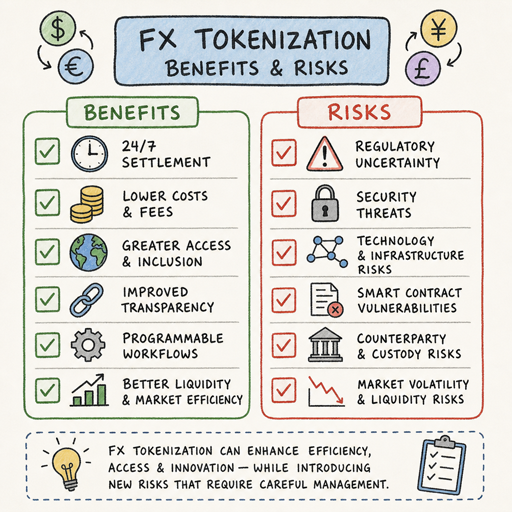
Blockchain is changing how foreign exchange participants think about ownership, settlement, collateral, liquidity, and post-trade workflows. Asset tokenization brings real-world or financial assets onto distributed ledgers as digital tokens, which can make certain FX processes faster, more transparent, and easier to automate when the legal, regulatory, and operational design is sound. This guide explains how blockchain tokenization applies to FX, where it may add value, and what firms should consider before adopting it.
What does asset tokenization mean in FX?
Asset tokenization in FX means representing a currency balance, financial instrument, collateral asset, or related claim as a digital token on a blockchain or distributed ledger. In practical terms, a token can act as a programmable record of value that can be transferred, settled, restricted, reconciled, or used in automated workflows. For FX markets, the core appeal is not novelty; it is the possibility of reducing friction in cross-border value movement, settlement coordination, collateral mobility, and operational reporting.
Traditional FX infrastructure relies on many intermediaries, account relationships, messaging systems, cut-off times, and reconciliation steps. Blockchain asset tokenization FX models try to simplify parts of that chain by creating a shared, tamper-resistant record of who owns what and under which conditions it can move. The token does not magically remove credit risk, legal risk, or regulatory obligations, but it can provide a different technical layer for representing and transferring value.
The phrase can apply to several types of tokenized assets, including tokenized deposits, stable-value tokens, tokenized money market instruments, tokenized bonds used as collateral, or tokenized fund units. In an FX context, the most relevant use cases tend to involve payment-versus-payment settlement, cross-border payments, liquidity management, and collateral transformation rather than speculative crypto trading.
The building blocks of blockchain tokenization
Blockchain tokenization combines legal structuring, asset custody, ledger technology, smart contracts, identity controls, and settlement processes. Each layer matters because a token is only useful if market participants can trust what it represents and rely on the rules that govern it. A token that is technically elegant but legally unclear is not a strong foundation for institutional FX activity.
The underlying asset or claim
Every tokenized asset starts with something it represents. That may be a fiat currency balance, a deposit claim against a regulated institution, a government bond, a corporate debt instrument, a fund share, or another financial asset. The token should clearly define whether the holder owns the asset directly, owns a beneficial interest, holds a contractual claim, or has access to redemption under specified conditions.
In FX, this distinction is especially important because settlement depends on finality and certainty. A token that represents cash must be understood differently from a token that represents a claim on a cash balance. Firms evaluating asset tokenization blockchain structures should look closely at redemption rights, bankruptcy treatment, custody arrangements, and the legal venue governing disputes.
The ledger and token standard
The ledger records token balances and movements. It may be a public blockchain, a permissioned blockchain, or a private distributed ledger operated by known participants. Public networks offer broad interoperability but may raise questions around privacy, compliance controls, transaction fees, and network governance. Permissioned networks can give institutions more control over participation, identity, and transaction rules, but they may be less open and less composable.
Token standards define how tokens behave. Fungible tokens are interchangeable, which suits currencies, deposits, and standardized instruments. Non-fungible tokens are unique, which is why nft tokenization is more often associated with one-of-a-kind rights, records, or assets. In FX, fungible token models usually matter more, though NFT-style structures could theoretically represent unique legal agreements, trade confirmations, or specific claims.
Smart contracts and programmability
Smart contracts are software instructions that execute on a ledger when predefined conditions are met. In tokenized FX workflows, they can help automate settlement logic, margin calls, corporate action handling, transfer restrictions, or compliance checks. They can also reduce manual coordination by making operational rules visible and consistent across approved participants.
However, programmability creates its own risks. If a contract is poorly designed, difficult to upgrade, or inconsistent with legal documentation, automation can amplify mistakes. Strong governance, testing, auditability, and contingency procedures are essential before smart contracts are used in high-value FX or collateral workflows.
Why tokenized assets matter for FX markets
Tokenized assets matter for FX because foreign exchange is both global and operationally complex. Even when trading is fast, settlement and post-trade processes can involve time-zone gaps, correspondent banks, nostro balances, credit lines, internal controls, and manual reconciliation. Digital asset tokenization offers a way to redesign some of those processes around shared records, automated conditions, and potentially faster transfer of value.
The practical value depends on the use case. Tokenization is not automatically better than existing systems, especially where current infrastructure is efficient, deeply liquid, and legally robust. Its promise is strongest where assets move across borders, settlement windows create exposure, collateral is trapped in silos, or participants need a common view of ownership and transaction status.
Key areas where tokenization may affect FX include:
- Settlement coordination: Tokenized cash or deposit claims may support payment-versus-payment mechanisms, where both sides of an FX transaction settle together or not at all.
- Collateral mobility: Tokenized bonds, funds, or cash-like instruments may be transferred or pledged more efficiently across platforms, subject to legal recognition.
- Liquidity management: Firms may reduce idle balances if value can move more predictably between locations, currencies, and counterparties.
- Operational transparency: A shared ledger can reduce mismatches between internal records, counterparties, custodians, and settlement agents.
- Programmable controls: Compliance rules, transfer restrictions, and approval workflows can be embedded into transaction logic rather than handled only after the fact.
For treasury teams, banks, brokers, asset managers, and payment providers, the strongest argument is not that blockchain is fashionable. It is that blockchain tokenization may help solve specific FX pain points when existing infrastructure creates cost, delay, risk, or opacity.
Core use cases for asset tokenization in FX
The most credible tokenization use cases in FX focus on settlement, payments, liquidity, and collateral. These are areas where ownership records and transfer mechanics directly affect risk and efficiency. Each use case requires careful design because FX markets operate within regulated financial systems, not outside them.
Tokenized cash and deposit claims
Tokenized cash structures aim to represent money or money-like claims on a ledger. Depending on the model, a token may represent a bank deposit, central bank money in controlled environments, electronic money, or a fully reserved private instrument. The key question is what the holder can redeem, from whom, and under what conditions.
In FX, tokenized cash can support faster cross-currency settlement if both legs of a trade can be exchanged on compatible rails. Instead of relying entirely on sequential settlement steps, parties may use atomic or conditional transfer logic. This can reduce the risk that one side pays while the other side fails to deliver, though it does not remove all counterparty, legal, or operational risk.
Tokenized collateral
Collateral is central to many FX relationships, especially for derivatives, prime brokerage, and institutional credit exposure. Tokenized collateral can make eligible assets easier to identify, pledge, transfer, or release. If the token accurately represents rights in the underlying asset, smart contracts can help automate parts of the margin process.
The benefit is especially relevant when assets are valuable but operationally slow to mobilize. For example, tokenized money market fund shares or high-quality securities could be used in workflows that require timely collateral movement. The challenge is ensuring that token transfers are legally effective, recognized by counterparties, and integrated with custody and risk systems.
Cross-border payments and treasury movement
FX and cross-border payments are closely linked. Businesses moving funds between countries often face delays, fees, limited transparency, and cut-off times. Tokenized assets may help by representing value on networks that operate continuously and provide a shared transaction record.
For corporate treasurers, this could mean better visibility into payment status and more flexible liquidity positioning. For payment providers, it could mean new settlement rails that reduce reliance on pre-funded accounts. But adoption depends heavily on regulatory approval, banking relationships, redemption reliability, and integration with local payment systems.
Tokenized FX instruments
Beyond cash and collateral, firms may explore tokenized versions of FX forwards, swaps, structured products, or fund exposures. Here, tokenization is less about moving currency itself and more about representing contractual rights and obligations in a programmable form. The goal may be to automate lifecycle events, reduce reconciliation, or improve transparency for approved participants.
This area is complex because FX instruments can involve credit support, valuation, margining, confirmations, amendments, and close-out provisions. Tokenizing the instrument without aligning the full legal and operational lifecycle may create more complexity rather than less. The strongest designs connect the token, contract documentation, pricing systems, risk controls, and settlement process into one coherent workflow.
How blockchain asset tokenization FX workflows operate
A tokenized FX workflow usually begins with asset issuance and ends with redemption, settlement, or lifecycle management. The exact process varies, but the same core steps appear in many institutional models. Understanding these steps helps firms distinguish a serious operating model from a superficial technology demo.
- Asset selection and legal structuring: The issuer defines what the token represents, who can hold it, how it can be redeemed, and which laws apply.
- Custody or reserve arrangement: The underlying asset is held, recorded, or safeguarded through an agreed structure.
- Token issuance: Tokens are created on the chosen ledger and allocated to eligible participants.
- Identity and access control: Participants complete onboarding, compliance checks, and permissioning before they can transact.
- Trade execution or instruction: Parties agree to an FX transaction, collateral movement, or payment instruction through a connected platform or workflow.
- Smart contract validation: The system checks balances, permissions, conditions, and settlement rules.
- Transfer and settlement: Tokens move between wallets or accounts according to the agreed logic.
- Reconciliation and reporting: Records are updated for participants, custodians, compliance teams, and internal systems.
- Redemption or lifecycle event: Tokens may be redeemed for the underlying asset, rolled, pledged, released, or adjusted as needed.
The power of this model is that several steps can be connected through a shared ledger rather than reconciled separately after the fact. The limitation is that the off-chain world still matters. Banking records, legal agreements, asset custody, regulatory reporting, and accounting systems must line up with the token record.
Benefits of blockchain tokenization for FX participants
The benefits of asset tokenization in FX are best understood as operational and structural improvements, not guaranteed investment returns. Tokenization can make certain workflows faster and more transparent, but only where participants, rules, and systems are designed to support that outcome. A token alone does not create liquidity, trust, or compliance.
Faster and more synchronized settlement
FX settlement risk arises when the two legs of a trade do not complete at the same time. Tokenized workflows can support synchronized settlement by linking transfers through programmable conditions. If both assets are available and both parties meet the rules, the transaction can complete; if not, it can fail or pause according to defined logic.
This can be valuable for institutions that operate across time zones or currencies with different settlement conventions. Faster settlement may also improve capital and liquidity efficiency. However, the benefit depends on network reach, asset availability, legal finality, and whether participants are willing to settle on the same infrastructure.
Improved transparency and reconciliation
Many FX operations teams spend significant effort reconciling trade records, cash movements, settlement confirmations, and collateral positions. A shared ledger can reduce breaks by giving authorized parties access to the same transaction history. Instead of each participant maintaining a separate version of the truth, the ledger becomes a common reference point.
Transparency does not mean all data must be public. Institutional tokenization platforms can use permissioning, privacy tools, and role-based access to protect sensitive information. The goal is controlled visibility: enough shared information to reduce errors, without exposing confidential positions or client data.
More flexible liquidity and collateral use
Liquidity can become fragmented across currencies, accounts, branches, custodians, and time zones. Tokenized assets may help firms move or pledge value in a more flexible way, especially if the network supports continuous operation and clear transfer rules. This can be useful when firms need to respond quickly to margin requirements, settlement obligations, or treasury needs.
Collateral tokenization may also reduce idle assets if previously trapped holdings can be represented and mobilized in approved workflows. Still, tokenized collateral is only useful if counterparties accept it, legal rights are enforceable, and valuation and risk systems can process it correctly.
Better programmability and compliance controls
Programmable tokens can carry rules about who may hold them, where they may move, and what approvals are required. This is particularly important in regulated FX environments, where anti-money laundering controls, sanctions screening, client classification, reporting obligations, and internal limits all matter. Tokenization can embed some controls earlier in the transaction process rather than relying only on after-the-fact monitoring.
That said, compliance cannot be fully outsourced to code. Rules change, facts require interpretation, and some decisions require human judgment. A strong tokenization model combines automated controls with governance, audit trails, exception handling, and clear accountability.
Risks and limitations firms need to manage
Digital asset tokenization introduces real opportunities, but it also creates risks that FX participants cannot ignore. The most common mistake is treating tokenization as a technology upgrade only. In reality, it affects legal rights, operations, cybersecurity, market structure, vendor dependence, and regulatory exposure.
Legal and regulatory uncertainty
Tokenized assets must fit within applicable financial laws. Depending on structure and jurisdiction, a token may be treated as money, electronic money, a security, a derivative, a deposit claim, a fund interest, or another regulated instrument. The same technical token can have different legal implications depending on its rights, issuer, holder base, and use case.
FX participants should avoid vague descriptions such as “backed by assets” without legal clarity. They need documentation that explains ownership, redemption, transfer restrictions, insolvency treatment, dispute resolution, and settlement finality. Legal review should happen before deployment, not after a pilot becomes operational.
Counterparty, issuer, and redemption risk
A token is only as strong as the promise behind it. If a token represents a claim on an issuer, the holder depends on that issuer’s ability and willingness to honor redemption. If the underlying asset is held by a custodian, the holder depends on custody controls and legal segregation.
In FX workflows, redemption risk can become liquidity risk. If participants cannot convert tokenized value into usable fiat currency when needed, the token may fail precisely when it matters most. Clear reserve policies, redemption procedures, audit rights, and contingency arrangements are essential.
Technology and cybersecurity risk
Blockchain infrastructure can reduce certain reconciliation issues while introducing new technical risks. Smart contract bugs, wallet compromise, key management failures, oracle errors, network congestion, and integration failures can all disrupt tokenized workflows. In high-value FX environments, operational resilience is non-negotiable.
Firms should evaluate whether the ledger has suitable performance, privacy, security, governance, and support arrangements. They should also plan for incidents. If a key is lost, a transaction is sent incorrectly, or a smart contract behaves unexpectedly, the organization needs predefined recovery and escalation procedures.
Fragmented liquidity and interoperability
Tokenization works best when many relevant participants can use the same or compatible networks. If tokenized assets sit on isolated platforms, liquidity may fragment rather than improve. A bank may accept one tokenized deposit, a broker may support another collateral token, and a corporate treasury team may still need traditional rails to complete the transaction.
Interoperability is therefore a strategic issue. Firms should examine whether a tokenization platform can connect with existing trading venues, custody systems, payment networks, risk engines, and reporting tools. The most useful solutions often complement existing infrastructure before they replace it.
Comparing traditional FX workflows and tokenized workflows
Tokenization should be evaluated against specific process improvements. A broad claim that blockchain is “faster” or “more efficient” is not enough. The better question is where the current workflow creates friction and whether tokenization addresses that friction without creating unacceptable new risks.
|
Area |
Traditional FX workflow |
Tokenized FX workflow |
|---|---|---|
|
Ownership records |
Maintained across internal ledgers, banks, custodians, and counterparties |
Recorded on a shared ledger with controlled participant access |
|
Settlement |
Often depends on banking rails, cut-off times, and sequential processes |
May support conditional or near-real-time transfers where assets are available |
|
Reconciliation |
Multiple parties compare records after events occur |
Authorized parties can reference a common transaction record |
|
Collateral movement |
May require custody instructions, confirmations, and manual checks |
Can be represented, pledged, or released through programmable workflows |
|
Compliance controls |
Applied through onboarding, monitoring, and operational review |
Can combine onboarding with embedded transfer restrictions and automated checks |
|
Key risks |
Settlement delay, reconciliation breaks, trapped liquidity |
Legal uncertainty, cyber risk, issuer risk, interoperability limits |
This comparison does not mean tokenized workflows are always superior. Traditional FX infrastructure is mature, trusted, and highly liquid in many areas. Tokenization is most compelling when it solves a clearly defined problem, such as reducing settlement exposure, improving collateral mobility, or creating a more transparent post-trade record.
How should firms evaluate a tokenization strategy?
Firms should evaluate tokenization by starting with a business problem, not a blockchain preference. A strong strategy identifies where FX workflows are slow, expensive, risky, or opaque, then tests whether tokenized assets can improve that process in a legally and operationally sound way. The best projects are narrow enough to govern but important enough to matter.
A practical evaluation should include the following checklist:
- Use case clarity: Define whether the goal is settlement, payments, collateral, liquidity, reporting, or instrument lifecycle automation.
- Legal certainty: Confirm what the token represents, who is liable, and how rights are enforced.
- Regulatory fit: Assess licensing, reporting, client protection, market conduct, sanctions, and anti-money laundering obligations.
- Asset quality: Understand the underlying asset, reserve model, custody setup, valuation method, and redemption process.
- Participant network: Identify who must join for the workflow to be useful, including banks, custodians, clients, venues, and service providers.
- Technology resilience: Review smart contract controls, cybersecurity, key management, privacy, scalability, and disaster recovery.
- Interoperability: Check how the platform connects to treasury systems, order management tools, settlement systems, accounting records, and compliance platforms.
- Governance: Define who can change rules, pause transfers, resolve disputes, approve participants, and manage incidents.
- Economic case: Compare expected benefits with integration costs, vendor costs, operational change, training, and risk controls.
This checklist also helps teams avoid chasing overly broad transformation projects. A focused pilot might examine one currency pair, one collateral type, or one internal treasury process. If the pilot proves value, the firm can expand gradually with stronger evidence and governance.
The role of NFT tokenization and other token models
Most FX tokenization use cases rely on fungible tokens because currencies and standardized claims are designed to be interchangeable. If one tokenized dollar claim has the same issuer, rights, and restrictions as another, they should usually be treated the same. That makes fungible token structures a natural fit for cash-like instruments, deposits, and standardized collateral.
NFT tokenization has a narrower but still relevant conceptual role. Non-fungible tokens can represent unique rights, documents, identifiers, or asset records. In an FX environment, this could theoretically apply to unique trade documents, collateral agreements, receivables, or specific contractual claims, though such models require careful legal and operational design.
The distinction matters because using an NFT structure for the wrong asset can create unnecessary complexity. FX teams should choose the token model based on the economic substance of the asset. If the asset is interchangeable, fungible tokenization is usually more appropriate; if the asset is unique, an NFT-style record may be worth considering.
Implementation best practices for FX teams
Successful asset tokenization projects usually combine financial market expertise with disciplined technology delivery. The work is not only about selecting a blockchain. It is about aligning legal rights, operational processes, controls, user experience, and commercial incentives.
Start with a controlled scope. Choose a workflow where the current pain point is measurable and where participants can agree on rules. Internal treasury transfers, collateral tracking, or a limited settlement pilot may be more realistic than a full market-wide transformation. Define success criteria before building, such as fewer reconciliation breaks, faster availability of funds, reduced manual steps, or improved visibility.
Bring legal, compliance, operations, treasury, risk, cybersecurity, and technology teams into the design early. Tokenization changes how value moves, so it cannot be left to one innovation team in isolation. Each function should understand what happens if the network pauses, a counterparty defaults, a token is incorrectly transferred, or a regulator asks for records.
Document the off-chain process as carefully as the on-chain process. The token record may show ownership or transfer, but the business still needs policies for onboarding, exceptions, accounting, tax treatment, customer communications, audits, and record retention. In institutional FX, operational details determine whether a promising concept becomes a usable system.
What the future of digital asset tokenization in FX may look like
The future of digital asset tokenization in FX is likely to be gradual, practical, and uneven across markets. Some use cases may remain experimental, while others become embedded into settlement, collateral, and treasury infrastructure. Adoption will depend on legal clarity, institutional trust, network participation, and the ability to connect tokenized assets with existing financial systems.
A realistic future is not one where all FX activity moves onto a single blockchain. More likely, firms will use a mix of traditional rails, permissioned networks, tokenized cash instruments, custody platforms, and interoperable settlement tools. The winners will be solutions that make FX workflows safer or easier without forcing participants to abandon controls they still need.
For businesses exploring blockchain asset tokenization FX opportunities, the path forward should be deliberate. Identify the workflow, verify the legal basis, test the operational model, and scale only when the benefits are clear. Tokenized assets can be powerful, but in FX, trust, liquidity, compliance, and execution quality remain just as important as the technology itself.