
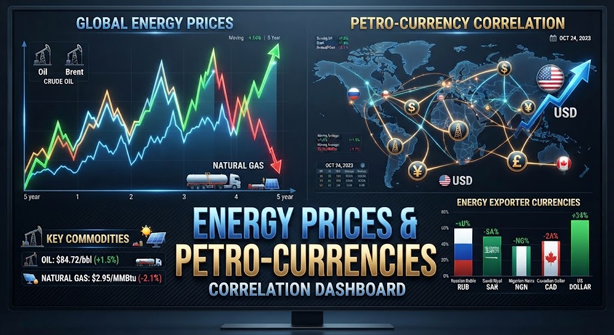
Energy prices and petro-currencies are closely connected because oil, gas, and other fuels are still priced, traded, and financed through global currency relationships. When fuel prices move, the effects rarely stop at the pump; they can ripple into shipping, food processing, packaging, electricity rates, and household budgets. Understanding the link helps readers make better sense of why gas prices rise or fall even when local conditions seem unchanged.
Why do petro-currencies matter when energy prices change?
Petro-currencies matter because major energy-exporting countries often see their currencies move with oil and gas revenues, while importing countries feel pressure when energy becomes more expensive in foreign currency terms. A petro-currency is typically associated with an economy where petroleum exports play a large role, so changes in global crude prices can influence national income, exchange rates, inflation, and trade balances.
This does not mean every movement in the energy market is caused by currency trading. Supply disruptions, refinery capacity, seasonal fuel rules, demand, interest rates, and geopolitics all matter. But currency values can amplify the final cost consumers and businesses see. If the U.S. dollar strengthens, dollar-priced oil may feel different to foreign buyers than it does to American buyers. If an exporting nation’s currency weakens while oil revenue falls, government budgets and investment plans can tighten.
For households, the connection feels indirect but real. Drivers notice gas prices first. Businesses notice fuel prices in freight bills, supplier quotes, and production costs. Over time, these increases may show up in food, construction materials, airline tickets, or monthly utility costs.
The energy market links global shocks to local prices
The energy market is global at the commodity level and local at the retail level. Crude oil may trade internationally, but gasoline prices depend on refining, distribution, taxes, inventories, regional fuel standards, and station-level competition. That is why two states, or even two nearby metro areas, can experience different prices at the same time.
A useful way to think about price movement is to separate the layers:
- Global commodity prices: Crude oil, natural gas, and refined products respond to supply, demand, conflict, production decisions, and expectations.
- Currency effects: Exchange rates influence what energy costs in different countries and can affect importers, exporters, and investors.
- Refining and blending: Gasoline and diesel must meet specifications, and seasonal or regional blends can affect availability and cost.
- Transportation and storage: Pipelines, terminals, trucks, ports, and inventories determine whether supply reaches the right place on time.
- Retail conditions: Local taxes, competition, operating costs, and demand shape the final price consumers see.
This layered structure explains why a headline about oil may not immediately match the price on a neighborhood sign. It also explains why policy actions sometimes focus on logistics or fuel specifications rather than trying to control the global price of oil directly.
How can government action affect gas prices?
Government action can affect gas prices by changing taxes, emergency fuel rules, transportation requirements, environmental specifications, or supply logistics, but it usually cannot override global supply and demand by itself. A recent example is Michigan, where Governor Gretchen Whitmer issued Executive Order 2026-4 on April 2, 2026, declaring a state of energy emergency in response to sharply rising gasoline prices; the state said the order was intended to save motorists money at the pump by easing certain fuel-blend requirements. (michigan.gov)
This is the context behind the search phrase “governor whitmer issued an energy emergency order lowering gas prices.” More precisely, the order aimed to lower or relieve gas prices by allowing different gasoline blends under emergency conditions. According to the official order, Michigan reported that regular gasoline averaged $3.89 per gallon on April 2, 2026, up from $2.99 before the cited conflict, and the order was set to remain in effect no later than July 1, 2026, unless extended under state law. (michigan.gov)
The broader lesson is that energy policy often works through bottlenecks. If a rule limits which fuel can be sold in a region, temporary flexibility may expand supply. If a storm damages transportation infrastructure, emergency orders may prioritize delivery. These actions can help at the margin, but they do not make a region immune to global price pressure.
Energy costs move through the food supply chain
Energy is embedded in the food industry long before a product reaches the shelf. Farms use diesel, electricity, fertilizer inputs, irrigation, refrigeration, and transport. Processors use heat, power, packaging lines, sanitation systems, and cold storage. Distributors rely on trucks, warehouses, and route planning.
That is why the phrase grain protein packaging energy prices food industry may look awkward, but the connection is practical. A grain-based protein product, for example, may be affected by crop input costs, milling, extrusion or processing energy, packaging materials, and freight. If electricity rates rise, the processing plant may pay more to operate. If diesel rises, inbound grain and outbound finished goods become more expensive to move. If petrochemical-based packaging costs increase, margins can tighten again.
Food companies often respond in several ways:
- Operational efficiency: Reducing waste, improving equipment maintenance, and optimizing production schedules.
- Packaging review: Lightweighting materials, redesigning cases, or adjusting supplier contracts.
- Freight planning: Consolidating loads, improving routing, or shifting warehouse strategy.
- Pricing discipline: Deciding whether to absorb costs, adjust pack sizes, or change wholesale prices.
- Energy sourcing: Exploring fixed-rate contracts, on-site generation, or efficiency upgrades where feasible.
For consumers, this means energy inflation may appear as higher shelf prices, smaller promotions, fewer discounts, or changed product formats rather than a clearly labeled “fuel surcharge.”
Electricity rates are part of the same affordability story
Gasoline gets public attention because drivers see the price every day, but electricity rates can be just as important for households and businesses. Monthly bills affect renters, homeowners, factories, grocery stores, data centers, farms, and restaurants. When electricity costs rise, the impact can compound with fuel prices because many businesses pay for both transportation and power.
Electricity pricing is different from gasoline pricing. It is shaped by generation sources, grid investment, fuel costs, regulation, demand peaks, transmission constraints, and utility planning. Natural gas prices can influence power costs in regions where gas-fired plants set marginal electricity prices. Renewable energy, storage, nuclear power, coal retirements, and transmission buildout can also affect long-term rate trends.
For a business, the practical question is not only “What is the rate today?” but “How exposed are we to volatility?” A food processor with refrigeration loads, a packaging manufacturer with high electricity demand, or a retailer with many locations may need a different strategy than a small office.
Practical ways to read energy price news
Energy headlines can be noisy. A better approach is to look for the mechanism behind the movement.
Use this quick checklist:
- Is the story about crude oil, gasoline, diesel, natural gas, or electricity? Each market behaves differently.
- Is the change global, national, regional, or local? Local supply rules can matter even when global prices are stable.
- Is currency part of the story? Petro-currencies and exchange rates may influence trade flows and producer revenues.
- Is the issue temporary or structural? A refinery outage is different from years of underinvestment.
- Who absorbs the cost first? Households, shippers, utilities, manufacturers, and retailers feel price changes on different timelines.
This framework helps separate political claims from market mechanics. It also makes it easier to understand why relief measures may help in one state or sector while doing little elsewhere.
The takeaway for consumers and businesses
Energy prices and petro-currencies are not abstract financial topics. They influence gas prices, fuel prices, electricity rates, and the hidden cost structure behind food, packaging, transportation, and everyday goods. The link is complex, but the pattern is simple: when energy becomes more expensive or more volatile, the effects spread through the economy.
Consumers can respond by tracking usage, comparing plans where available, maintaining vehicles, and budgeting for volatility. Businesses can map energy exposure across production, freight, packaging, and utilities. In both cases, the goal is not to predict every market move. It is to understand where energy risk enters the budget and make smarter decisions before the next price shock arrives.