
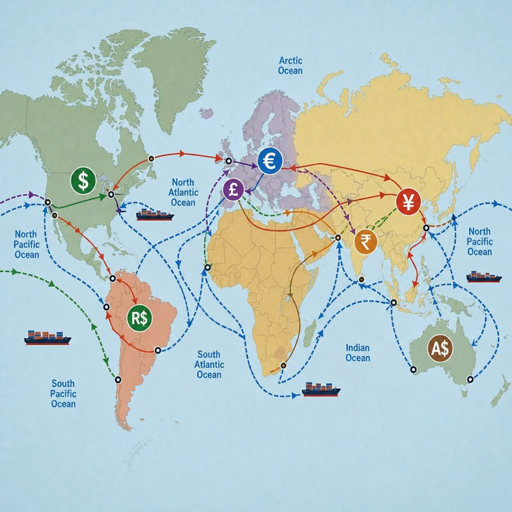
Global supply chain disruptions affect foreign exchange because they change the cost, timing, and currency exposure of international trade. When freight, energy, inputs, or inventory buffers become more expensive, companies often face margin pressure in one currency while paying suppliers, carriers, lenders, or customers in another. This article explains the global supply chain disruptions FX impact in practical terms, with a focus on what finance, procurement, and supply chain management teams should watch in 2026.
How do global supply chain disruptions affect FX?
Global supply chain disruptions affect FX by changing trade flows, inflation expectations, interest-rate paths, and demand for safe-haven currencies. If a company imports goods priced in U.S. dollars while earning revenue in a weaker local currency, a logistics shock can quickly become a currency shock. The same disruption can also affect exporters, because late shipments, higher input costs, and customer renegotiations may reduce the benefit of a favorable exchange rate.
The mechanism is usually indirect. A port delay, route closure, tariff change, or energy shock raises landed cost. Higher costs can feed into producer and consumer prices, which may influence central bank policy. As markets reprice inflation, growth, and interest-rate expectations, exchange rates move — sometimes before the operational cost is fully visible in invoices. The New York Fed’s Global Supply Chain Pressure Index is designed to combine transport cost and manufacturing data into a broader gauge of supply chain pressure, and related research links changes in the index with goods and producer price inflation in major economies.
That is why the phrase “global supply chain disruptions fx impact” matters for more than traders. It belongs in boardroom planning, working-capital reviews, supplier negotiations, and customer pricing conversations.
The 2025–2026 disruption cycle is different from the pandemic shock
The supply chain crisis that followed the pandemic trained companies to think about congestion, container shortages, and single-source risk. Global supply chain disruptions 2025 and 2026 added a different mix: trade policy shifts, regional conflict, energy-market stress, shipping-route uncertainty, and targeted shortages in critical inputs.
McKinsey’s 2025 supply chain risk research described how companies had been managing repeated external shocks through larger buffers and resilience measures, including responses to tariffs, conflict in Europe and the Middle East, and post-pandemic volatility. In 2026, the focus widened further as energy and shipping disruptions became more central to the macro story. The IMF noted that shipping and air disruptions can slow trade, raise supply chain costs, and hit import-reliant economies especially hard.
By May 2026, global supply chain disruptions were again visible in pressure indicators. Reuters reported that the New York Fed’s index eased only slightly to 1.77 in May from 1.82 in April, remaining elevated as Middle East conflict affected oil and other goods flows. S&P Global also reported that global new export orders fell in May 2026, with weaker trade volumes, higher energy costs, and safety-stock building reflecting concern about supply constraints.
The practical takeaway is simple: today’s supply chain issues are not only about whether goods arrive. They are also about which currency costs are paid in, how long cash is tied up, and whether hedges still match the operating reality.
The main FX channels companies should monitor
FX exposure usually becomes more complex during disruption because normal assumptions break. A supplier that invoices in euros may switch contract terms. A carrier may add dollar-denominated surcharges. A customer may delay payment. Inventory may sit in transit while exchange rates move against the buyer.
Key channels include:
- Import cost pass-through: A weaker home currency makes foreign inputs more expensive, especially when goods, freight, fuel, or insurance are priced in dollars.
- Export competitiveness: Currency depreciation can help exporters on price, but only if they can produce and ship reliably.
- Working-capital timing: Longer lead times increase the gap between purchase orders, payments, delivery, and customer cash collection.
- Commodity-linked FX pressure: Energy or food importers may see currency stress when global commodity prices rise.
- Hedge mismatch: Forecast-based hedges can become too large, too small, or timed incorrectly when shipments are delayed or rerouted.
- Supplier solvency risk: Vendors facing unfavorable FX moves may request repricing, shorter payment terms, or currency clauses.
The U.S. dollar deserves special attention because of its role in trade invoicing. BIS research has noted that dollar appreciation tends to raise foreign import prices because of the dollar’s central role as an invoicing currency, and that effect can compound inflation when commodity prices are also rising. For companies outside the U.S., this means a stronger dollar can make the same supply chain disruption feel larger in local-currency terms.
Why does supply chain management now require currency planning?
Supply chain management requires currency planning because procurement decisions create financial exposures before finance teams see the full cash impact. Choosing a supplier, route, incoterm, payment date, or inventory policy can change the amount of foreign currency a company needs and the timing of that need.
In stable periods, finance teams can often hedge based on predictable order cycles. During disruption, those cycles stretch and split. A shipment might be booked in one month, delayed into the next quarter, partially delivered, and repriced after a carrier surcharge. If the hedge was built around the original schedule, the company may be protected on paper but exposed in practice.
Good supply chain management therefore connects operational and financial data. Procurement should know which contracts have currency-adjustment clauses. Treasury should know which purchase orders are most likely to move. Sales should know when exchange-rate changes make old quotes unprofitable. Operations should know that expediting freight may solve a customer problem while creating a new FX or margin problem.
A useful internal workflow looks like this:
- Map currency by supplier and lane. Identify invoice currency, payment timing, and exposure by product category.
- Separate committed from forecast exposure. Hedge firm purchase orders differently from uncertain demand.
- Track disruption triggers. Monitor ports, routes, tariffs, energy inputs, supplier countries, and lead-time changes.
- Update landed-cost models weekly during stress. Include freight, duties, insurance, FX, financing, and expected delay costs.
- Align pricing and hedging decisions. Customer quotes should reflect both supply availability and currency risk.
- Review hedge effectiveness after delays. Make sure contracts still match actual shipment and payment dates.
This is not about turning supply chain teams into currency traders. It is about making sure operational decisions and FX risk controls are based on the same reality.
Inflation, interest rates, and FX amplify each other
Supply disruptions can create a feedback loop. Higher freight or energy costs push up import prices. Higher import prices raise inflation concerns. Central banks may keep policy tighter for longer, while investors shift capital toward currencies with stronger yields or safer perceived fundamentals.
The IMF’s July 2026 World Economic Outlook update warned that renewed conflict could increase commodity-price volatility, threaten supply chains, raise prices, and weigh on financial conditions. It also noted that where disorderly depreciation amplifies inflation or balance-sheet stress, temporary FX intervention or targeted capital-flow measures may be part of the policy toolkit. The BIS Annual Economic Report 2026 similarly described how energy shocks can propagate through supply chains and keep inflation pressure alive even after an initial disruption begins to ease.
For companies, the implication is that FX risk should not be treated as a separate spreadsheet exercise. It sits inside a larger cost environment. If suppliers raise prices because of fuel, carriers add surcharges, and the home currency weakens at the same time, the combined effect can be much larger than any single line item suggests.
Practical actions for finance and operations teams
Companies cannot control geopolitical shocks, commodity prices, or currency markets. They can, however, reduce the chance that a disruption becomes a surprise liquidity event.
Use this checklist to strengthen resilience:
- Create a shared exposure dashboard that combines open purchase orders, shipment status, invoice currency, hedge coverage, and payment due dates.
- Stress-test major currency pairs against realistic delay scenarios, not just month-end exchange-rate moves.
- Renegotiate terms before crisis peaks, including currency clauses, payment windows, minimum order quantities, and surcharge transparency.
- Build supplier optionality carefully. A backup supplier is only useful if its currency, logistics route, quality process, and payment terms are understood.
- Keep safety stock targeted. Extra inventory can reduce service risk, but it can also lock in working capital and FX exposure.
- Coordinate pricing governance. Sales teams need clear rules for when FX, freight, or duty changes justify quote revisions.
- Review natural hedges. Matching costs and revenue in the same currency can reduce net exposure without relying only on financial derivatives.
The best approach is cross-functional. Treasury can measure risk, procurement can negotiate flexibility, logistics can flag delays, and commercial teams can protect margins. None of those functions has the complete answer alone.
Turning disruption into a planning advantage
The companies that handle global supply chain disruptions 2026 most effectively will not be the ones that predict every shock. They will be the ones that notice exposure early, update assumptions quickly, and connect supply chain decisions with cash, margin, and currency outcomes.
That means treating FX as part of operational resilience. A delayed shipment is not only a delivery problem. It may also be a hedge-timing problem, a pricing problem, a supplier-credit problem, and a working-capital problem. When teams see those links, they can make better decisions under pressure.
The broader supply chain crisis has made one lesson clear: efficiency without visibility is fragile. Businesses that combine supply chain management with disciplined FX planning are better prepared for volatility, whether the next shock comes from a port, a policy change, an energy market, or a currency screen.