
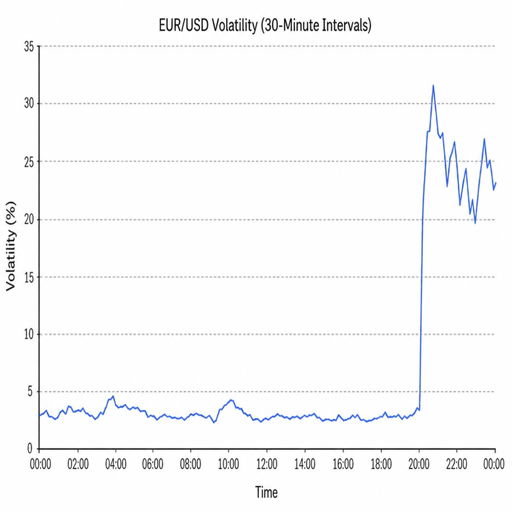
Cross-currency volatility can rise quickly when markets reassess interest rates, inflation, growth, policy risk, or investor confidence across more than one economy at the same time. For businesses, investors, and finance teams, these spikes can turn routine payments, forecasts, and hedges into moving targets. Understanding what drives volatility in forex helps decision-makers separate normal currency fluctuations from risk events that require a more deliberate response.
What causes cross-currency volatility to spike?
Cross-currency volatility spikes when the market rapidly changes its view of the relative value of two currencies. That shift may come from economic data, central bank guidance, political uncertainty, commodity price moves, or a sudden change in global risk appetite. Because currency pairs reflect two economies at once, pressure can build from either side of the exchange rate, and sometimes from both.
A simple example is a currency pair where one central bank is expected to keep rates high while the other is expected to cut. Traders may quickly reprice the pair, exporters may adjust their hedging, and investors may move capital toward the currency with the more attractive yield. The result can be sharp intraday moves, wider spreads, and less confidence in short-term forecasts.
Volatility also tends to cluster. Once a major pair starts moving aggressively, related crosses may follow as market participants rebalance exposures. This is why cross-currency volatility is not only a trading issue; it is also a planning issue for any organization with revenues, costs, assets, or liabilities in multiple currencies.
The mechanics behind fast currency fluctuations
Currency fluctuations are not random noise, even when they look chaotic on a screen. They are usually the visible result of new information meeting existing positions. If many investors are positioned the same way, a surprise can force rapid exits, creating a larger move than the news alone might imply.
Liquidity matters as well. During calm periods, major currencies often trade with deep participation and tighter bid-ask spreads. During stress, market makers may quote more cautiously, leveraged traders may reduce exposure, and execution costs can rise. This can make forex volatility feel self-reinforcing: prices move, liquidity thins, and thinner liquidity allows prices to move further.
There is also a timing effect. Data releases, central bank meetings, elections, budget announcements, and geopolitical developments can all concentrate attention into specific windows. When expectations are strong going into those events, even a small surprise can trigger a large exchange rate reaction.
Key drivers often include:
- Interest rate expectations: Currency values often react when markets revise expectations for future policy rates.
- Inflation surprises: Higher or lower inflation can change assumptions about purchasing power and central bank action.
- Growth signals: Strong or weak economic data can alter demand for a country’s assets and currency.
- Risk sentiment: In uncertain markets, investors may seek perceived safe-haven currencies or reduce exposure to higher-risk regions.
- Commodity exposure: Currencies tied closely to energy, metals, or agricultural exports can move when commodity prices swing.
- Political and fiscal uncertainty: Elections, policy changes, and debt concerns can quickly reshape confidence.
Why exchange rate risk matters beyond trading desks
Exchange rate risk affects more than active forex traders. A manufacturer buying components abroad, a software company billing international clients, a university collecting overseas tuition, or a fund holding foreign assets can all feel the impact of sharp cross-currency moves. The challenge is not only that rates change, but that they can change at the wrong time.
For a business, a sudden move may reduce margins on a signed contract, increase the local-currency cost of imported goods, or distort reported revenue after conversion. For investors, a profitable foreign asset can deliver disappointing domestic-currency returns if the exchange rate moves against them. For lenders and borrowers, mismatched currencies can create repayment pressure if cash flows and obligations are not aligned.
The practical issue is predictability. Budgets and forecasts usually assume a range of possible outcomes. When cross-currency volatility breaks outside that range, leaders may have to revisit pricing, sourcing, working capital, or hedge coverage. That is why currency risk management should not be treated as a one-time transaction. It is an operating discipline.
Signs that a volatility spike deserves attention
Not every rise in forex volatility requires a major response. Some moves are short-lived, technical, or limited to a narrow part of the market. The important task is to identify when volatility is likely to affect cash flows, pricing, or strategic decisions.
A useful starting point is to compare the current move with your actual exposures. If your organization has no near-term payments, receivables, or balance sheet items in the affected currencies, the move may be worth monitoring rather than acting on immediately. If you have large upcoming conversions, contract renewals, or margin-sensitive imports, the same move could be material.
Watch for these warning signs:
- The move is broad, not isolated. Several related currency pairs are moving at once, suggesting a wider market repricing.
- Volatility is tied to policy uncertainty. Central bank or government decisions can keep markets unsettled beyond one trading session.
- Spreads are widening. Execution may become more expensive or less reliable during stressed conditions.
- Your forecast rate is no longer realistic. Budget assumptions may need to be refreshed before decisions are made.
- Natural offsets are weakening. Revenues and costs that usually balance each other may no longer move in sync.
- Counterparties are changing terms. Suppliers, customers, or lenders may shorten quote validity or add buffers.
How should businesses approach currency risk management during spikes?
Businesses should approach currency risk management during volatility spikes by first mapping exposure, then separating urgent cash-flow risk from longer-term strategic risk. The goal is not to guess the next exchange rate perfectly. The goal is to reduce the chance that currency movements disrupt margins, liquidity, or decision-making.
A practical response begins with visibility. Teams need to know which currencies are involved, when conversions are expected, whether the exposure is committed or forecast, and how sensitive profit or cash flow is to further movement. Without that view, hedging decisions can become reactive and inconsistent.
From there, companies can consider a structured plan:
- Confirm exposure timing. A payment due next week is different from a forecast sale six months from now.
- Prioritize material currencies. Focus attention on currency pairs that affect margins, debt service, or cash availability.
- Review hedge coverage. Existing forwards, options, or natural hedges may already reduce some risk.
- Stress-test key assumptions. Model what happens if the rate moves further in either direction.
- Coordinate across departments. Treasury, finance, procurement, sales, and leadership should work from the same rate assumptions.
- Document decisions. A written rationale helps prevent second-guessing if markets continue to move.
The best approach depends on the organization’s risk tolerance, cash-flow certainty, and financial policy. Some businesses may prefer more hedge certainty; others may preserve flexibility. What matters is that the response is intentional rather than driven by headlines.
Practical tools for managing forex volatility
Currency risk management usually works best when it combines financial tools with operational habits. Hedging can reduce exposure, but it cannot replace clear policies, timely data, and realistic forecasting. During periods of heightened forex volatility, small process improvements can be as valuable as market views.
Common tools and practices include:
- Natural hedging: Matching foreign-currency revenues with foreign-currency costs where possible. This can reduce the amount that must be converted.
- Forward contracts: Locking in an exchange rate for a future date, which can support budgeting and margin protection.
- Options: Buying the right, but not the obligation, to exchange at a set rate. Options may help preserve upside while limiting downside, though costs and terms matter.
- Layered hedging: Spreading hedge execution across time instead of covering an entire exposure at once.
- Sensitivity analysis: Testing how different exchange rates affect profit, cash flow, and covenant headroom.
- Pricing clauses: Building exchange rate adjustment language into contracts when commercial relationships allow it.
- Regular exposure reporting: Keeping leadership informed before volatility forces rushed decisions.
No single tool fits every situation. A highly predictable payable may suit a different approach than a forecast sale with uncertain timing. The most resilient programs match tools to the nature of the exposure instead of treating all currency risk as the same.
Forex market analysis turns noise into decisions
Forex market analysis is useful when it helps explain what is moving a currency pair and how that movement affects a real exposure. It becomes less useful when it turns into prediction for its own sake. During cross-currency volatility spikes, the most important question is often not “Where will the exchange rate go?” but “What decision do we need to make if it goes there?”
Effective analysis should combine market context with business context. Market context includes policy expectations, economic releases, technical levels, positioning, and broader risk sentiment. Business context includes payment dates, budget rates, hedge ratios, pricing flexibility, and tolerance for variance.
A simple decision framework can help:
- Define the exposure. Which currency pair, amount, and timeline are involved?
- Identify the trigger. What event or theme is driving the move?
- Measure the impact. How does the current rate affect margin, cash, or reporting?
- Set action levels. At what rate or volatility level should the team act?
- Review alternatives. Compare doing nothing, hedging partially, hedging fully, or changing commercial terms.
- Revisit after the event. Update assumptions once the market has absorbed the news.
This keeps analysis connected to outcomes. It also helps teams avoid overreacting to every price move while still respecting genuine exchange rate risk.
Building resilience before the next spike
The best time to prepare for cross-currency volatility is before it arrives. When markets are calm, teams have more space to refine policies, improve reporting, and agree on acceptable risk levels. Once volatility rises, the cost of unclear decision-making increases.
Resilience starts with a clear currency policy. The policy does not need to be overly complex, but it should explain who owns decisions, which exposures are eligible for hedging, what instruments are allowed, and how performance is reviewed. It should also clarify whether the objective is margin protection, cash-flow certainty, balance sheet stability, or a mix of goals.
Scenario planning is equally important. Finance teams can prepare rate shock scenarios around major currencies, then estimate the effect on budgets and cash needs. Sales and procurement teams can review contract terms, quote validity, and supplier exposure. Leadership can decide in advance how much volatility is acceptable before pricing or sourcing changes are considered.
A strong preparation checklist includes:
- Maintain a current inventory of foreign-currency exposures.
- Update forecast rates and assumptions on a consistent schedule.
- Separate committed exposures from uncertain forecasts.
- Review counterparty limits and operational settlement processes.
- Agree on escalation triggers for unusual market moves.
- Train non-treasury teams to recognize exchange rate risk in commercial decisions.
- Reassess hedging outcomes after major volatility events.
Clear thinking matters when markets move fast
Cross-currency volatility spikes can create pressure, but they also reveal whether an organization understands its currency exposure. Sharp currency fluctuations are not automatically a crisis; they become a problem when they catch decision-makers unprepared or expose hidden mismatches between revenues, costs, assets, and liabilities.
The practical response is to stay disciplined. Use forex market analysis to understand the drivers, measure the business impact before acting, and apply currency risk management tools that fit the exposure. In volatile markets, the strongest advantage is not a perfect forecast. It is a clear process that turns uncertainty into informed decisions.