
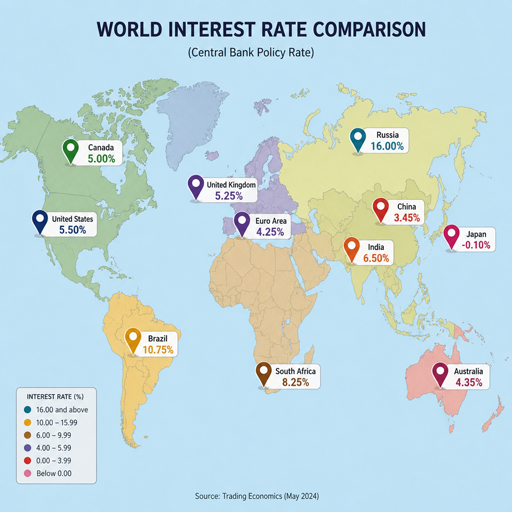
Global interest rate differentials describe the gaps between interest rates in one country or currency area and another. Those gaps influence currency values, bond yields, borrowing costs, investment flows, and the way businesses think about risk. Understanding them helps investors, finance teams, and globally exposed companies read interest rate trends with more context instead of looking at central bank rates in isolation.
What are global interest rate differentials?
Global interest rate differentials are the differences between interest rates across countries, usually measured by comparing policy rates, short-term money-market rates, or government bond yields. A simple example is the spread between one central bank’s benchmark rate and another’s, but the real meaning depends on inflation, currency expectations, credit risk, and the maturity of the rate being compared.
The Bank for International Settlements tracks central bank policy rates across countries, making it possible to compare how monetary policy settings evolve around the world. Its policy-rate data focuses on widely referenced central bank or money-market rates, which is why analysts often use it as a starting point for international interest rates research.
At first glance, a higher rate may seem automatically attractive. In practice, the interest rate impact is more complicated. A high nominal yield can be offset by high inflation, currency depreciation, political risk, or weak liquidity. A low-rate market may still attract capital if investors view it as stable, liquid, and relatively safe.
Why rate gaps matter in global markets
Interest rates act like gravitational forces in financial markets. When central bank rates rise in one economy while rates stay lower elsewhere, money may move toward the higher-yielding currency or asset class. That movement can affect exchange rates, equity valuations, mortgage markets, trade competitiveness, and corporate funding costs.
For businesses, global interest rate differentials can change the economics of expansion, sourcing, pricing, and debt management. A company borrowing in one currency and earning revenue in another may find that a rate gap affects both financing costs and exchange-rate exposure. For investors, the same gap can shape decisions about bonds, currency hedging, and international portfolio allocation.
The key is not simply which country has the highest rate. The more useful question is whether the rate compensates for the risks attached to that currency, economy, and financial system. That is why professional analysis often looks at both nominal and real rates, as well as market expectations for where rates may go next.
The main forces behind interest rate differences
Interest rate gaps rarely appear by accident. They reflect different economic conditions, policy priorities, and market assumptions. A country fighting persistent inflation may keep rates elevated, while another dealing with slow growth may cut rates to support demand. Even when economies face similar shocks, their central banks may respond differently because labor markets, banking systems, debt levels, and inflation expectations vary.
The Federal Reserve, for example, describes monetary tightening as raising its target range for the federal funds rate when conditions such as overheating or high inflation require restraint. That basic policy logic applies broadly, though each central bank has its own mandate and operating framework.
Several forces commonly drive international interest rates apart:
- Inflation pressure: Higher inflation often pushes central banks toward tighter policy, especially when inflation expectations risk becoming unstable.
- Growth conditions: Weak growth can encourage lower rates, while strong demand may support higher rates.
- Currency stability: Some central banks may consider exchange-rate pressure when setting policy, particularly in economies exposed to imported inflation or capital outflows.
- Fiscal position: Heavy government borrowing can influence bond yields if investors demand more compensation for risk.
- Market credibility: Countries with trusted institutions may borrow at lower rates than economies with similar inflation but weaker policy confidence.
- Global spillovers: Policy shifts in major economies can influence financial conditions elsewhere, even when local fundamentals differ.
A BIS paper on international monetary spillovers notes that even countries with flexible exchange rates may find it difficult to conduct monetary policy while ignoring developments in major advanced economies. That matters because global capital markets transmit policy signals across borders quickly.
How do interest rate differentials affect currencies?
Interest rate differentials affect currencies by changing the relative return investors expect from holding assets in one currency rather than another. If one market offers higher rates, investors may demand that currency to buy local bonds or deposits, but expectations about future exchange-rate changes can offset or overwhelm the yield advantage.
This is where interest rate parity becomes useful. In simplified terms, uncovered interest parity suggests that the expected currency movement should balance the difference in interest rates between two comparable assets. Federal Reserve research describes uncovered interest parity as a common starting point for studying the relationship between exchange rates and interest rates.
In the real world, currencies do not always behave neatly. A high-yielding currency can strengthen when investors chase carry, then fall quickly when risk appetite changes. A low-yielding currency can rise during periods of stress if investors treat it as a safe haven. This is why the interest rate impact on foreign exchange is best viewed as one powerful input, not a complete forecast.
A practical currency read should include:
- The rate gap itself: Compare policy rates or bond yields with the same maturity when possible.
- Inflation-adjusted returns: A high nominal rate may be less attractive after inflation.
- Forward guidance: Markets react to expected future rates, not only today’s level.
- Hedging costs: Forward contracts can reduce or remove the apparent yield advantage.
- Risk sentiment: During stress, investors may prioritize safety over yield.
The difference between nominal and real rate gaps
Nominal interest rates are the rates quoted by central banks, banks, or bond markets. Real rates adjust those nominal rates for inflation. This distinction is crucial because two countries can have similar central bank rates but very different real returns if inflation is much higher in one economy.
For example, a country with a high policy rate and high inflation may offer little real yield. Another country with a modest rate and low inflation may provide a stronger inflation-adjusted return. Investors who ignore that difference may overestimate the benefit of moving capital toward the higher nominal rate.
Real rate differentials also help explain why currencies sometimes move against the headline rate story. If investors believe inflation will erode returns, the currency may weaken despite high nominal yields. If a central bank has strong anti-inflation credibility, a smaller rate increase may still support confidence.
Central bank divergence and market expectations
Central bank divergence occurs when major central banks move in different directions or at different speeds. One may be raising rates, another holding steady, and another cutting. These differences can reshape global interest rate differentials before official decisions even happen because markets price expectations in advance.
This expectation channel is especially important. A currency or bond market may react less to the rate decision itself and more to what policymakers say about the next several meetings. If a central bank raises rates but signals that it may soon pause, the market reaction can be very different from a smaller move paired with a more hawkish message.
Businesses and investors should therefore monitor both decisions and communication. Policy statements, inflation projections, labor-market commentary, and balance-sheet guidance can all affect perceived rate paths. The stated rate is the headline; the expected path is often the market mover.
What should businesses watch when rates differ across countries?
Businesses should watch how rate differentials affect borrowing costs, foreign exchange exposure, customer demand, and supplier pricing. A global company may face cheaper funding in one market but higher currency risk if its revenues are earned elsewhere.
For finance teams, the goal is not to predict every central bank move. The goal is to identify where rate gaps could change margins, cash flow, and risk. A disciplined review can turn abstract macro trends into practical decisions.
Useful questions include:
- Debt exposure: Which loans or credit lines reprice when rates change?
- Currency mismatch: Are costs and revenues in different currencies?
- Hedging policy: Do current hedges still make sense if rate gaps widen or narrow?
- Supplier contracts: Could financing costs affect vendor pricing or payment terms?
- Customer demand: Are higher local borrowing costs likely to reduce sales in key markets?
- Investment timing: Could rate changes alter the return hurdle for overseas projects?
These questions are especially relevant for companies importing goods, exporting products, holding overseas cash, or borrowing across multiple jurisdictions. Even firms that do not trade currencies directly can feel the effect through suppliers, commodity prices, or customer financing conditions.
Investor implications across asset classes
Global interest rate differentials influence asset classes in different ways. In fixed income, yield gaps can make foreign bonds appear attractive, but currency movements and hedging costs may reduce the benefit. In equities, higher rates can pressure valuations by increasing discount rates, yet some sectors may benefit from stronger bank margins or currency-driven earnings changes.
Currency investors often focus directly on rate differentials through carry strategies. A carry trade generally involves borrowing in a lower-yielding currency and investing in a higher-yielding one. The potential reward is the yield spread, but the major risk is that exchange-rate losses exceed the income earned.
For multi-asset investors, the lesson is to connect rate analysis with risk management. A higher yield should be tested against volatility, liquidity, inflation, and policy credibility. If the only reason to own an asset is that the headline rate is higher, the position may be vulnerable when market sentiment turns.
A simple framework for reading interest rate trends
Interest rate trends become easier to interpret when you separate the signal from the noise. Daily market reactions can be dramatic, but the deeper story usually comes from inflation, growth, labor markets, fiscal policy, and central bank communication.
Use this checklist when assessing global interest rate differentials:
- Start with comparable rates. Compare policy rate to policy rate, two-year yield to two-year yield, or ten-year yield to ten-year yield.
- Adjust for inflation. Look at real returns, not just nominal yield.
- Read the policy path. Ask whether markets expect hikes, cuts, or a long pause.
- Check currency pricing. A rate advantage may already be reflected in exchange rates or forward points.
- Consider capital controls and liquidity. Higher returns may be harder to access in less open markets.
- Watch global anchors. Major central banks can influence conditions far beyond their borders.
- Review the risk premium. Some rate gaps reflect compensation for uncertainty rather than opportunity.
This framework helps prevent a common mistake: assuming that a wider rate gap automatically creates a better investment or financing opportunity. Often, the gap is a clue that the market is pricing different risks.
Common mistakes when interpreting international interest rates
One mistake is treating central bank rates as the only rates that matter. Policy rates influence financial conditions, but companies and investors often face rates shaped by credit spreads, bank margins, bond-market liquidity, and hedging costs. The rate that appears in headlines may not be the rate available in practice.
Another mistake is ignoring time horizons. Short-term rate gaps may matter most for cash, floating-rate debt, and currency forwards. Longer-term yields may matter more for capital investment, mortgages, pension portfolios, and valuation models. Mixing maturities can lead to misleading conclusions.
A third mistake is assuming cause and effect always run in one direction. Higher rates can attract capital, but they can also signal economic stress. Lower rates can weaken a currency, but they can also support growth and risk appetite. Context decides which interpretation is more convincing.
Turning rate analysis into better decisions
The practical value of studying global interest rate differentials is not in memorizing every central bank rate. It is in understanding how rate gaps connect to decisions: where to borrow, when to hedge, how to price risk, and how to evaluate international opportunities.
For a business, that may mean stress-testing cash flow under different rate and currency scenarios. For an investor, it may mean comparing local-currency returns with hedged returns before buying a foreign bond. For an analyst, it may mean watching whether market expectations are moving faster than official policy.
A simple decision process can help:
- Define the exposure. Identify the currencies, rates, and maturities that affect the decision.
- Measure the differential. Use comparable rates and update them regularly.
- Adjust for inflation and hedging. Focus on realistic net returns or costs.
- Test scenarios. Consider what happens if rate gaps widen, narrow, or reverse.
- Act with limits. Use risk controls rather than relying on a single macro view.
Key takeaway
Global interest rate differentials are one of the clearest ways to see how economies, currencies, and capital markets relate to one another. They show where policy is tight or loose, where investors may seek yield, and where currency or financing risks may build.
The most useful approach is balanced: compare central bank rates, adjust for inflation, consider expectations, and evaluate the full interest rate impact before making decisions. Rate gaps can reveal opportunity, but they can also reveal risk. Reading them well means looking beyond the headline number and asking what the market is really being paid to accept.