
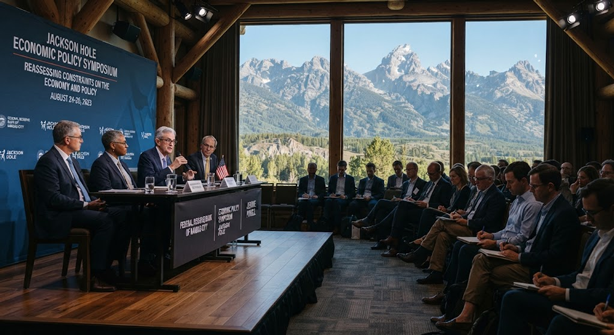
The Federal Reserve Bank of Kansas City has wrapped its latest Jackson Hole Economic Policy Symposium, shifting attention from labor-market transition in 2025 to financial innovation, payments and the policy challenges created by faster-moving money systems in 2026. The annual gathering remains a closely watched forum for central bankers, academics, policymakers and market participants because it often frames the debate around the global economic outlook rather than announcing immediate policy decisions.
What changed at the latest Jackson Hole economic symposium?
The latest update is that the 2026 Jackson Hole Economic Policy Symposium was held Aug. 27-29 in Jackson Hole, Wyoming, with the theme “Financial Innovation: Implications for Payments and Policy.” The Kansas City Fed said the 49th annual event focused on how innovation in financial intermediation and payments may affect currency, banking, monetary policy implementation and global financial integration.
That theme marked a clear turn from the jackson hole economic symposium 2025 agenda, which centered on “Labor Markets in Transition: Demographics, Productivity and Macroeconomic Policy.” For readers searching for jackson hole economic symposium 2025 dates official, the official 2025 dates were Aug. 21-23, 2025, according to the Kansas City Fed’s release.
The 2026 agenda put payments and policy at the center
The Kansas City Fed described payment systems as the economy’s “circulatory system,” noting that digital payments, instant payments, cryptocurrencies and stablecoins are changing the infrastructure through which households, firms and financial institutions move money. The policy question is not simply whether these technologies are useful, but how they alter the transmission of monetary policy, the role of banks and the international flow of funds.
Federal Reserve Chairman Kevin Warsh used his Aug. 28 keynote to connect the innovation theme to broader questions about artificial intelligence, productivity, forward guidance and inflation control. He said the Fed is watching AI as a possible new factor shaping productivity and labor markets, while also arguing that routine forward guidance should be limited in normal times so markets and policymakers do not become overly dependent on one another’s signals.
At a glance: key Jackson Hole updates
- Latest event: The 2026 jackson hole economic policy symposium took place Aug. 27-29, 2026, in Jackson Hole, Wyoming.
- Latest theme: “Financial Innovation: Implications for Payments and Policy,” with emphasis on digital payments, instant payments, cryptocurrencies and stablecoins.
- Official 2025 dates: The jackson hole economic symposium 2025 dates were Aug. 21-23, 2025.
- 2025 theme: “Labor Markets in Transition: Demographics, Productivity and Macroeconomic Policy.”
- Core audience: The event brings together central bankers, Federal Reserve officials, policymakers, academics and economists from around the world.
Why the symposium still matters for the global economic outlook
Jackson Hole is not a rate-setting meeting, and investors should not treat it as a substitute for the Federal Open Market Committee calendar. Its influence comes from the way it concentrates major policy arguments in one setting. The Kansas City Fed says participants gather to discuss the economic issues, implications and policy options tied to each year’s topic, with papers, commentary and discussion forming the proceedings.
That makes the jackson hole economic symposium especially important when the economy is being reshaped by forces that do not fit neatly into monthly data releases. In 2025, the official focus on demographics, productivity, labor mobility and artificial intelligence reflected concern over how work itself is changing. In 2026, the move to payments and financial innovation showed that policymakers are also watching how money moves, who intermediates it and whether new systems complicate or strengthen the conduct of monetary policy.
Warsh’s 2026 remarks reinforced that broader lens. He described labor markets as stable and output as solid, but said inflation remained too high and emphasized that the Fed’s 2 percent PCE inflation objective is a firm target. He also said financial conditions did not look broadly restrictive, pointing to resilient consumer spending, rising business investment and strong credit conditions, while still identifying strains in sectors such as housing and agriculture.
The 2025 symposium framed the labor-market debate
The jackson hole economic symposium 2025 was the 48th annual event and arrived at a time when policymakers were weighing structural labor-market shifts. The Kansas City Fed’s official release cited declining birth rates, an aging labor force, reduced labor mobility and the spread of artificial intelligence as factors that could change the role and value of labor.
Federal Reserve Chair Jerome Powell’s 2025 Jackson Hole speech addressed the economic outlook and the Fed’s framework review. The speech page was last updated Aug. 22, 2025, and linked the event to the Fed’s review of monetary policy strategy, tools and communications.
For SEO and reference purposes, the distinction matters: “jackson hole economic symposium 2025 dates” refers to Aug. 21-23, 2025, while the most recent completed symposium was Aug. 27-29, 2026. Using the correct year helps readers separate archived 2025 labor-market material from the latest 2026 discussion on financial innovation and payments.
What happens next
The practical next step is the publication and digestion of symposium materials. The Kansas City Fed said papers and other materials are posted on its website as they are presented, and its main Jackson Hole page keeps proceedings from current and past events available for review.
Markets and policy watchers will now compare the symposium’s longer-term themes with incoming inflation, labor-market, productivity, credit and payments data. Jackson Hole rarely gives a complete near-term policy map. Its value is in showing which risks central bankers believe deserve more attention before the next round of formal decisions.