
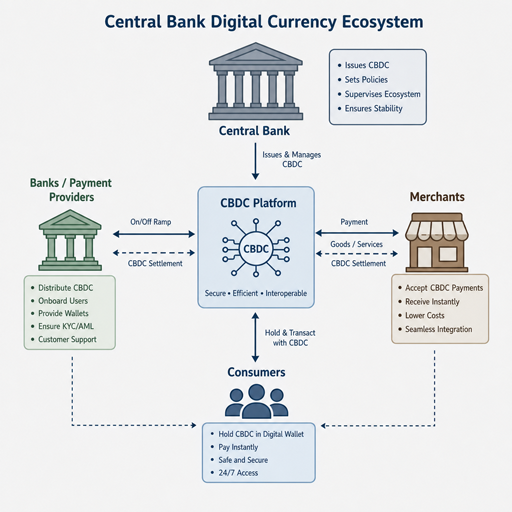
Central bank digital currencies are moving from policy papers into pilots, public debate, and real payment experiments. For consumers, businesses, banks, and crypto investors, the real question is not whether digital money will exist, but what kind of digital money becomes trusted, usable, and widely accepted. This article explains how central bank digital currencies CBDCs may affect payments, banks, privacy, monetary policy, and the digital currency future, including the possible impact of central bank digital currencies on bitcoin dominance.
What are central bank digital currencies, and why are they gaining attention?
Central bank digital currencies are digital forms of national money issued by a central bank, rather than by a private bank, payment company, or crypto network. In simple terms, a CBDC is meant to function as official money in digital form, with the credibility of the state behind it; the Atlantic Council describes a CBDC as a digital form of fiat currency and a claim on the central bank.
CBDCs are gaining attention because money is already becoming more digital in daily life. Many people now pay with cards, mobile wallets, instant transfers, and app-based payment systems, while cash use has declined in some markets. Central banks are studying whether public money should evolve alongside private digital payment tools, stablecoins, and cryptocurrencies.
The momentum is no longer theoretical. A 2024 BIS survey found that 91% of 93 surveyed central banks were exploring a retail CBDC, wholesale CBDC, or both, with wholesale CBDC work generally more advanced than retail CBDC work. The Atlantic Council’s CBDC tracker reports that the Bahamas, Jamaica, and Nigeria have fully launched CBDCs, while many other jurisdictions remain in research, pilot, or development phases.
The main types of CBDCs shape their impact
Not all CBDCs central bank digital currencies are designed for the same audience. The broad distinction is between retail CBDCs and wholesale CBDCs, and this distinction matters because each model affects different parts of the financial system.
A retail CBDC is designed for public use. Individuals and businesses could use it for everyday transactions, person-to-person transfers, merchant payments, government disbursements, or other digital payments. If designed well, it could feel similar to a wallet app, but the underlying money would be central bank money rather than a commercial bank deposit or private wallet balance.
A wholesale CBDC is designed for banks, financial institutions, and settlement systems. Its goal is usually to improve how large-value payments, securities settlement, or cross-border transactions move between institutions. This may be less visible to consumers, but it could still influence costs, speed, liquidity management, and financial market infrastructure.
A practical way to compare them:
|
CBDC type |
Main users |
Common goals |
Potential public visibility |
|---|---|---|---|
|
Retail CBDC |
Consumers, merchants, businesses |
Everyday payments, inclusion, public digital money |
High |
|
Wholesale CBDC |
Banks, payment providers, market institutions |
Settlement efficiency, liquidity, cross-border payments |
Low to moderate |
|
Cross-border CBDC links |
Multiple central banks and institutions |
Faster international transfers and settlement |
Indirect but meaningful |
This is why discussions about digital currency trends can feel confusing. One country may be testing a consumer wallet, another may be exploring bank settlement, and another may be focused on cross-border interoperability. They all fall under the CBDC umbrella, but their real-world consequences can be very different.
CBDC benefits are strongest when they solve a real payment problem
The most persuasive cbdc benefits are practical, not futuristic. A CBDC is not automatically useful simply because it is digital. It becomes valuable only if it improves something people already struggle with, such as payment access, settlement delays, high transfer costs, weak competition, or fragile payment infrastructure.
For consumers, a retail CBDC could potentially support faster transfers, lower-cost basic payments, and broader access to digital money. For governments, it could improve the delivery of benefits, tax refunds, or emergency payments if the system is designed with accessibility and resilience in mind. For merchants, faster settlement could reduce uncertainty and improve cash flow.
The IMF has noted that well-designed CBDCs may support goals such as payment efficiency and financial inclusion, but also emphasizes that policymakers must weigh expected benefits against financial, operational, and implementation risks. That balance is important. A CBDC that is difficult to use, poorly integrated with banks and merchants, or distrusted by the public may not deliver meaningful benefits.
Strong CBDC use cases often share a few traits:
- Clear user need: The CBDC addresses a visible pain point, such as expensive transfers or limited access to digital payments.
- Simple experience: Users do not need to understand central bank infrastructure to make a payment.
- Reliable acceptance: Merchants, banks, and wallet providers have a reason to support it.
- Privacy expectations: Users understand what data is collected, who can access it, and under what rules.
- Offline or resilient access: The system can still function during outages or in areas with limited connectivity.
In other words, central bank digital currencies need more than policy support. They need product-market fit.
How could CBDCs change everyday payments?
CBDCs could change everyday payments by adding a public digital payment option that sits alongside cash, bank deposits, cards, instant payment networks, and private wallets. The scale of the change would depend on design choices: whether the CBDC is easy to access, whether it pays interest, whether users face holding limits, whether merchants accept it, and whether private intermediaries help distribute it.
For many people, the visible experience might not feel revolutionary. A CBDC wallet could resemble existing payment apps. The difference would be in the settlement asset and governance: instead of relying entirely on private payment balances or commercial bank deposits, users would hold or transfer a form of central bank money.
That difference could matter during outages, bank stress, or periods of low trust in private payment providers. BIS publications emphasize that CBDCs are direct liabilities of the central bank and therefore do not carry the same credit risk as private liabilities. This feature is one reason policymakers discuss CBDCs as a way to preserve access to public money in a digital economy.
However, everyday adoption is not guaranteed. In markets that already have fast, cheap, trusted payment systems, a retail CBDC would need to offer a clear advantage. In markets where digital payment access is uneven, the case may be stronger, especially if the CBDC can reach people who are underserved by banks or costly private payment networks.
The banking system would feel the pressure first
One of the biggest CBDC debates is how central bank digital currencies could affect commercial banks. Banks rely on deposits to fund lending and manage liquidity. If households and businesses could move large amounts of money into CBDC wallets, banks might face deposit outflows, especially during periods of stress.
This does not mean a CBDC would automatically weaken banks. Design choices can reduce the risk. Central banks could set holding limits, use tiered remuneration, rely on intermediated wallet models, or create safeguards that discourage rapid movement from bank deposits into CBDC balances. BIS and central bank research frequently highlights the need to design CBDCs with financial stability considerations in mind.
The likely future is not a simple replacement of banks. More realistically, CBDCs may push banks and payment firms to improve their own digital services. If public digital money becomes available, private providers may compete on convenience, credit, rewards, merchant tools, and financial services that a basic CBDC wallet does not offer.
For businesses, the key practical questions are:
- Will customers want to pay with CBDC? Adoption depends on trust, convenience, and incentives.
- Will settlement be faster or cheaper? Merchant value increases if funds arrive quickly and reliably.
- Will accounting and compliance be simple? Businesses need clean records, tax treatment, and integration with existing systems.
- Will banks support smooth conversion? Easy movement between deposits and CBDC balances will be essential.
Banks may resist, adapt, or become central distribution partners. The final impact depends less on the label “CBDC” and more on the architecture behind it.
Privacy, control, and trust remain the hardest questions
CBDCs sit at the intersection of money, identity, data, and state authority. That makes privacy one of the most important adoption issues. People may welcome faster payments but reject a system they believe enables excessive surveillance, arbitrary restrictions, or unclear data sharing.
A CBDC can be designed in many ways. Some models may offer strong privacy for low-value transactions while requiring more identity checks for larger transfers. Others may rely on regulated intermediaries to manage customer relationships, reducing the amount of personal transaction data directly handled by a central bank. The design challenge is to support financial integrity without turning every payment into an unnecessarily exposed data event.
Operational risk also matters. A national digital currency system would be critical infrastructure. BIS research on CBDC information security and operational risks highlights that introducing a CBDC has far-reaching implications for central bank operations and risk management. Cybersecurity, fraud prevention, outage planning, user recovery, and governance cannot be afterthoughts.
For public trust, policymakers need to answer plain-language questions before adoption:
- Who can see transaction data?
- Can CBDC balances be frozen, limited, or programmed?
- What legal protections apply to users?
- What happens if a phone is lost or a wallet provider fails?
- Can people still use cash or other payment options?
A technically strong CBDC can still fail if users do not trust it. Trust is not just a security feature; it is the product.
What is the impact of central bank digital currencies on bitcoin dominance?
The impact of central bank digital currencies on bitcoin dominance is likely to be indirect, not a simple one-for-one battle. CBDCs are designed as sovereign digital money for payments and settlement, while Bitcoin is a decentralized cryptoasset with a fixed issuance schedule and a different value proposition. A CBDC may compete with some crypto payment use cases, but it does not replicate Bitcoin’s core appeal to users who value decentralization, censorship resistance, or non-sovereign monetary design.
CBDCs could reduce the need for volatile cryptocurrencies in everyday payments if they become fast, low-cost, and widely accepted. In that scenario, people who mainly want a convenient digital payment method may choose official digital money instead of crypto. This could limit Bitcoin’s role as a medium of exchange in CBDC-heavy markets.
But Bitcoin dominance is driven by more than payments. It is influenced by investor sentiment, liquidity, regulation, exchange infrastructure, stablecoin markets, macroeconomic conditions, and competition from other cryptoassets. A CBDC rollout could even increase public familiarity with digital wallets and tokenized value, indirectly making digital assets easier to understand. That does not guarantee Bitcoin benefits, but it shows why the relationship is complex.
A realistic view is that CBDCs may compete more directly with stablecoins and payment-focused tokens than with Bitcoin’s store-of-value narrative. Stablecoins are private digital representations of fiat value, often used in crypto trading and cross-border digital transfers. CBDCs, if interoperable and accessible, could challenge some stablecoin use cases by offering official digital fiat infrastructure.
CBDCs will influence the broader digital currency future
The digital currency future will probably be plural. CBDCs, stablecoins, tokenized deposits, cryptocurrencies, and instant payment systems can all coexist because they solve different problems. The key question is which forms of money become trusted for which jobs.
CBDCs may become foundational infrastructure in some markets and remain experimental in others. Countries with fragmented payment systems, costly remittances, or financial inclusion gaps may see stronger motivation. Countries with highly efficient payment networks may move more slowly or focus on wholesale CBDC experiments rather than consumer wallets.
This uneven development is one of the most important digital currency trends. The future will not arrive everywhere at the same speed. It will be shaped by local banking systems, public trust, regulation, technology readiness, and political appetite.
For investors, businesses, and policymakers, the practical takeaway is to watch design details instead of headlines. A CBDC with strict holding limits, no interest, and limited merchant adoption will have a different impact from one deeply integrated into national payment rails. Similarly, a wholesale CBDC used by financial institutions may matter greatly for markets while barely changing consumer habits.
What businesses and investors should watch next
The CBDC conversation can become abstract, but the signals worth watching are concrete. Instead of asking whether central bank digital currencies will “win,” it is more useful to ask where they are being used, who is using them, and what problem they solve better than existing alternatives.
Important signals include:
- Pilot results: Look for evidence of real usage, not just announcements.
- Merchant acceptance: Consumer payment tools need places to be spent.
- Bank participation: Intermediaries can accelerate or slow adoption.
- Privacy rules: Legal protections will affect trust and public response.
- Cross-border tests: International settlement may become one of the strongest CBDC use cases.
- Stablecoin regulation: Tighter rules or clearer frameworks could shift demand between private and public digital money.
- Crypto market behavior: Bitcoin dominance may react more to liquidity, regulation, and investor narratives than to CBDCs alone.
Businesses should also consider operational readiness. If a CBDC becomes relevant in a target market, payment systems, accounting workflows, refunds, customer support, and treasury policies may need updates. The earlier a company understands the model, the easier it becomes to adapt without rushing.
A balanced view of the CBDC impact
Central bank digital currencies could modernize payments, expand access, strengthen public money in a digital economy, and improve settlement infrastructure. They could also create new risks around privacy, cybersecurity, bank funding, operational resilience, and government overreach if they are poorly designed or poorly governed.
The most likely outcome is not a single global CBDC revolution. It is a gradual, uneven shift in which some countries launch retail systems, others focus on wholesale settlement, and many continue testing before making a final decision. The impact will depend on real adoption, not policy ambition.
For the crypto world, CBDCs are important but not necessarily existential. They may narrow some payment use cases for cryptocurrencies and stablecoins, yet they also validate the broader move toward programmable, digital, and interoperable forms of money. Bitcoin’s role will continue to depend on whether users treat it as a payment tool, a speculative asset, a hedge, or a decentralized alternative to sovereign money.
The clearest takeaway is this: CBDCs are not just a technology trend. They are a redesign of how public money may function in a digital society. Anyone following digital currency trends should pay close attention to the details, because the design choices made now will shape how money moves, who controls payment infrastructure, and what the next era of digital finance feels like.