
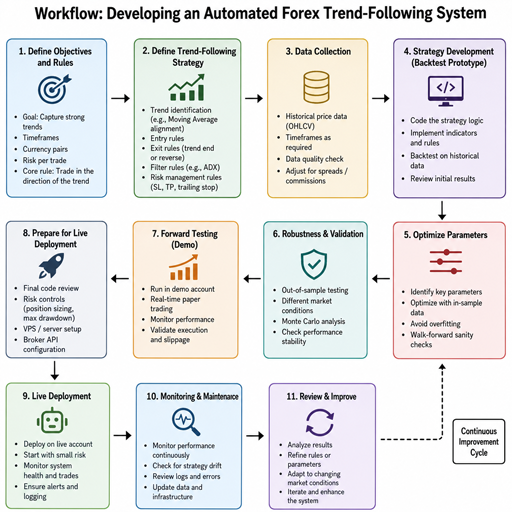
Trend-following forex algorithms are automated rules designed to identify, enter, manage, and exit currency trades when a market appears to be moving persistently in one direction. They combine forex trend analysis with execution logic, risk controls, and ongoing monitoring so traders can respond to forex market trends without making every decision manually. This guide explains how these systems work, what makes them useful, where they can fail, and how to think about building or evaluating them responsibly.
What are trend-following forex algorithms?
Trend-following forex algorithms are forex trading algorithms that attempt to participate in sustained upward or downward price moves rather than predict exact turning points. In practical terms, they use market data, technical indicators, price-action rules, or statistical signals to decide when a currency pair is trending strongly enough to justify a trade.
The core idea is simple: if a currency pair has been moving consistently in one direction, the system looks for evidence that the move may continue. Instead of asking, “Is this the top or bottom?” a trend-following system asks, “Is there enough directional movement to join, and where should risk be controlled if the move fails?”
That distinction matters. Many traders lose discipline when price moves quickly, reverses sharply, or appears to be “too extended.” Automated forex systems can reduce some of that emotional pressure by applying the same rules repeatedly. However, automation does not remove uncertainty. A trend-following algorithm can still enter late, exit too early, suffer during sideways markets, or perform poorly if its assumptions no longer fit the current market environment.
The logic behind trend-following strategies
Trend-following strategies are built on the observation that markets sometimes move in persistent directional phases. In forex, those phases may be influenced by interest-rate expectations, economic releases, central bank communication, risk sentiment, commodity exposure, or broader capital flows. The algorithm does not need to understand every macro reason behind a move, but it does need a repeatable way to detect and manage directional behavior.
A basic trend-following system usually has four parts:
- Trend identification — rules that define whether the market is trending up, trending down, or not trending.
- Entry logic — conditions that trigger a position once a valid trend is detected.
- Exit logic — rules for closing a position when momentum weakens, price reverses, or a risk limit is reached.
- Position sizing — controls that determine how much capital is exposed on each trade.
The strength of this structure is consistency. A human trader may interpret the same chart differently depending on mood, recent losses, or outside opinions. A properly coded algorithm applies its logic the same way every time. That consistency is useful, but only if the rules are thoughtful, tested, and monitored.
Price action, indicators, and signal confirmation
Trend-following forex algorithms often use price-based signals because price is the final expression of market activity. A system might define an uptrend as a sequence of higher highs and higher lows, a breakout above a previous range, or price staying above a moving average. A downtrend may be defined by the opposite conditions.
Technical indicators can help organize that information. Moving averages, average true range, directional movement indicators, channel breakouts, and momentum measures are common components. The important point is not that one indicator is magically superior. It is that the algorithm needs a clear definition of what a trend looks like and what invalidates it.
Many systems also use confirmation filters. For example, an algorithm might require both a breakout and volatility expansion before entering. Another might trade only when a shorter-term moving average is aligned with a longer-term trend. Filters can reduce weak signals, but too many filters may cause the system to miss trades or overfit historical data.
Why do forex market trends matter for algorithmic trading?
Forex market trends matter because algorithmic systems need exploitable behavior, not just price movement. A trend-following model works best when directional moves are large enough to offset false signals, spreads, slippage, and losing trades that occur before a stronger move develops.
Currency markets are highly liquid, open across global sessions, and influenced by different regional catalysts. That creates many opportunities for movement, but it also creates noise. A pair may trend during one session and chop during another. It may respond cleanly to a macro theme for weeks, then become erratic after a policy surprise or shift in risk appetite.
This is where forex trend analysis becomes more than drawing lines on a chart. It involves asking whether the market is actually rewarding directional participation. If a pair repeatedly breaks out and then reverses, a trend-following system may struggle. If breakouts are followed by sustained moves, the same logic may perform better.
Trending, ranging, and transitional markets
A useful algorithm should recognize that not all market conditions are equal. Forex pairs often move through three broad states:
- Trending markets: Price moves persistently higher or lower, pullbacks are relatively contained, and momentum tends to continue.
- Ranging markets: Price rotates between support and resistance zones, breakouts fail often, and mean-reversion behavior dominates.
- Transitional markets: Direction is unclear, volatility may expand or contract quickly, and signals become less reliable.
Trend-following strategies are usually designed for the first state. They can still trade during the second and third states, but that is often where drawdowns appear. A robust system needs rules that either reduce exposure during unfavorable conditions or keep losses small enough that profitable trends can compensate.
Why forex trends can be difficult to capture
Forex does not always trend cleanly. Currency pairs are relative instruments: buying one currency means selling another. This means a trend depends on the changing relationship between two economies, two policy paths, and two market narratives. A strong currency can rise against one counterpart while falling against another.
There is also the issue of timing. A trend may already be mature by the time an algorithm confirms it. Entering earlier can improve reward potential but increases false signals. Entering later can improve confirmation but may reduce the remaining move. The design challenge is finding a practical balance rather than trying to eliminate uncertainty completely.
Core components of automated forex systems
Automated forex systems are more than entry signals. A simple signal can say “buy” or “sell,” but a trading algorithm must decide when to act, how large the position should be, what conditions cancel the idea, and how to behave when market data changes quickly. The difference between a fragile bot and a more thoughtful system often lies in these supporting details.
Data quality and market inputs
Every algorithm depends on its input data. If the data is inaccurate, delayed, incomplete, or mismatched to the execution environment, the system’s decisions may be unreliable. Forex algorithms may use bid and ask prices, candlestick data, volume proxies, volatility measures, spreads, and time-of-day information.
Data consistency is especially important when backtesting. A strategy that appears strong on clean historical data may behave differently in live trading if spreads widen, orders fill at less favorable prices, or liquidity changes around news events. Good development treats execution reality as part of the system, not an afterthought.
Entry and exit rules
Entry rules define when the algorithm is allowed to open a trade. A breakout system may buy when price closes above a recent high. A moving-average system may buy when a faster average crosses above a slower average. A momentum system may enter when price strength exceeds a defined threshold.
Exit rules are just as important. Trend-following systems often give trades room to breathe because strong trends can include pullbacks. Common exits include trailing stops, moving-average breaks, volatility-based stops, channel exits, or time-based rules. The goal is to protect capital when the trend fails while avoiding exits so tight that normal market noise ends the trade prematurely.
Risk management and position sizing
Risk management is where many forex trading algorithms succeed or fail. A strategy can have reasonable signals and still be dangerous if it risks too much on each trade, ignores correlated positions, or increases size after losses without a sound framework.
Position sizing should reflect account size, stop distance, volatility, and the trader’s tolerance for drawdown. A volatile pair may require smaller position size than a calmer pair if the risk per trade is meant to remain consistent. Systems that trade multiple currency pairs also need to consider overlap. For example, several positions may all depend on the same currency moving in one direction, increasing hidden concentration.
Common trend-following models in forex
There is no single model that defines all trend-following forex algorithms. Most are variations on a few recurring ideas, each with strengths and weaknesses. Understanding these models helps traders evaluate whether a system’s behavior matches their goals and risk tolerance.
Moving-average systems
Moving-average systems smooth price data to identify directional bias. A common approach is to compare a short-term average with a longer-term average. When the short-term average moves above the longer-term average, the system may interpret that as bullish. When it moves below, the system may interpret that as bearish.
The benefit is simplicity. Moving averages are easy to define, test, and understand. The weakness is lag. Because moving averages respond to past prices, they can enter after a move has already started and can generate repeated false signals in sideways markets.
Breakout systems
Breakout systems look for price to move beyond a prior range, high, low, or channel. The assumption is that a decisive move outside a boundary may indicate new participation and potential continuation. These systems can be effective when markets transition from consolidation into directional expansion.
The challenge is false breakouts. Forex pairs often move beyond a visible level and then snap back into the previous range. To address this, some algorithms require a candle close beyond the level, a volatility filter, or confirmation from a higher timeframe.
Volatility-adjusted trend systems
Volatility-adjusted systems change their thresholds, stops, or position sizes based on market movement. Instead of using a fixed stop distance, the algorithm may use a volatility measure so the system adapts when conditions become calmer or more active.
This can make risk more consistent across pairs and market regimes. However, volatility adjustment is not a complete solution. During sudden shocks, volatility can change faster than the model adjusts, and stops can still be hit in unfavorable conditions.
Multi-timeframe models
Multi-timeframe models combine signals from different chart intervals. For example, a system may use a higher timeframe to define the main trend and a lower timeframe to refine entries. This helps prevent the algorithm from taking trades that conflict with broader direction.
The trade-off is complexity. More timeframes mean more rules, and more rules can increase the risk of overfitting. The best designs keep the logic clear: one timeframe defines context, another handles execution.
|
Model type |
Main idea |
Potential benefit |
Common weakness |
|---|---|---|---|
|
Moving average |
Smooth price to define direction |
Simple and transparent |
Lag and whipsaws |
|
Breakout |
Enter after price leaves a range |
Can catch new directional moves |
False breakouts |
|
Volatility-adjusted |
Adapt stops or size to market movement |
More flexible risk control |
Sudden shocks can overwhelm settings |
|
Multi-timeframe |
Align broad trend with tactical entries |
Better context |
Added complexity |
Building a practical trend-following workflow
A practical workflow turns an idea into a process that can be tested, reviewed, and improved. It should move from concept to data, then to rules, testing, implementation, and ongoing monitoring. Skipping steps can make a system look promising on paper but fragile in live conditions.
Start with a clear hypothesis. For example, “This system will attempt to capture medium-term directional moves after a confirmed breakout,” is more useful than, “This system will trade trends.” A clear hypothesis helps determine which data, pairs, timeframes, and risk rules are relevant.
Then define every rule before testing. If a human must interpret whether a setup “looks good,” the system is not fully algorithmic. Rules do not have to be complicated, but they should be specific enough that another person could reproduce the same signals.
A structured development checklist
Use this checklist to keep the process grounded:
- Define the market universe: Decide which currency pairs the system may trade and why they fit the strategy idea.
- Choose the timeframe: Match the timeframe to the intended holding period, signal frequency, and monitoring capacity.
- Specify trend criteria: Write exact rules for bullish, bearish, and no-trade conditions.
- Set entry logic: Define the trigger, confirmation requirements, and any filters.
- Set exit logic: Include stop-loss, trailing exit, profit-taking, or trend-failure rules.
- Control risk: Determine position sizing, maximum exposure, and what happens after losses or high volatility.
- Backtest carefully: Include realistic spreads, execution assumptions, and out-of-sample checks where possible.
- Forward test cautiously: Use a demo or small-scale environment before relying on live automation.
- Monitor performance: Review whether losses are consistent with expectations or signal a broken assumption.
- Document changes: Track every adjustment so improvements are not confused with random tinkering.
How should traders evaluate algorithmic trading trends?
Traders should evaluate algorithmic trading trends by separating durable principles from temporary excitement. Automation, machine learning, alternative data, and faster execution can all influence system design, but a trend-following algorithm still needs a valid market premise, clear risk controls, and evidence that its behavior is understandable.
A new technique is not automatically better because it is more advanced. A simple breakout model with disciplined risk may be easier to validate than a complex model that produces signals no one can explain. Complexity can help when it solves a real problem, such as adapting to volatility or filtering poor market regimes. It can hurt when it hides weak assumptions.
Backtesting is useful but limited
Backtesting allows developers to see how rules would have behaved on historical data. It can reveal whether a strategy is obviously flawed, overly sensitive, or dependent on rare conditions. It also helps compare variations before risking capital.
However, backtesting cannot guarantee future results. Historical data may not include every type of market stress the system will face. Execution assumptions can be too optimistic. Parameter choices can be shaped accidentally to fit the past. Treat backtesting as a research tool, not as proof that a system will work.
Overfitting is a persistent risk
Overfitting happens when a strategy is tuned so closely to historical data that it loses real-world usefulness. A system with many parameters may look excellent in a test because it has learned the quirks of that dataset. When market behavior changes, performance can deteriorate quickly.
Signs of possible overfitting include rules that are hard to explain, parameters that only work in narrow ranges, and performance that depends on a small number of exceptional trades. One way to reduce this risk is to favor robust logic over perfect historical results. If a small change to a setting destroys the system, the edge may not be stable.
Live monitoring remains essential
Even fully automated forex systems need supervision. Platforms can disconnect, spreads can widen, data feeds can fail, and market conditions can shift. A responsible setup includes alerts, logs, emergency stop procedures, and regular review.
Monitoring should focus on whether the system is behaving as designed. A losing period is not automatically a failure; trend-following systems can experience drawdowns when markets are choppy. But unexpected trade frequency, abnormal slippage, repeated execution errors, or risk exposure beyond the plan should trigger immediate review.
Strengths and limitations of trend-following forex algorithms
Trend-following forex algorithms offer discipline, speed, and repeatability, but they are not a shortcut around market risk. Their value depends on the quality of the rules, the suitability of the market environment, and the trader’s ability to manage uncertainty.
Key strengths
- Consistency: The algorithm applies the same rules across similar conditions, reducing emotional decision-making.
- Scalability: A system can monitor multiple pairs or timeframes more efficiently than a manual trader.
- Clear review process: Rule-based trades can be logged, analyzed, and improved more systematically.
- Trend participation: The system is designed to stay involved when directional moves continue.
- Risk discipline: Predefined exits and sizing rules can prevent impulsive changes during live trades.
Key limitations
- Whipsaw losses: Sideways markets can trigger repeated entries and exits with little follow-through.
- Lag: Confirmation often arrives after part of the trend has already occurred.
- Execution risk: Slippage, spreads, and platform issues can affect real results.
- Changing regimes: Market behavior can shift, reducing the relevance of historical testing.
- False confidence: Automation may make a weak strategy feel more reliable than it is.
The practical takeaway is that automation should support a trading process, not replace judgment entirely. The trader or team still needs to decide what the system is meant to do, when it should be paused, and how performance should be interpreted.
Best practices for responsible implementation
Responsible implementation begins with humility. Forex markets are competitive, and no algorithm can remove uncertainty. A good process focuses on controlling what can be controlled: rule clarity, risk limits, execution quality, documentation, and review.
First, keep the initial design as simple as possible. Add complexity only when it solves a clearly identified problem. For example, a volatility filter may be justified if testing shows the system performs poorly during very quiet periods. A new indicator should not be added merely because it improves one historical test.
Second, separate research from live trading. Development environments, demo accounts, and limited-risk trials help identify operational problems before they become costly. If the system behaves differently in live conditions than expected, investigate the gap rather than assuming it will correct itself.
Third, define failure conditions in advance. A trader should know what level of drawdown, execution error, rule deviation, or market disruption requires a pause. Waiting until stress is high can lead to emotional overrides, exactly what automation was meant to reduce.
Practical operating rules
A well-managed algorithm should have operating rules outside the trading signal itself:
- Maximum daily or weekly loss limits to prevent abnormal conditions from compounding.
- Exposure caps by currency so multiple trades do not create unintended concentration.
- News-event rules if the system is not designed for high-impact volatility.
- Platform and connection checks to confirm the system can place, modify, and close orders correctly.
- Change-control procedures so updates are tested before deployment.
- Performance review intervals that compare live results with expected system behavior.
These controls may seem less exciting than signal design, but they often determine whether an automated strategy remains usable over time.
Matching the system to the trader
Not every trader needs the same kind of trend-following system. A short-term algorithm may generate more signals and require tighter execution control. A longer-term model may trade less often but require patience through larger open swings. The right fit depends on objectives, available capital, technical ability, and tolerance for drawdown.
A trader who wants frequent activity may become frustrated with a slower model that waits for major trends. A trader who dislikes rapid decision-making may struggle with a system that opens and closes positions often. Automation does not eliminate personality fit; it changes where discipline is required.
Before adopting or building a system, ask:
- What market condition is this algorithm designed to exploit?
- How does it define a trend, and is that definition understandable?
- What causes it to exit a losing trade?
- What causes it to stay in a winning trade?
- How does it handle choppy or low-volatility conditions?
- What assumptions were used in testing?
- What would make me stop trading it?
Clear answers do not guarantee success, but vague answers are a warning sign.
A realistic view of trend-following automation
Trend-following forex algorithms are best understood as disciplined participation tools. They do not know the future, and they do not need to. Their purpose is to identify conditions that may favor continuation, take predefined action, and manage risk if the market does something else.
The strongest systems usually combine simple logic with careful execution and ongoing review. They accept that many trades may be small losses or modest gains, while the larger directional moves are what the strategy is built to capture. That profile requires patience. If a trader expects every signal to work, the normal behavior of a trend-following system can feel uncomfortable.
For anyone exploring automated forex systems, the sensible path is gradual. Learn the mechanics, define the rules, test honestly, start cautiously, and monitor continuously. When used responsibly, trend-following forex algorithms can bring structure to forex trend analysis and help traders engage with algorithmic trading trends in a more systematic way. They are not a promise of profit, but they can be a powerful framework for turning market observation into a repeatable process.