
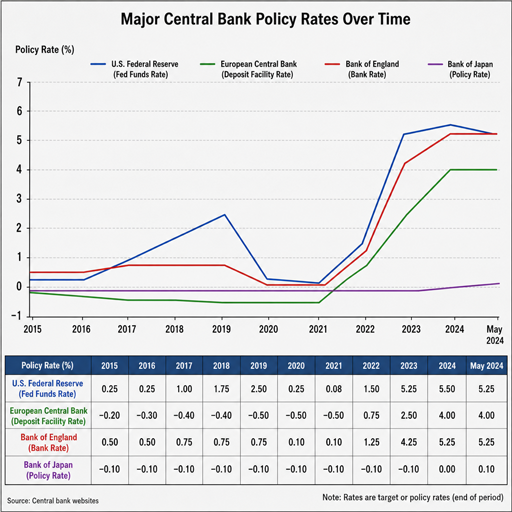
Central bank policy divergence is the gap between how different central banks set interest rates, manage liquidity, and communicate future policy. Today, it matters because global central banks are no longer moving in one neat cycle: inflation, growth, energy shocks, currencies, and labor markets are pulling policy in different directions. For investors, businesses, and households, that means interest rate disparity can shape borrowing costs, exchange rates, capital flows, and financial planning.
What does central bank policy divergence mean today?
Central bank policy divergence means major central banks are pursuing different policy paths at the same time because their economies face different inflation and growth conditions. One central bank may raise rates to fight persistent inflation, another may hold steady to assess risks, and another may keep policy easier because domestic demand is weak or inflation is closer to target. The result is not just an academic split; central bank divergence changes the relative price of money across countries.
In the years after the pandemic inflation shock, many global central banks tightened policy in broadly similar fashion. That phase was easier to understand: inflation was too high in many economies, and rates rose. The current environment is more complicated. Inflation is no longer identical across regions, growth momentum differs, and local shocks have become more important.
Why divergence became the defining policy story
The phrase “Central bank policy divergence 2025” captured a turning point. By early 2025, the IMF was already highlighting widening divergences across countries, with the United States stronger than previously projected while euro area growth was expected to improve only modestly. The IMF also warned that higher U.S. inflation could prevent the Federal Reserve from cutting rates and might even require renewed hikes, strengthening the dollar and tightening financial conditions for emerging markets.
That logic still explains much of the policy landscape. Central banks share a broad price-stability mission, but they do not share one economy. A central bank facing resilient demand and sticky inflation will behave differently from one facing weak growth, currency pressure, or inflation driven mainly by energy prices.
Several forces are driving interest rate divergence:
- Inflation composition: Energy-led inflation may require a different response than broad wage-and-services inflation.
- Growth momentum: Strong domestic demand gives policymakers more room to keep policy tight.
- Currency movements: A weaker currency can import inflation, especially for energy and goods.
- Labor market conditions: Wage pressure can make central banks more cautious about cutting.
- Financial stability risks: High debt, property-market stress, or banking-sector sensitivity can limit policy choices.
- Different mandates and frameworks: The Fed’s dual mandate differs from the ECB’s primary price-stability focus, while other central banks balance local institutional priorities.
Central bank monetary policy divergence 2026 in practice
Central bank monetary policy divergence 2026 is visible in the latest major policy settings. On September 16, 2026, the Federal Reserve raised the federal funds target range by 25 basis points to 3.75%–4.00%, citing elevated inflation and solid economic activity. Two days earlier, the Bank of Japan moved in its own normalization cycle, deciding on September 18, 2026, to guide the uncollateralized overnight call rate to around 1.25%, while saying it would continue raising the policy rate if economic and price developments warranted it.
The European Central Bank also raised rates in September 2026. Its Governing Council lifted the deposit facility rate to 2.50%, the main refinancing rate to 2.65%, and the marginal lending facility to 2.90%, while emphasizing inflation risks linked to the Middle East conflict and a meeting-by-meeting approach. Meanwhile, the Bank of England maintained Bank Rate at 3.75% on September 17, 2026, though three MPC members preferred a 25-basis-point increase, showing that even a “hold” can contain a hawkish signal.
A few other policy stances underline the point. The Bank of Canada held its target for the overnight rate at 2.25% on September 2, 2026, while noting higher upside risks to inflation and uncertainty around trade and energy prices. The Swiss National Bank, by contrast, left its policy rate unchanged at 0% in June 2026 and said it was willing to intervene in foreign exchange markets if needed to counter excessive Swiss franc appreciation.
|
Central bank |
Recent policy stance |
What it shows |
|---|---|---|
|
Federal Reserve |
Raised to 3.75%–4.00% target range |
Inflation concern with resilient activity |
|
European Central Bank |
Raised key rates; deposit rate at 2.50% |
Inflation risks still central to policy |
|
Bank of England |
Held Bank Rate at 3.75% |
Split committee, upside inflation risks |
|
Bank of Japan |
Raised call-rate guideline to around 1.25% |
Ongoing normalization after long easing period |
|
Bank of Canada |
Held overnight target at 2.25% |
Cautious hold amid trade and energy uncertainty |
|
Swiss National Bank |
Held policy rate at 0% |
Low-rate stance with FX vigilance |
How does interest rate divergence affect markets, businesses, and households?
Interest rate divergence affects markets by changing the relative return investors can earn in different currencies, which can move exchange rates, bond yields, and capital flows. It affects businesses through financing costs, hedging expenses, imported input prices, and demand from overseas customers. It affects households through mortgages, savings rates, loan costs, and the price of imported goods.
Currency markets are often the first place divergence appears. If one country’s policy rate rises while another’s stays low, investors may prefer the higher-yielding currency, although risk sentiment and growth expectations can complicate the move. A stronger currency can help reduce import inflation, while a weaker one can make energy, food, and manufactured goods more expensive.
Bond markets also react. When investors believe a central bank will keep rates higher for longer, yields can rise along the curve. That raises borrowing costs for governments, companies, and households. When a central bank is expected to cut or remain easier, local yields may fall, but the currency may face pressure if global investors seek better returns elsewhere.
For companies, interest rate disparity creates practical planning challenges:
- Debt refinancing: Firms with floating-rate debt or near-term maturities may face very different costs by market.
- Foreign exchange exposure: Importers and exporters need to monitor how policy gaps affect currency values.
- Capital allocation: Multinationals may favor investment in markets where financing conditions and demand are more supportive.
- Pricing strategy: Imported inflation can squeeze margins unless companies can adjust prices.
- Customer demand: Higher local rates can cool housing, durable goods, and discretionary spending.
Divergence is not only about the headline rate
A common mistake is to reduce central bank monetary policy divergence to one number: the policy rate. The headline rate matters, but it is only part of the story. Balance sheet policy, forward guidance, asset purchases or runoffs, liquidity facilities, and foreign exchange operations can all tighten or loosen financial conditions.
The ECB, for example, has noted that its APP and PEPP portfolios are declining as the Eurosystem no longer reinvests principal payments from maturing securities. That matters because balance sheet runoff can remove liquidity even when rate changes are gradual. The Bank of England’s September 2026 decision also included a plan to reduce the stock of UK government bond purchases held for monetary policy purposes over multiple years, showing how quantitative tightening can continue alongside rate decisions.
Communication is another policy tool. When policymakers say they are “data dependent,” the phrase may sound vague, but it tells markets that incoming inflation, wage, labor, and growth data can quickly shift the expected path. Divergence often widens not on the day rates change, but when markets reinterpret what the next three to six meetings may look like.
The signals that matter most
Readers do not need to follow every speech from every central banker. A more useful approach is to track the indicators that directly affect the policy reaction function. In plain English, that means watching the data central banks say they care about most.
A practical checklist includes:
- Core inflation: Headline inflation can swing with energy, but core measures often reveal underlying pressure.
- Wage growth: Strong wage momentum can make services inflation harder to tame.
- Employment trends: A cooling labor market can open the door to cuts; persistent tightness can delay them.
- Growth surprises: Stronger-than-expected GDP can support tighter policy, while weak demand can push toward easing.
- Currency moves: Sharp depreciation can complicate cuts by raising import prices.
- Credit conditions: If lending tightens quickly, central banks may become more cautious.
- Fiscal policy: Large deficits or stimulus can influence inflation expectations and bond yields.
- Global shocks: Energy disruptions, trade barriers, and geopolitical events can change inflation and growth forecasts at the same time.
This checklist is especially helpful because central bank divergence often looks confusing in headlines. A rate hike may be less hawkish if policymakers signal it is near the end of the cycle. A hold may be more hawkish if several committee members voted for an increase. A cut may be less dovish if inflation remains above target and the central bank warns against expecting more.
What could narrow or widen divergence next?
Divergence could narrow if inflation falls toward target across major economies and growth slows into a more synchronized pattern. It could widen if the United States, euro area, United Kingdom, Japan, Canada, and Switzerland continue to face different combinations of inflation pressure, productivity growth, currency moves, and energy shocks. In other words, the next stage depends less on whether central banks want to align and more on whether their economies give them similar evidence.
A synchronized fall in inflation would make policy easier to compare. If wage growth moderates, energy prices stabilize, and demand cools, more central banks could shift toward neutral or easier settings. That would reduce interest rate disparity and likely calm some currency and bond-market volatility.
But divergence can also persist. Japan’s normalization from a long period of very low rates is structurally different from the Fed or ECB deciding whether policy is restrictive enough. Switzerland’s low-rate environment and currency sensitivity are different again. Canada’s exposure to U.S. trade conditions adds another layer, while the United Kingdom continues to balance domestic slack against inflation risks.
The takeaway
Central bank policy divergence is the new operating environment for global finance. It reflects local inflation paths, uneven growth, different mandates, and distinct financial vulnerabilities rather than a simple disagreement among policymakers.
For anyone watching markets or making financial decisions, the key is to move beyond the latest headline rate. Look at the direction of travel, the vote split, the inflation forecast, the currency backdrop, and the balance sheet. That broader view makes central bank divergence easier to interpret—and helps explain why the same global shock can lead one central bank to hike, another to hold, and another to stay patient.