
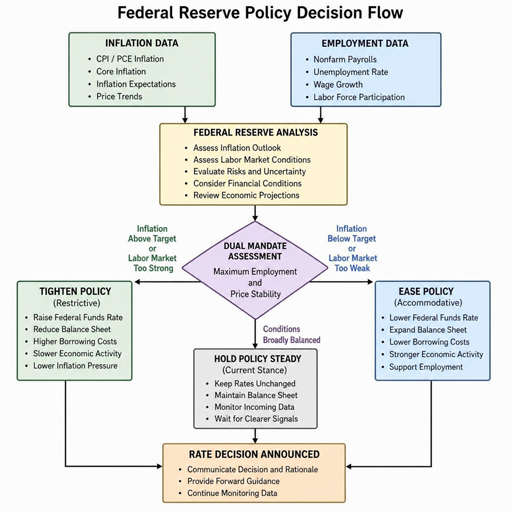
The FOMC monetary policy stance describes how the Federal Reserve is using interest rates, balance sheet tools, and public guidance to pursue stable prices and maximum employment. As of the September 15–16, 2026 meeting, the Committee raised the target range for the federal funds rate by 0.25 percentage point to 3.75%–4.00%, signaling a more restrictive stance aimed at supporting the Fed’s dual mandate. This guide explains what that stance means, how to read FOMC meetings, and why fed interest rates matter for the broader economic outlook.
What is the current FOMC monetary policy stance?
The current FOMC monetary policy stance is restrictive relative to an easy-money environment: the Fed is keeping short-term rates high enough to put downward pressure on inflation while still watching employment and growth risks. The September 2026 decision moved the federal funds target range to 3.75%–4.00%, and the Fed’s implementation note set related operating tools, including a 3.90% interest rate on reserve balances effective September 17, 2026.
In plain English, a restrictive stance means the Federal Reserve policy rate is intended to make borrowing more expensive than it would be in a neutral or stimulative setting. That can cool demand for credit, housing, business investment, and rate-sensitive purchases. It does not stop economic activity by itself, but it changes incentives throughout the financial system.
Key takeaways for readers following monetary policy news:
- Policy rate: The federal funds target range is the headline number most people track.
- Direction: A hike suggests policymakers see inflation risk as important enough to tighten conditions.
- Implementation: The Fed uses reserve balances, repo tools, and open market operations to keep market rates near the target.
- Outlook: FOMC projections are not promises; they show participants’ views under their assumptions.
- Next signal: The October 27–28 and December 8–9, 2026 FOMC meetings are the next scheduled opportunities for policy updates, with December marked for new projections.
How the FOMC sets policy
The Federal Open Market Committee is the Fed body responsible for setting the stance of U.S. monetary policy. It meets regularly, reviews incoming data, votes on the target range for the federal funds rate, and releases a statement explaining the decision. The Fed calendar shows eight regularly scheduled meetings each year, with minutes typically released three weeks after each policy decision.
The Committee’s mandate is not simply “raise rates when inflation is high” or “cut rates when growth slows.” The Fed seeks maximum employment and stable prices, and it identifies 2% inflation, measured by the annual change in the Personal Consumption Expenditures price index, as most consistent with that longer-run price-stability goal. That dual mandate is why FOMC statements often discuss both labor market conditions and inflation pressures.
The federal funds rate is the main signal
The federal funds rate is the overnight rate at which banks lend reserve balances to each other. The Fed does not set every consumer or business rate directly, but fed interest rates influence the short end of the yield curve and ripple into credit cards, auto loans, corporate borrowing, bank deposits, mortgages, and asset valuations.
When the FOMC raises its target range, it is generally trying to tighten financial conditions. When it cuts, it is generally trying to ease them. When it holds steady, the message depends on context: a hold after several hikes may still be restrictive, while a hold near zero may still be highly accommodative.
Operating tools make the target effective
The headline rate matters only if the Fed can keep market rates near it. The September 2026 implementation note directed the New York Fed’s Open Market Desk to conduct operations as needed to maintain the federal funds rate within the 3.75%–4.00% range, while also setting standing repo and reverse repo terms. These details are technical, but they are the plumbing that turns a policy announcement into market reality.
Why interest rate changes affect the economy
Interest rate changes work through several channels at once. Higher rates can reduce demand by raising the cost of financing, increasing the reward for saving, and lowering the present value investors place on future cash flows. Lower rates can do the opposite by encouraging borrowing, spending, and investment.
The effects are powerful but not instant. A rate hike today may influence financial markets quickly, but household budgets, business investment plans, hiring decisions, and inflation trends can take months to adjust. That lag is one reason FOMC meetings receive so much attention: the Committee is always acting on current data while trying to anticipate future conditions.
A practical way to understand the transmission of federal reserve policy is to trace the path from the policy decision to everyday outcomes:
- FOMC decision: The Committee raises, cuts, or holds the target range.
- Money-market adjustment: Short-term funding rates move toward the new range.
- Financial conditions: Bond yields, lending standards, equity prices, and the dollar may respond.
- Borrower behavior: Households and businesses reconsider loans, investments, and purchases.
- Economic activity: Spending, hiring, and production adjust.
- Inflation and employment: The Fed evaluates whether the economy is moving toward mandate-consistent outcomes.
This chain is not mechanical. Oil prices, fiscal policy, productivity, global demand, banking conditions, and market expectations can amplify or blunt the effect of any one rate move.
Reading the economic outlook behind the statement
The economic outlook is the reason behind the rate decision, not a separate side note. In each statement, look for language on growth, jobs, inflation, and risks. Small wording changes can matter because the Fed uses carefully drafted language to show whether policymakers are becoming more concerned about inflation, employment, or financial stability.
The Summary of Economic Projections, released at selected FOMC meetings, adds another layer. In September 2026, participants submitted projections for GDP growth, unemployment, inflation, and the federal funds rate from 2026 through 2029 and the longer run. The Fed states that these projections are based on information available at the meeting and each participant’s view of appropriate monetary policy.
The dot plot is useful but often misunderstood
The “dot plot” shows where each participant thinks the federal funds rate should be at the end of future years, assuming their own economic forecast and policy view. It is not a Committee commitment. It can move substantially as the data change.
Use the dot plot to answer three questions: Is the median path rising, falling, or flat? Are views tightly clustered or widely dispersed? Does the projected policy path match the statement’s tone on inflation and employment risk? If projections show a higher path while the statement emphasizes inflation pressure, the stance is likely tilted toward restraint.
What should investors, borrowers, and businesses watch?
Readers should watch the policy rate, the statement language, the projections, and incoming inflation and labor data together. A single FOMC meeting can move markets, but the policy stance is best understood as a sequence of decisions responding to the evolving economic outlook.
FOMC monitoring checklist:
- Target range: Did the Fed change rates, and by how much?
- Vote split: Was the decision unanimous, or did members dissent?
- Inflation language: Is inflation described as elevated, easing, persistent, or near target?
- Labor market language: Is employment strong, softening, or showing downside risk?
- Risk balance: Is the Committee more worried about inflation or growth?
- Projection updates: Did the median rate path or inflation forecast shift?
- Press conference tone: Does leadership reinforce the statement or soften it?
- Market reaction: Did Treasury yields, the dollar, or credit spreads move in a way that tightens or eases conditions?
Borrowers should focus on variable-rate exposure and refinancing risk. Savers should compare deposit and Treasury yields while remembering that rates can change quickly after future FOMC meetings. Businesses should stress-test capital spending and hiring plans under more than one rate scenario rather than assuming the latest decision is the final one.
Common mistakes when interpreting monetary policy news
One mistake is treating every rate hike as bad and every rate cut as good. A rate hike can reflect an economy with enough momentum to withstand tighter policy, while a rate cut can reflect growing downside risks. Context matters.
Another mistake is confusing the Fed’s target rate with long-term borrowing costs. Mortgage rates and corporate bond yields respond to the expected path of policy, inflation expectations, credit risk, Treasury supply, and investor demand. The Fed strongly influences financial conditions, but it does not mechanically set every rate in the economy.
A third mistake is assuming the latest dot plot is a forecast carved in stone. The Fed’s projection materials explicitly reflect participant assumptions at the time of the meeting, and policy can shift as new data arrive. For SEO readers searching “fomc monetary policy” or “interest rate changes,” the best interpretation is always conditional: if inflation, employment, and growth evolve differently, policy can evolve too.
The bottom line on the FOMC stance
The FOMC’s September 2026 stance is best described as restrictive and inflation-focused, with the federal funds target range at 3.75%–4.00% after a quarter-point increase. That does not mean every future meeting will bring another hike; it means the Fed is using policy to push the economy toward its maximum-employment and 2% inflation objectives.
For anyone tracking monetary policy news, the most useful habit is to read the decision, the implementation note, the projections, and the next data releases as one connected story. The headline rate tells you what changed. The economic outlook explains why it changed. The next FOMC meetings reveal whether the Committee believes the stance is working.